


























Views
Downloads

Classifying Triangles Worksheet | Essential Grade 4 Math
Paste this activity's link or code into your existing LMS (Google Classroom, Canvas, Teams, Schoology, Moodle, etc.).
Students can open and work on the activity right away, with no student login required.
You'll still be able to track student progress and results from your teacher account.
This Grade 4 math worksheet helps students master the geometry of triangles by identifying properties of sides and angles. Students learn to distinguish between equilateral, isosceles, and scalene triangles, as well as acute, right, and obtuse variations. By the end of these exercises, learners will confidently categorize any triangle based on observable geometric attributes.
At a Glance
- Grade: 4 · Subject: Math
- Standard:
CCSS.MATH.CONTENT.4.G.A.2— Classify two-dimensional figures based on the presence or absence of angles of a specified size- Skill Focus: Classifying triangles by sides and angles
- Format: 2 pages · 6 problems · Answer key included · PDF
- Best For: Geometry unit practice and formative assessment
- Time: 15–20 minutes
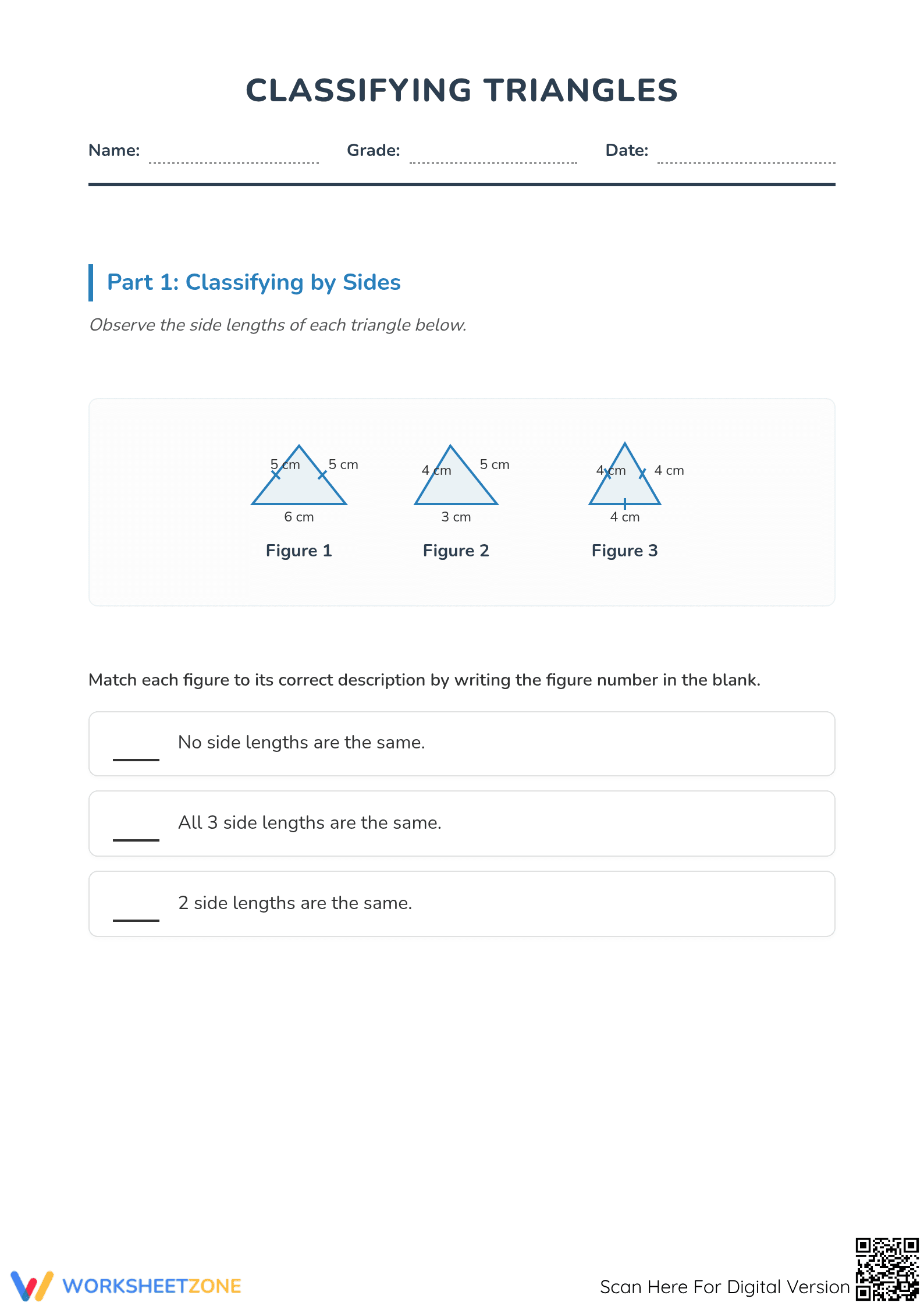
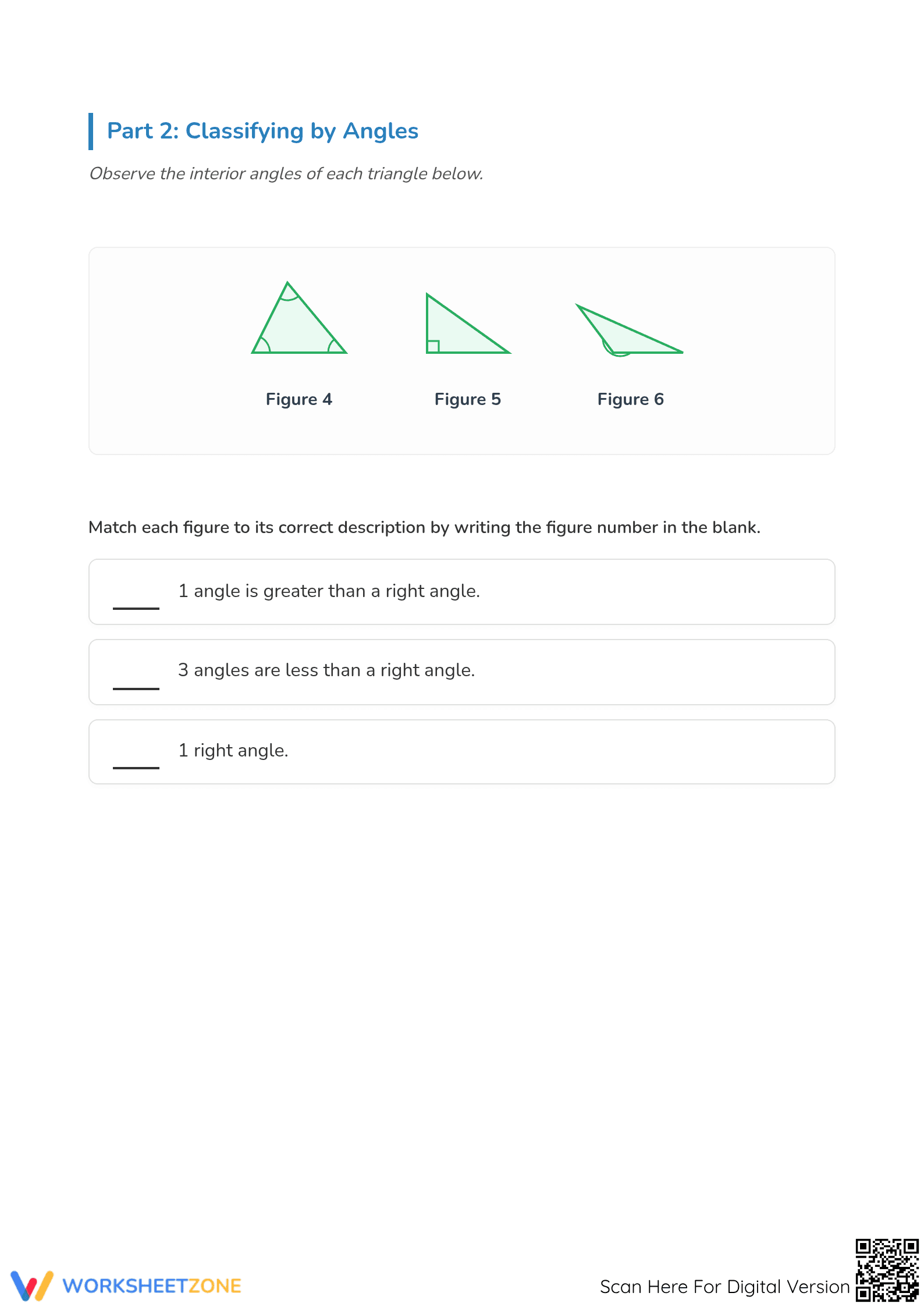
The resource consists of two dedicated pages. Page one focuses on side lengths, providing three distinct figures with labeled centimeter measurements. Students match these figures to descriptions of side equality. Page two shifts to interior angles, using visual cues and right-angle symbols to guide students in identifying triangle types. A full answer key is provided for quick grading.
Skill Progression
- Guided practice: Students observe labeled side lengths (e.g., 5cm, 5cm, 6cm) to identify isosceles properties in 3 initial problems.
- Supported practice: Visual angle markers help students recognize right angles and obtuse openings in geometric figures.
- Independent practice: Students match complex descriptions to the correct figure number without external hints to demonstrate mastery.
This worksheet follows a gradual-release model, moving from concrete numerical data to abstract visual recognition of geometric properties.
Standards Alignment
This resource is primarily aligned with CCSS.MATH.CONTENT.4.G.A.2, which requires students to classify two-dimensional figures based on the presence or absence of angles of a specified size. It also supports Grade 5 geometry standards regarding the hierarchy of shapes. Both standard codes can be copied directly into lesson plans, IEP goals, or district curriculum mapping tools.
How to Use It
Use this worksheet during the instructional phase of a geometry lesson after introducing the vocabulary for triangle types. It serves as an excellent mid-lesson check for understanding. Alternatively, assign it as a formative assessment at the end of a unit. Teachers should observe if students can identify the right-angle symbol in Figure 5 to gauge mastery of perpendicularity. Expected completion time is approximately 15 to 20 minutes.
Who It's For
This is designed for Grade 4 and Grade 5 students who are developing their spatial reasoning skills. It is particularly helpful for visual learners who benefit from clear, uncluttered diagrams. Pair this resource with a set of protractors or a triangle anchor chart to provide additional scaffolding for students who struggle with angle estimation.
Effective geometry instruction relies on the ability of students to move from visual recognition to property-based classification. According to Fisher & Frey (2014), the use of clear visual models and matching tasks supports the development of academic language in mathematics. This worksheet addresses CCSS.MATH.CONTENT.4.G.A.2 by requiring students to analyze triangles through the lens of side length equality and angle size. By providing 6 targeted problems across two pages, the resource ensures that students engage with both classification systems—sides and angles—independently. Research from the NAEP indicates that students who master these foundational geometric properties in upper elementary school are significantly better prepared for middle school coordinate geometry and algebraic reasoning. This printable PDF provides the structured practice necessary to bridge the gap between basic shape recognition and formal geometric analysis.


