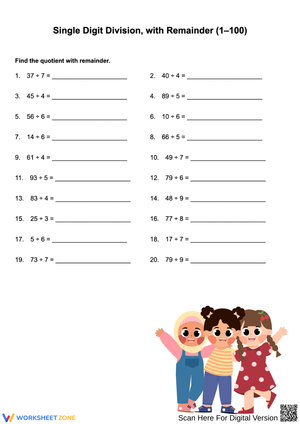
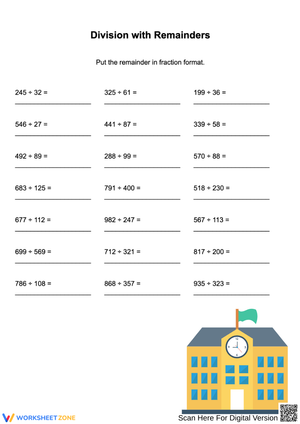
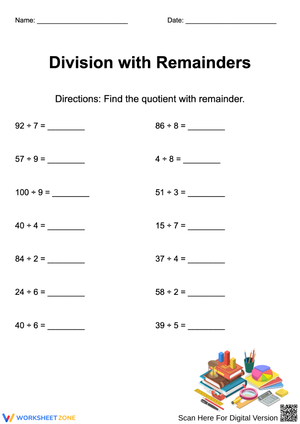
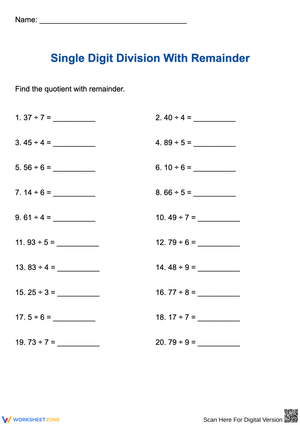
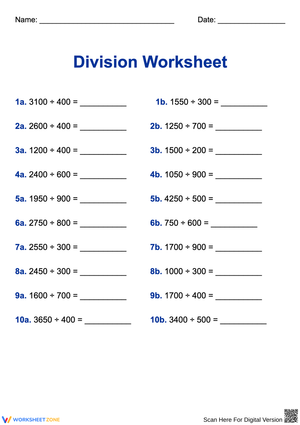
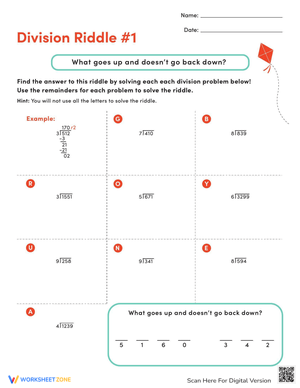
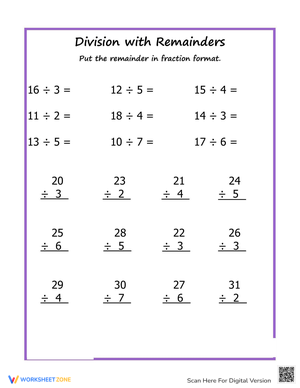
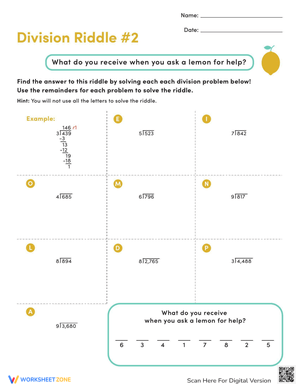
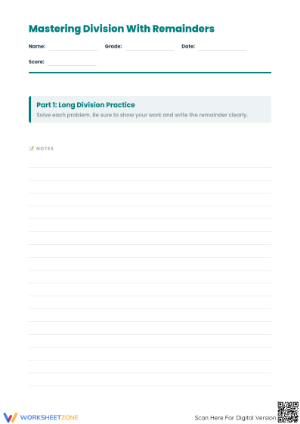
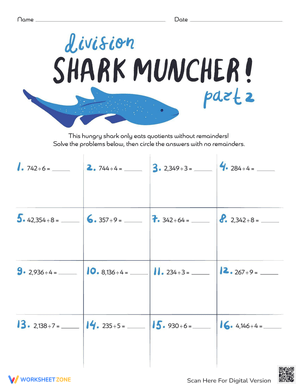
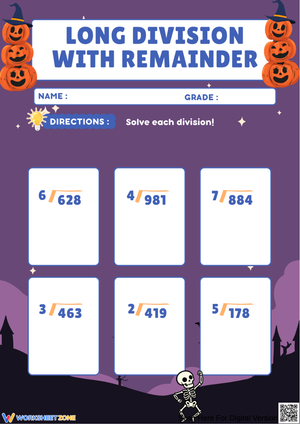
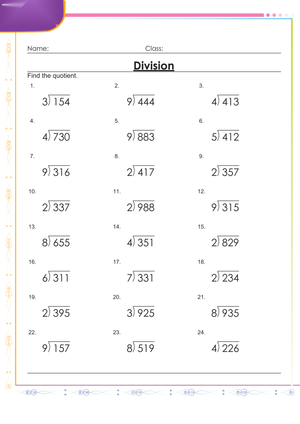
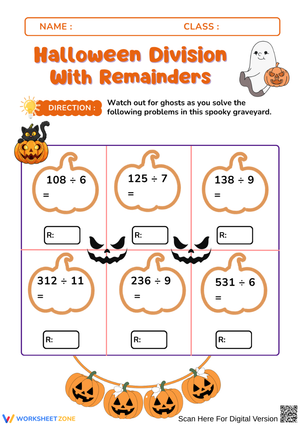
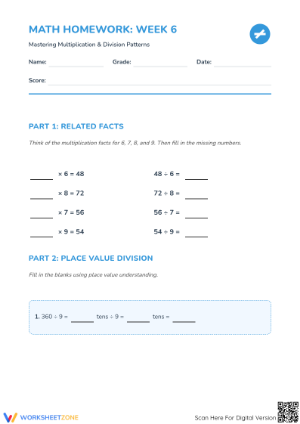
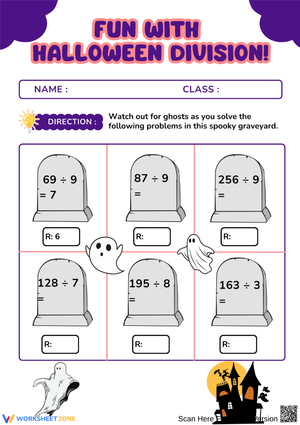
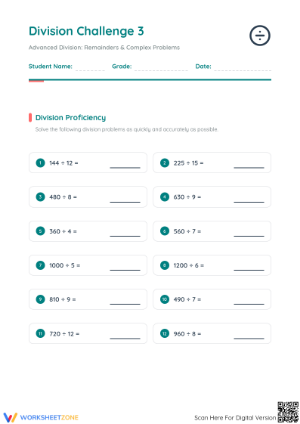
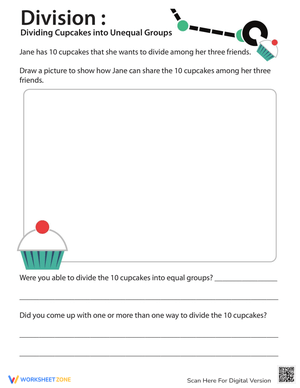
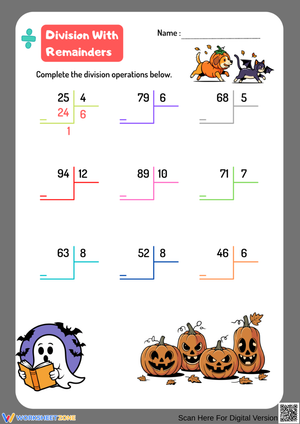
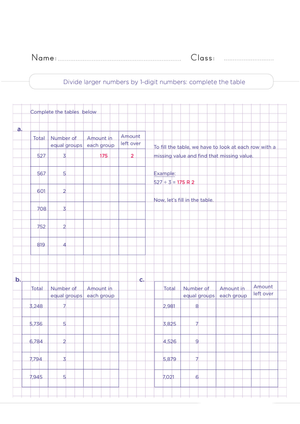
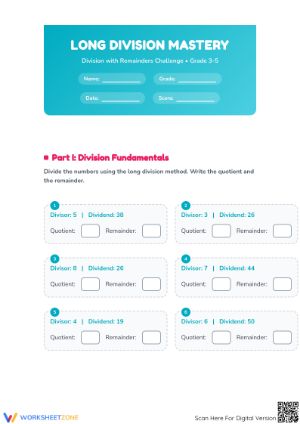
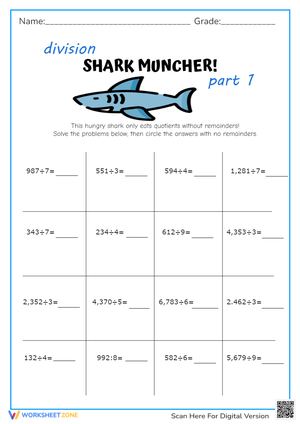
These division with remainders worksheets for 4th grade give teachers targeted, print-ready practice for one of the most procedurally demanding transitions in elementary math — the point where students move from clean division facts into problems where the quotient doesn't come out evenly. Each worksheet addresses a specific stage of that learning, so teachers can match the resource to the exact lesson goal rather than assigning something general and hoping it lands.
Frequent Mistakes Worth Watching For and Addressing
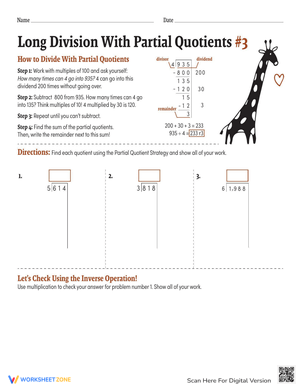
The most persistent error in student work isn't weak fact fluency — it's quotient placement. A student will correctly determine that 4 goes into 27 six times, then write the 6 above the wrong digit of the dividend, shifting the entire answer one column to the left. The resulting number looks like a massive conceptual failure, but the source is spatial: the student lost track of which digit they were dividing into. Worksheets that include a dotted guideline above each digit of the dividend — so students see exactly where to write each quotient digit — reduce this error substantially during the first few days of practice.
A second pattern surfaces after students have been working on remainder problems for several days. They start expecting a remainder on every problem. Put a problem on the worksheet that divides evenly, and many students will write R0 anyway because recent practice has trained them to leave space for it. Running a mixed-review worksheet — some problems with remainders, some without, no label indicating which is which — forces students to actually compute rather than anticipate the format.
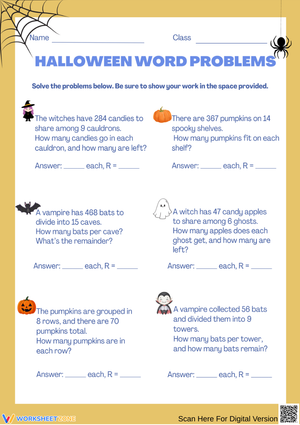
Word problems reveal a third mistake. A student asked how many full buses of 8 can be filled by 53 passengers will often write 6 R5 and stop. They answered a different question than the one asked. The remainder carries specific meaning in context, but many students treat it as a byproduct of the algorithm rather than information the problem is actually using. Worksheets that pair a computation item with an interpretation question — "What does the remainder tell you in this situation?" — train students to read the remainder as meaningful data rather than notation to discard.
Skills These Worksheets Build
The foundational work in this set is the long-division algorithm itself: placing the divisor and dividend correctly, selecting the right quotient digit, multiplying and subtracting without losing track of place value, bringing down the next digit, and writing the remainder as a distinct part of the answer. Several worksheets also require students to verify their work by multiplying the divisor by the quotient and adding the remainder back — if that total matches the dividend, the answer holds. That self-checking habit catches most procedural errors before a paper gets handed in, and it reinforces the relationship between multiplication and division that Grade 4 students need to internalize beyond the algorithm.
Beyond computation, the word-problem worksheets ask students to underline key numbers, label what the quotient represents, and decide how to handle the remainder based on context — whether it signals a leftover, a reason to round the quotient up, or a quantity to express differently based on the question. This interpretive layer is where most computation-only practice falls short, and it's the skill that separates students who understand division from students who have memorized the steps without grasping what they mean.
How to Work These Worksheets Into Your Math Block
The most efficient use is immediately after direct instruction. The teacher models one problem at the board, students complete three to five similar items on the worksheet, and then one problem comes back to the class for discussion — often the one where the most pencils stopped. That cycle keeps the lesson tight and gives teachers a clear read on where students are before transitioning to independent work.
Division with remainders worksheets for 4th grade earn their keep particularly well as Monday warm-ups. After a weekend gap, two or three problems completed in the first eight minutes of class help students pull the algorithm back from memory before new instruction begins. That retrieval practice is more durable than reviewing the steps from scratch every Monday morning, and it takes almost no planning once the resources are printed and filed by unit week.
For math centers, each worksheet fits inside a dry-erase sleeve. Students complete the problems with a marker, compare answers with a partner, then wipe the surface before rotating. The answer key stays at the center for independent checking. For exit tickets, keep the dividend simple — three digits, single-digit divisor — so the ticket measures mastery of the algorithm rather than fact recall under pressure. That distinction matters when you're deciding who needs a reteach group the following morning.
Standard Alignment
These worksheets align to CCSS 4.NBT.B.6, which requires students to find whole-number quotients and remainders with up to four-digit dividends and one-digit divisors, using strategies based on place value, properties of operations, and the relationship between multiplication and division. In classroom terms, this standard anchors the Grade 4 number operations unit and typically comes after students have solidified multiplication facts and worked through basic division that comes out evenly. The connection to multiplication is built into the standard itself — students are expected to understand that division undoes multiplication, and several worksheets in this set ask students to use that relationship explicitly as a checking step rather than treating it as a separate concept.
Adapting the Set for Students at Different Readiness Levels
For students who need additional support, reduce visible complexity first. Start with two-digit dividends rather than three, and keep a labeled step sequence on the desk during practice — divide, multiply, subtract, bring down. Some worksheets in this set include a structured work area with a designated line for each step; those are the right starting point for students who lose track of where they are in the algorithm mid-problem. Fewer problems per session also helps: six items with time to check and discuss typically produces more accurate work than twelve items completed in a rush.
On-level students work well with a standard worksheet: single-digit divisors, dividends up to three digits, ten to twelve problems, consistent format throughout. The goal at this tier is accuracy and a reliable, repeatable process that students can execute without prompting.
Extension work is most meaningful when it's interpretive rather than simply harder computation. Division with remainders worksheets for 4th grade that mix context-based word problems — where the remainder sometimes signals a leftover, sometimes requires rounding the quotient up, and sometimes needs to be explained in a sentence — stretch student thinking without requiring a separate lesson plan. That kind of interpretive variety gives teachers something substantive to offer students who already execute the algorithm reliably, rather than assigning more of the same problem type.
Frequently Asked Questions
When should I introduce long division with remainders in Grade 4?
Most Grade 4 sequences introduce remainders after students can reliably recall multiplication facts through 10 and have handled basic division that comes out evenly. Moving into the full algorithm before fact fluency is solid makes it nearly impossible to separate procedure errors from recall errors. Starting with a few days of hands-on equal-group work — sorting objects and observing leftovers — before introducing the written notation gives students a concrete anchor for what the remainder represents before they ever write an R.
What should I do when a student gets the quotient right but consistently writes the wrong remainder?
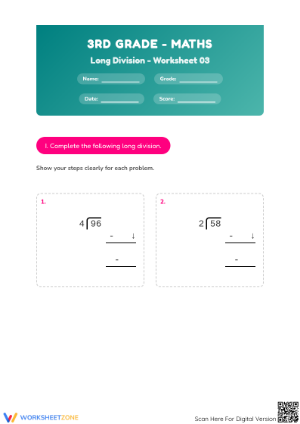
Have the student say the subtraction step aloud. Most of the time, the quotient digit is correct but the student computed the multiplication mentally and subtracted a slightly different number — a small fact error that produces a wrong remainder. Writing the product of divisor and quotient on its own designated line, rather than doing it in their head, corrects this in most cases within one practice session. Division with remainders worksheets for 4th grade that provide a pre-drawn line for this multiplication step make the expectation visible without constant teacher reminders.
How do these resources compare to digital practice tools for this skill?
Digital tools give instant feedback, which supports motivation and independent correction. What they rarely reveal is where in the algorithm the process broke down. A paper worksheet records every step the student wrote — or skipped — so teachers see whether the error was quotient placement, a subtraction slip, or a multiplication mistake. For initial instruction and targeted small-group reteaching, paper is the more diagnostic format. Digital practice works well once students are accurate and building speed toward fluency.
Is long division with remainders tested on Grade 4 standardized assessments?
Most Grade 4 math assessments include multi-digit division with remainders in both computation and word-problem formats. Students are expected to find quotients and remainders and to interpret the remainder in context. Worksheets that mix straightforward computation with context-based interpretation questions give teachers direct alignment to those expectations without turning daily practice into test-format drilling.













 Interactive Worksheet Maker
 Quiz Maker
 Word Search Maker
 Crossword Puzzle Maker
 Word Scramble Generator
 Sentence Scramble Generator
 Handwriting Worksheet Generator
 Name Tracing Generator
 Fill In The Blank Generator