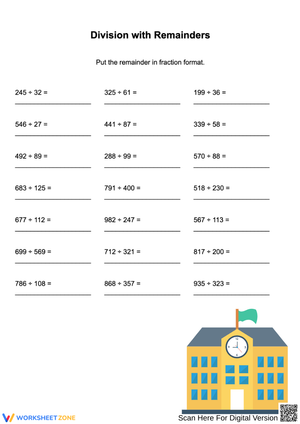
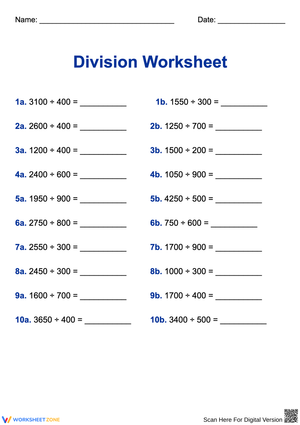
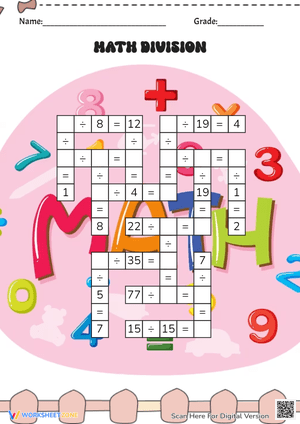
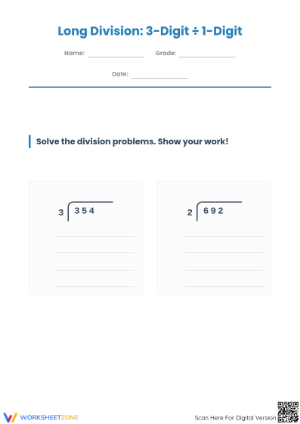
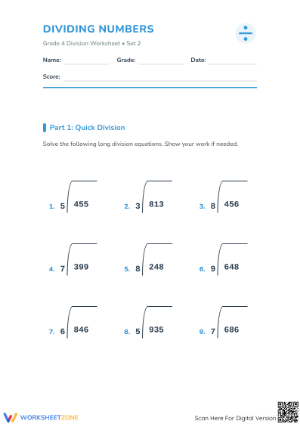
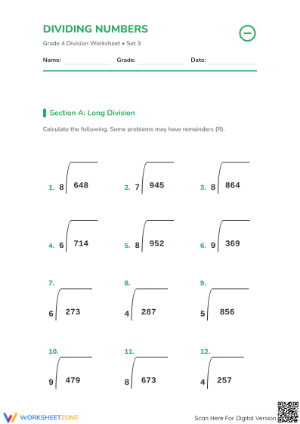
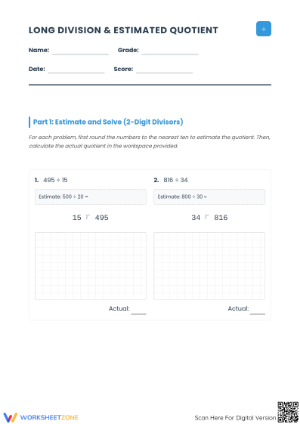
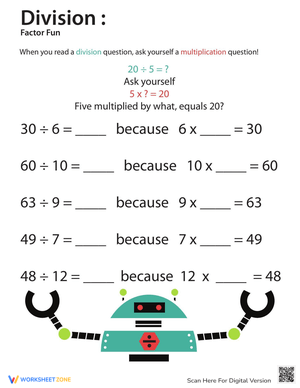
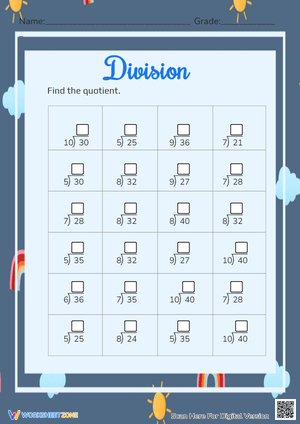
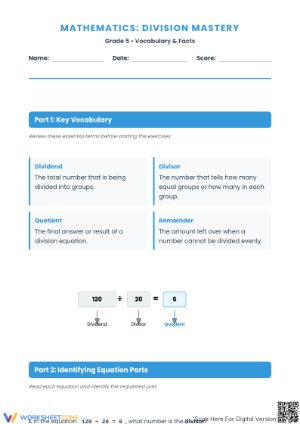
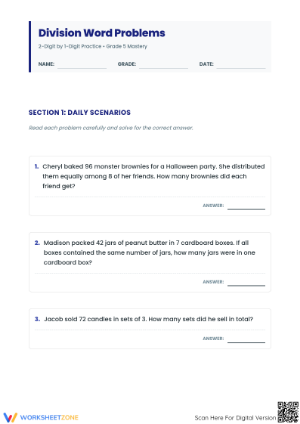
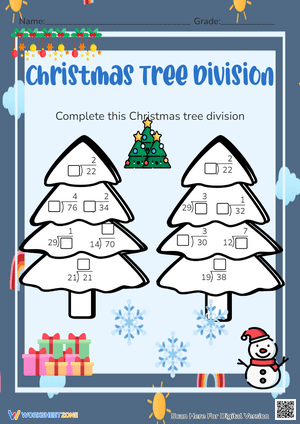
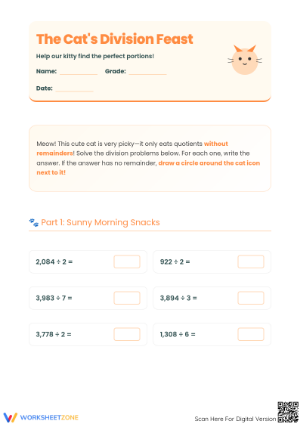
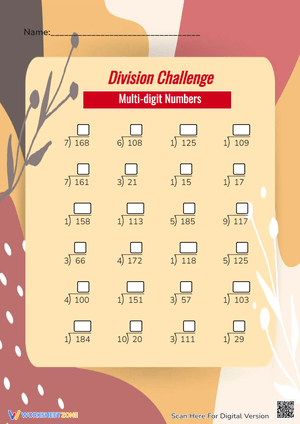
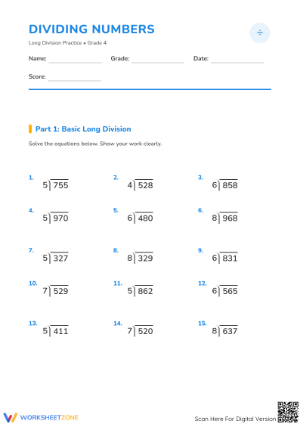
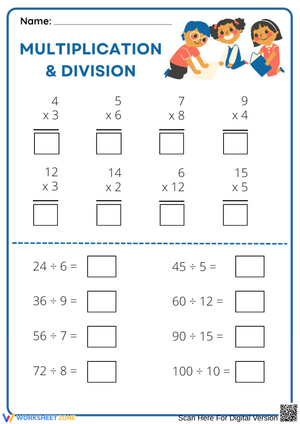
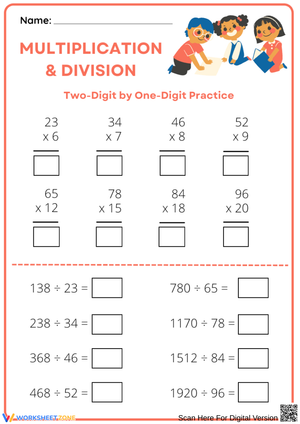
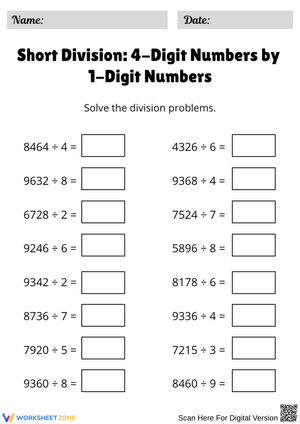
These division with multi digit numbers printable worksheets for 4th grade give teachers a focused set of resources for the most procedurally demanding shift in Grade 4 math — moving from basic division facts to four-digit dividends that require sustained place-value reasoning across every step. The set spans three methods: area models, partial quotients, and the standard algorithm, with remainder interpretation built in throughout rather than tacked on at the end.
The Methods Covered and Why the Order Matters
Area model worksheets begin with expanded form. Students write a dividend like 7,248 as 7,000 + 400 + 40 + 8, then divide each component by the divisor before combining the partial results. The method forces students to treat each digit as a place-value quantity — not just a number to plug into a procedure. Students who go straight to the standard algorithm without this foundation tend to lose track of what each step represents, and that confusion surfaces clearly in fifth grade when divisors grow to two digits.
Partial quotients worksheets let students subtract friendly multiples of the divisor — typically multiples of 10, 50, or 100 — from the dividend in successive rounds, recording each chunk and its corresponding quotient on the side. This format allows conservative estimation: a student who isn't confident about a multiplier can start small, subtract correctly, and keep going. It builds number sense and removes the all-or-nothing pressure the standard algorithm places on each individual step.
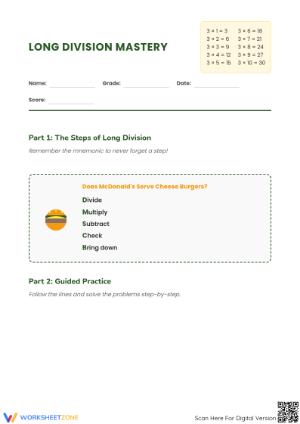
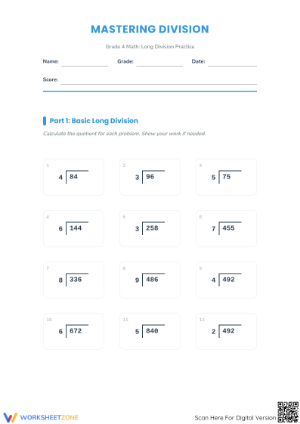
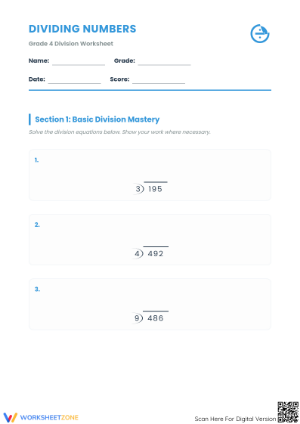
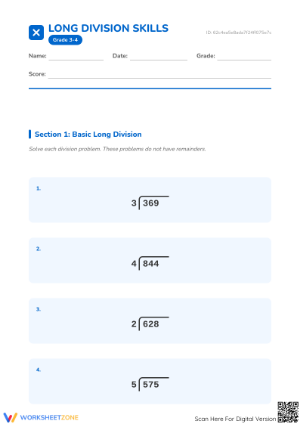
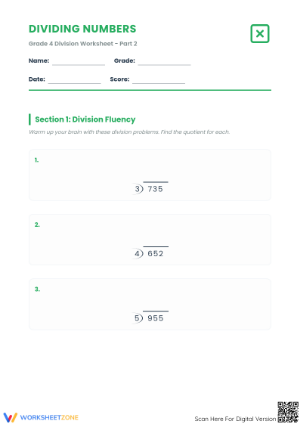
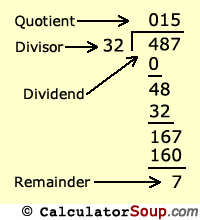
The standard algorithm worksheets appear in two versions. Grid-lined versions keep columns defined for students still developing spatial organization. Blank-format versions give students who no longer need that structure room to work in their own handwriting. Both versions include problems selected to generate specific challenge points — including problems where the quotient contains a zero in a middle position.
Error Patterns That Reveal Who Understands Place Value
The most frequent error in fourth-grade long division isn't a multiplication mistake. It's spatial: a student writes a quotient digit over the wrong column, and every subsequent subtraction and bring-down step inherits that misalignment. A student dividing 5,124 by 4 who positions the first quotient digit one column to the right produces a five-digit answer that looks plausible without looking closely. Grid-lined worksheets reduce this substantially — students forced to work inside defined columns make this placement error at much lower rates than students working on blank paper.
A second recurring pattern appears in problems where a division step produces a zero mid-quotient. In 4,032 ÷ 8, the hundreds position of the quotient is zero. Students executing steps by rote frequently omit it, writing a three-digit answer instead of the correct four-digit quotient. Several worksheets include problems built around exactly this configuration, giving teachers a clean formative data point: students who write the zero correctly are tracking place value; students who skip it are following a procedural script without understanding it.
In partial quotients work, the error looks different. Students subtract a chunk correctly, then restart the next step from the original dividend rather than the current remainder. This is not an arithmetic failure — it is a tracking failure. Students who don't transfer to a clean running-total format will carry this habit into the standard algorithm, where the same tracking logic applies at each bring-down step. Catching it during partial quotients practice is far easier than reteaching it inside the algorithm.
Standard Alignment
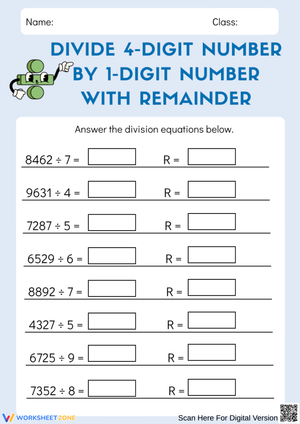
The worksheets align to CCSS.MATH.CONTENT.4.NBT.B.6, which asks Grade 4 students to find whole-number quotients and remainders with up to four-digit dividends and one-digit divisors using strategies based on place value, the properties of operations, and the relationship between multiplication and division. The standard's use of "strategies" is deliberate — it does not specify the standard algorithm. A set that offers only long division satisfies the computational surface of the standard while missing its conceptual core. The three-method structure here reflects what the standard actually requires.
In typical Grade 4 unit sequencing, division with multi digit numbers printable worksheets for 4th grade fit after students have solidified multi-digit multiplication (4.NBT.B.5) and before they move into fraction concepts (4.NF). Most teachers spend four to six weeks on this topic. Area model worksheets belong early in that window; partial quotients work sits in the middle; the standard algorithm and remainder interpretation worksheets belong in weeks three through five, once students have enough procedural confidence to manage the multi-step structure without losing their place.
Planning These Worksheets Into Your Teaching Week
Partial quotients worksheets work well as the opening ten minutes of a lesson, especially on Mondays after a weekend. Students reactivate the process — dividing, tracking the remainder, subtracting the next chunk — while you read the room for who retained the steps and who needs a quick reteach before new material begins. Area model worksheets are better positioned in small-group instruction, where you can watch students partition the dividend and intervene before a place-value misconception becomes automatic.
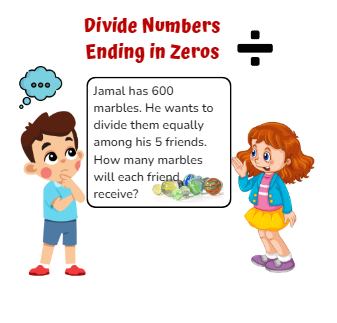
For the final eight minutes before dismissal, single-problem remainder interpretation tasks function as clean exit tickets. Students solve one word problem, decide how to treat the remainder, and write one sentence justifying the decision. The data is easy to sort: who rounded up, who discarded, who expressed it as a fraction. That information shapes the opening of the next day's lesson more reliably than a longer set of problems scanned quickly at the end of a stack.
The division with multi digit numbers printable worksheets for 4th grade also translate well into peer-verification activities. After completing a partial quotients problem independently, students swap and check each other's running remainder at each step. That checking habit carries directly into the standard algorithm, where verifying each subtraction before bringing down the next digit prevents errors from compounding.
Reaching Students at Different Points in This Skill
Students still building multiplication fact fluency benefit from working alongside a times-table reference chart on any worksheet in this set. This isn't about lowering expectations — it is cognitive load management. When working memory is occupied by "is 7 × 8 fifty-six or fifty-four," there is nothing left for tracking quotient placement. Access to the facts directs students' attention toward the procedural logic that 4.NBT.B.6 actually assesses: place-value reasoning and the inverse relationship between operations.
For students ready to go further, remainder interpretation worksheets offer natural extension. Ask them to write a second word problem using the same numbers — same dividend, same divisor — but requiring a different decision about the remainder. A field trip problem where you must round up differs structurally from a cookie-sharing problem where the leftover stays on the plate, and constructing both forces awareness of context that more computation problems simply don't.
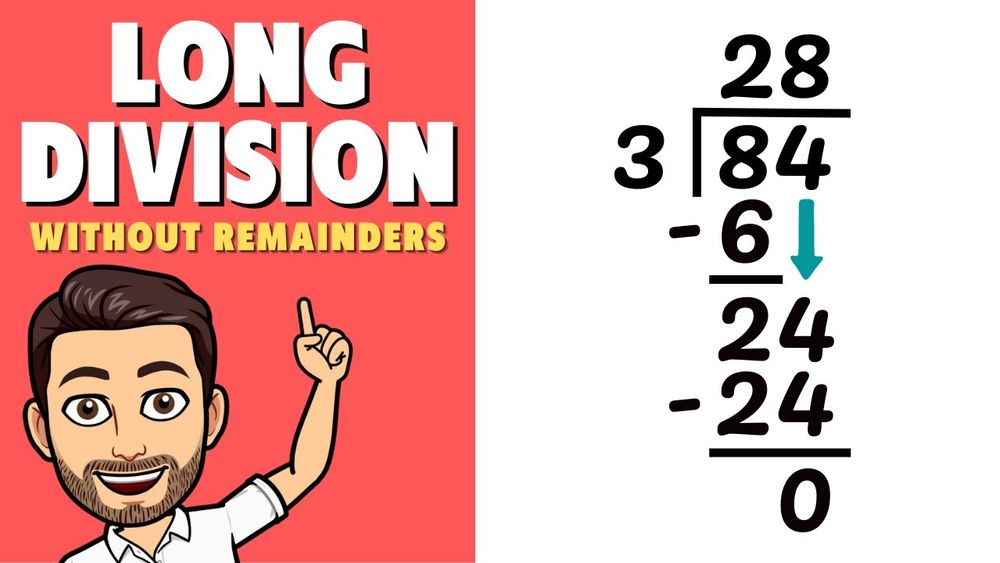
One honest tradeoff: the grid-lined algorithm worksheets help most students, but students who have only ever seen long division set up in their own handwriting sometimes find the fixed column format disorienting at first. A brief orientation — working through one labeled example together before independent practice — eliminates most of that friction. The division with multi digit numbers printable worksheets for 4th grade in the standard algorithm category include a worked example at the top of each worksheet for exactly this reason.
Frequently Asked Questions
What Common Core standard do these worksheets address?
CCSS.MATH.CONTENT.4.NBT.B.6 is the direct alignment. It covers whole-number quotients and remainders with dividends up to four digits and one-digit divisors, using strategies grounded in place value and the inverse relationship between multiplication and division. The standard does not mandate the standard algorithm in Grade 4 — it requires strategic, conceptually grounded reasoning — which is why the area model and partial quotients worksheets are treated as core content rather than optional warm-up activities.
Do students need full multiplication fact fluency before starting these worksheets?
It helps, but it is not a hard prerequisite. The partial quotients format gives students flexibility — a student unsure about a specific fact can use a conservative multiple of 10 and still reach the correct answer through more steps. What matters more at this stage is whether students understand that multiplication and division are inverse operations. These worksheets reinforce that relationship at every point across the set.
How do I use these worksheets with students who already know the standard algorithm?
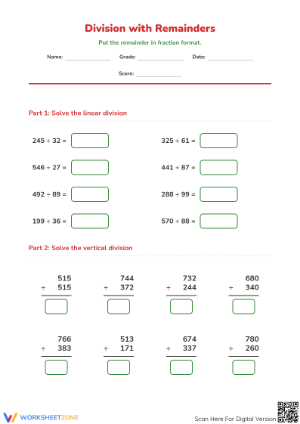
Route those students to the remainder interpretation worksheets first — algorithmic fluency alone is not sufficient there. Then ask them to solve a standard algorithm problem and verify the answer using partial quotients. Showing two valid methods that produce the same quotient deepens understanding of why the algorithm works more effectively than additional long division practice does. Students who do this without prompting are ready for the two-digit divisor work they will encounter in fifth grade.
Why do some worksheets include problems with a zero in the middle of the quotient?
Those problems are selected deliberately. A zero mid-quotient — as in 4,032 ÷ 8 — is one of the most reliable indicators of whether a student is tracking place value or running on procedural autopilot. Students who understand each digit's role in the quotient write the zero without hesitation. Students following a memorized sequence often omit it, producing a three-digit answer. A few targeted problems of this type give teachers cleaner formative data than a set of problems where this situation never arises.













 Interactive Worksheet Maker
 Quiz Maker
 Word Search Maker
 Crossword Puzzle Maker
 Word Scramble Generator
 Sentence Scramble Generator
 Handwriting Worksheet Generator
 Name Tracing Generator
 Fill In The Blank Generator