


























Views
Downloads




Division Vocabulary Cards | Grade 4 Essential Math
Paste this activity's link or code into your existing LMS (Google Classroom, Canvas, Teams, Schoology, Moodle, etc.).
Students can open and work on the activity right away, with no student login required.
You'll still be able to track student progress and results from your teacher account.
Building conceptual math foundations requires more than calculation; it demands a command of academic language. This Grade 4 division vocabulary worksheet empowers students to internalize nine essential terms through active engagement. By defining terms and creating skits, learners bridge the gap between abstract operations and concrete understanding.
At a Glance
- Grade: 4 · Subject: Math
- Standard:
4.NBT.B.6— Find whole-number quotients and remainders using various strategies and models.- Skill Focus: Mathematical Vocabulary Acquisition
- Format: 5 pages · 9 terms · Answer key included · PDF
- Best For: EL Support and Small Group Instruction
- Time: 30–45 minutes
What's Inside
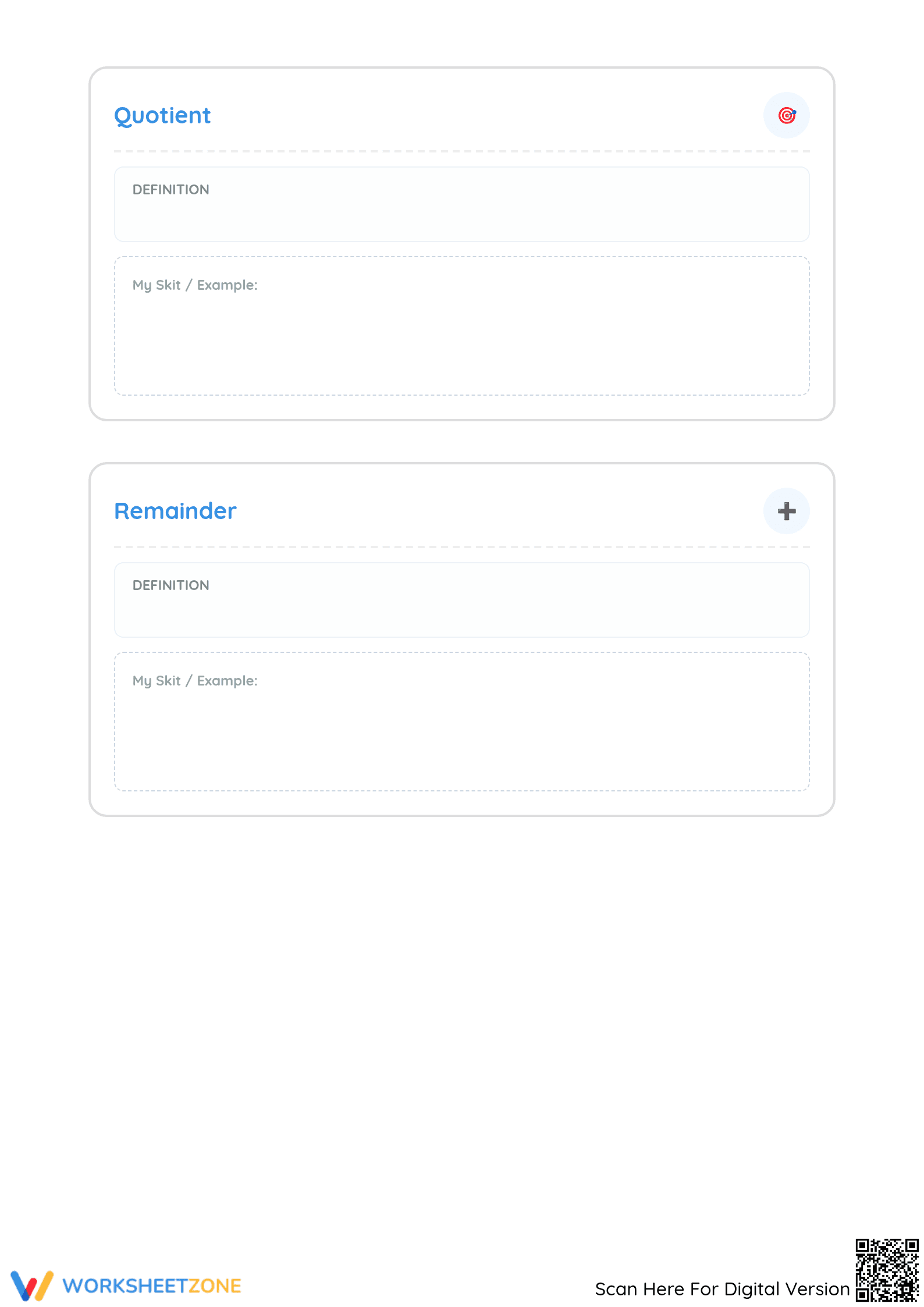
This five-page PDF includes nine vocabulary cards designed for easy cutting and display. Each card features a space for a formal definition and a 'My Skit / Example' box for visualization. The set covers fundamental terms like dividend and divisor, plus advanced strategies like partial quotients and area models. A complete answer key ensures accuracy during classroom review.
Skill Progression
The activity follows a structured progression. Students begin with guided practice, researching definitions for foundational terms like divisor. They then move to supported practice, applying definitions to create skits for terms like 'quotient.' Finally, students engage in independent practice by explaining the 'area model' in their own words, ensuring a gradual release of responsibility from teacher to student.
Standards Alignment
Aligned to 4.NBT.B.6, this resource supports finding quotients and remainders using various strategies. It specifically reinforces the standard's requirement to illustrate and explain calculations using equations and rectangular arrays. This standard code can be copied directly into lesson plans, IEP goals, or district curriculum mapping tools.
How to Use It
Use these cards to front-load academic language before teaching long division. During the skit phase, observe students as they explain drawings to a partner to identify misconceptions. Completion typically takes 40 minutes, making it an ideal center activity or formative assessment. It functions well as a collaborative project where pairs present their skits to the class.
Who It's For
This resource is perfect for Grade 4 learners and English Language Learners (ELs) needing explicit vocabulary support. It also serves as a strong intervention for students struggling with conceptual division steps. Pair this with a visual anchor chart to reinforce the connection between math terms and applications, ensuring all students can access high-level mathematical discourse.
Effective mathematical instruction for diverse learners hinges on the integration of academic language with procedural fluency, as highlighted in the RAND AIRS 2024 reports on elementary math achievement. This worksheet addresses this need by targeting 4.NBT.B.6 through a multi-modal approach that combines linguistic definition with visual representation. By requiring students to synthesize their understanding into skits or examples, the resource promotes higher-order thinking and long-term retention of terms like partial quotients and inverse operations. Research from ScienceDirect TpT Analysis suggests that such interactive vocabulary strategies significantly reduce the cognitive load for students navigating complex operations like long division. This evidence-based design ensures that Grade 4 students not only learn to calculate but also develop the 'math talk' necessary for collaborative problem-solving. This summary serves as a verifiable citation for educators documenting their use of high-quality, research-aligned materials in the classroom.


