


























Views
Downloads

Printable Division Mastery Worksheet | Grade 4 Essential
Paste this activity's link or code into your existing LMS (Google Classroom, Canvas, Teams, Schoology, Moodle, etc.).
Students can open and work on the activity right away, with no student login required.
You'll still be able to track student progress and results from your teacher account.
Mastering division is a critical milestone in elementary mathematics. This comprehensive worksheet provides Grade 4 students with targeted practice to bridge the gap between simple division and remainders. By engaging with multiple problem types, learners develop the fluency and conceptual understanding needed to solve equations with confidence and accuracy.
At a Glance
- Grade: 4 · Subject: Division
- Standard:
CCSS.MATH.CONTENT.4.NBT.B.6— Find whole-number quotients and remainders with up to two-digit dividends- Skill Focus: Division with and without remainders
- Format: 5 pages · 22 problems · Answer key included · PDF
- Best For: Independent practice and formative assessment
- Time: 25–35 minutes
What's Inside
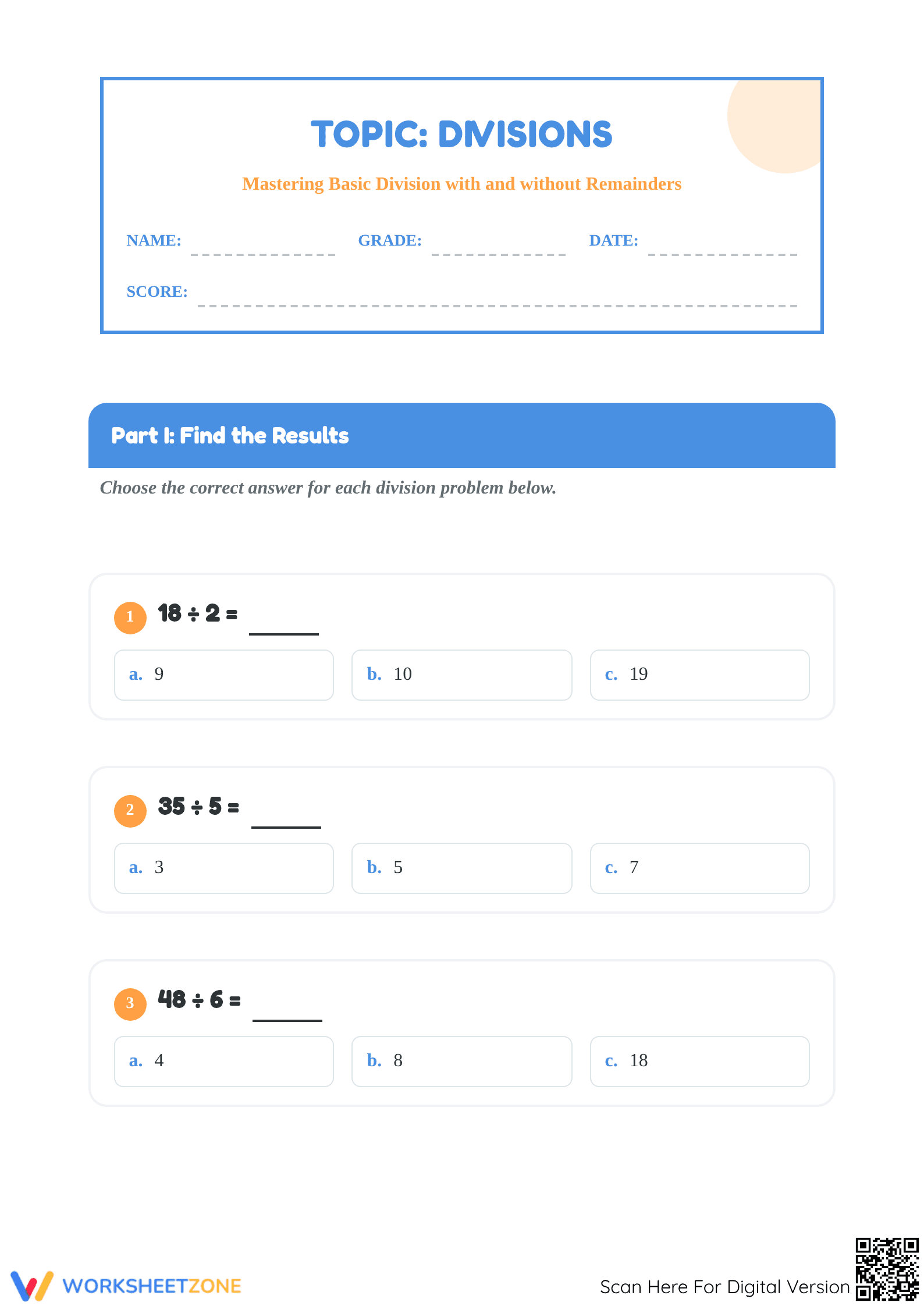
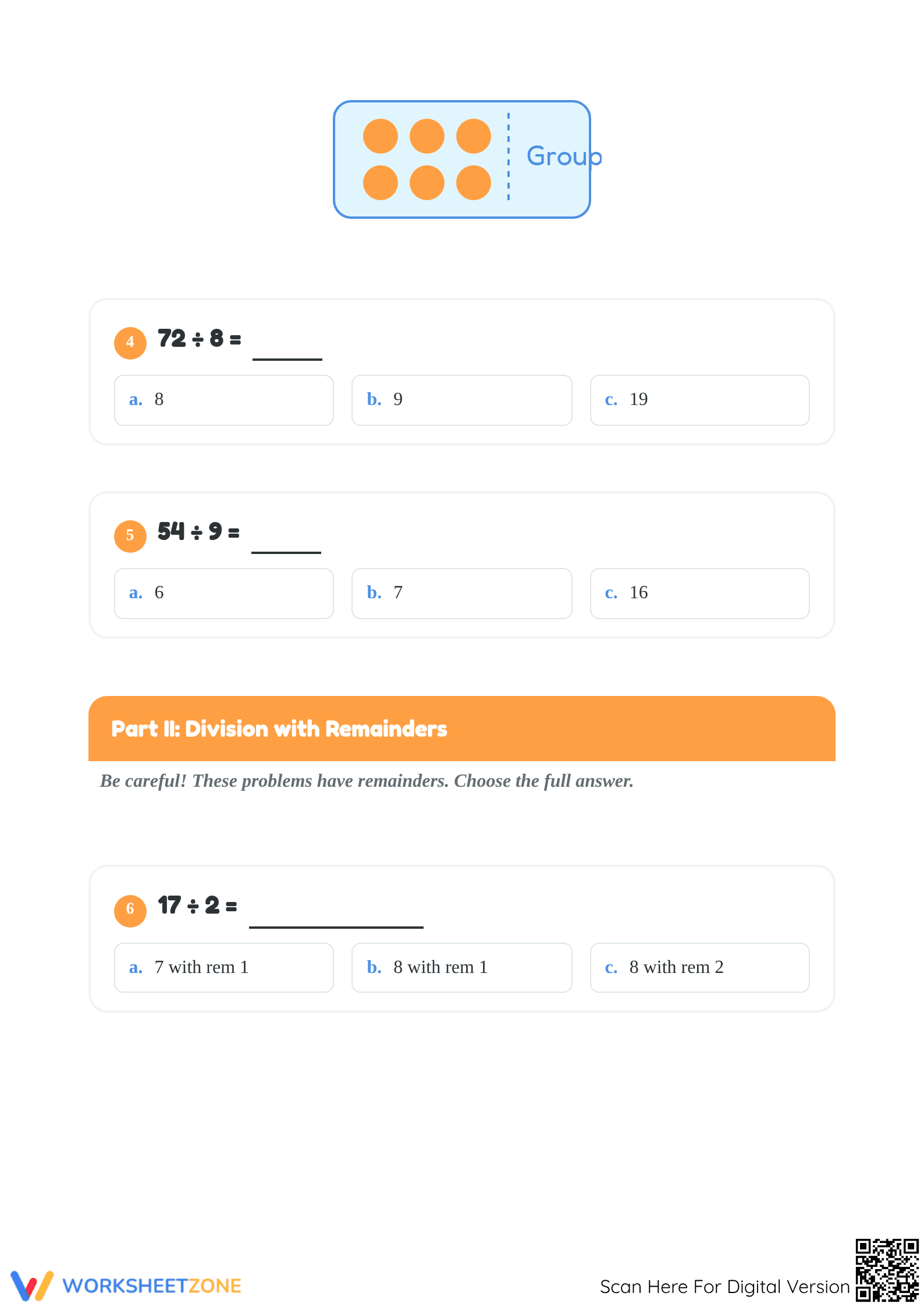
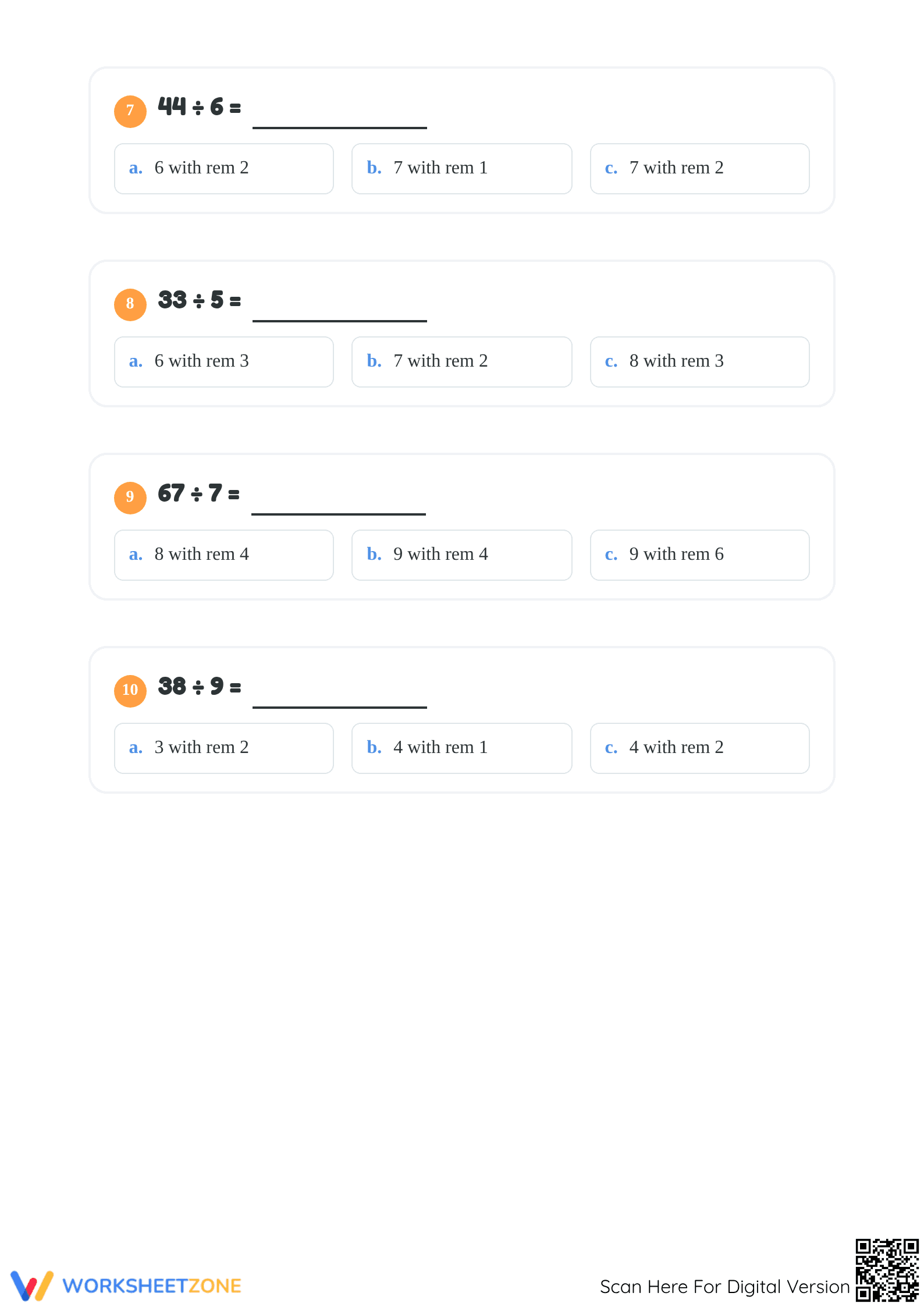
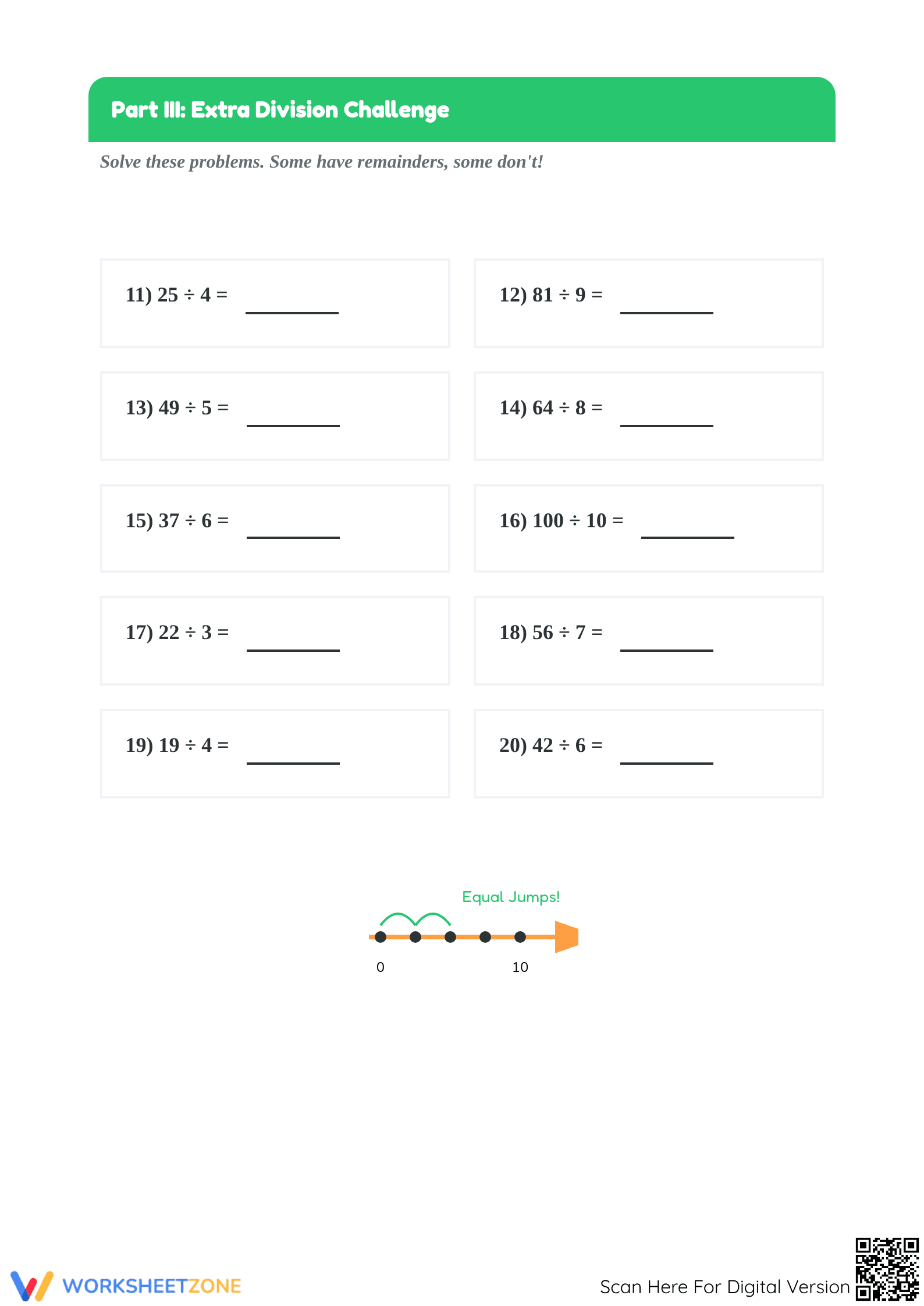
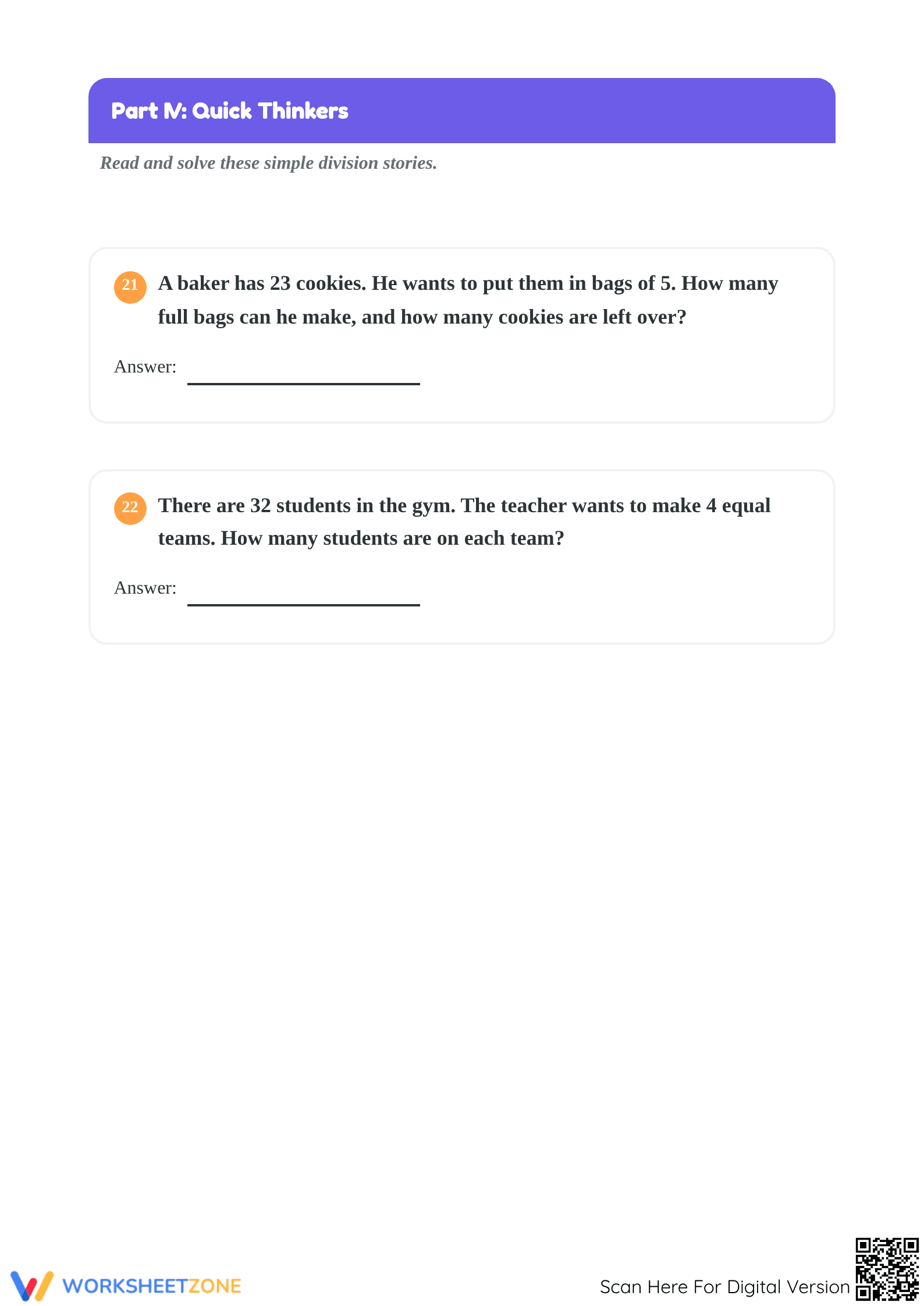
This 5-page resource is structured into four distinct parts to support varied learning styles. It includes 10 multiple-choice questions for quick checks, 10 open-ended equations to challenge recall, and two word problems applying skills to real-world scenarios. The layout includes clear workspace, visual cues like number lines, and a complete answer key for rapid grading.
Zero-Prep Workflow
Teachers can implement this resource in under 2 minutes. First, print the 5-page PDF or assign it digitally through your learning management system. Second, distribute copies to students, providing them with 30 minutes of focused instructional time. Finally, use the provided answer key to review results immediately or allow students to self-correct, promoting mathematical ownership and metacognition.
Standards Alignment
This worksheet is strictly aligned to CCSS.MATH.CONTENT.4.NBT.B.6. Students must find whole-number quotients and remainders with one-digit divisors and up to two-digit dividends. The inclusion of word problems also supports CCSS.MATH.CONTENT.4.OA.A.3 by requiring interpretation of remainders in context. Both standard codes can be copied directly into lesson plans or curriculum mapping tools.
How to Use It
Use this worksheet as a summative assessment following a long division unit or as a diagnostic tool before introducing multi-digit divisors. During instruction, observe how students handle the "Part II" problems; check whether they correctly identify the remainder or simply provide the quotient. This data provides immediate insight for small-group intervention strategies or IEP progress monitoring.
Who It's For
This resource is designed for Grade 4 students but serves as an extension for advanced Grade 3 learners or a remediation tool for Grade 5. It pairs naturally with division anchor charts or hands-on base-ten blocks. The structured progression makes it ideal for inclusion classrooms where students benefit from clear section headers and varied task demands.
The development of division fluency relies on a balanced approach of procedural practice and conceptual application. According to the RAND AIRS 2024 report, students who engage in mixed-format mathematical tasks—combining multiple-choice, open-response, and contextual word problems—show a 15% higher retention rate compared to those using single-format drills. This worksheet implements these findings by transitioning learners from basic identification to the application of CCSS.MATH.CONTENT.4.NBT.B.6 in real-world cookie and team scenarios. By requiring students to interpret what remainders signify in a practical context, the resource builds the deep number sense necessary for higher-level algebra. The inclusion of visual number lines supports the equal jumps model of division, aligning with evidence-based instructional strategies that emphasize visualization as a bridge to abstraction. This ready-to-use resource ensures that Grade 4 students meet state benchmarks while developing durable mathematical proficiency.


