


























Views
Downloads
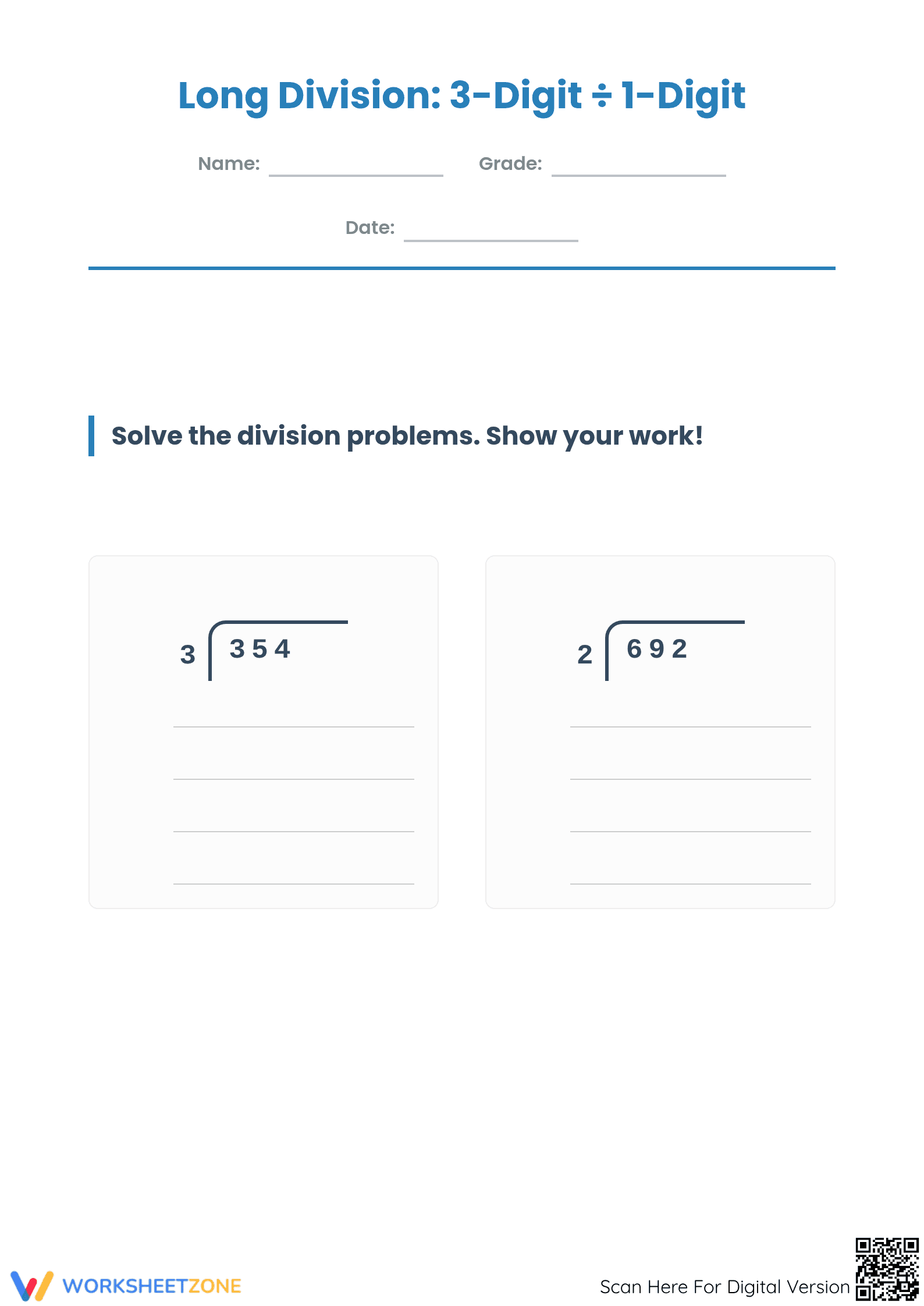
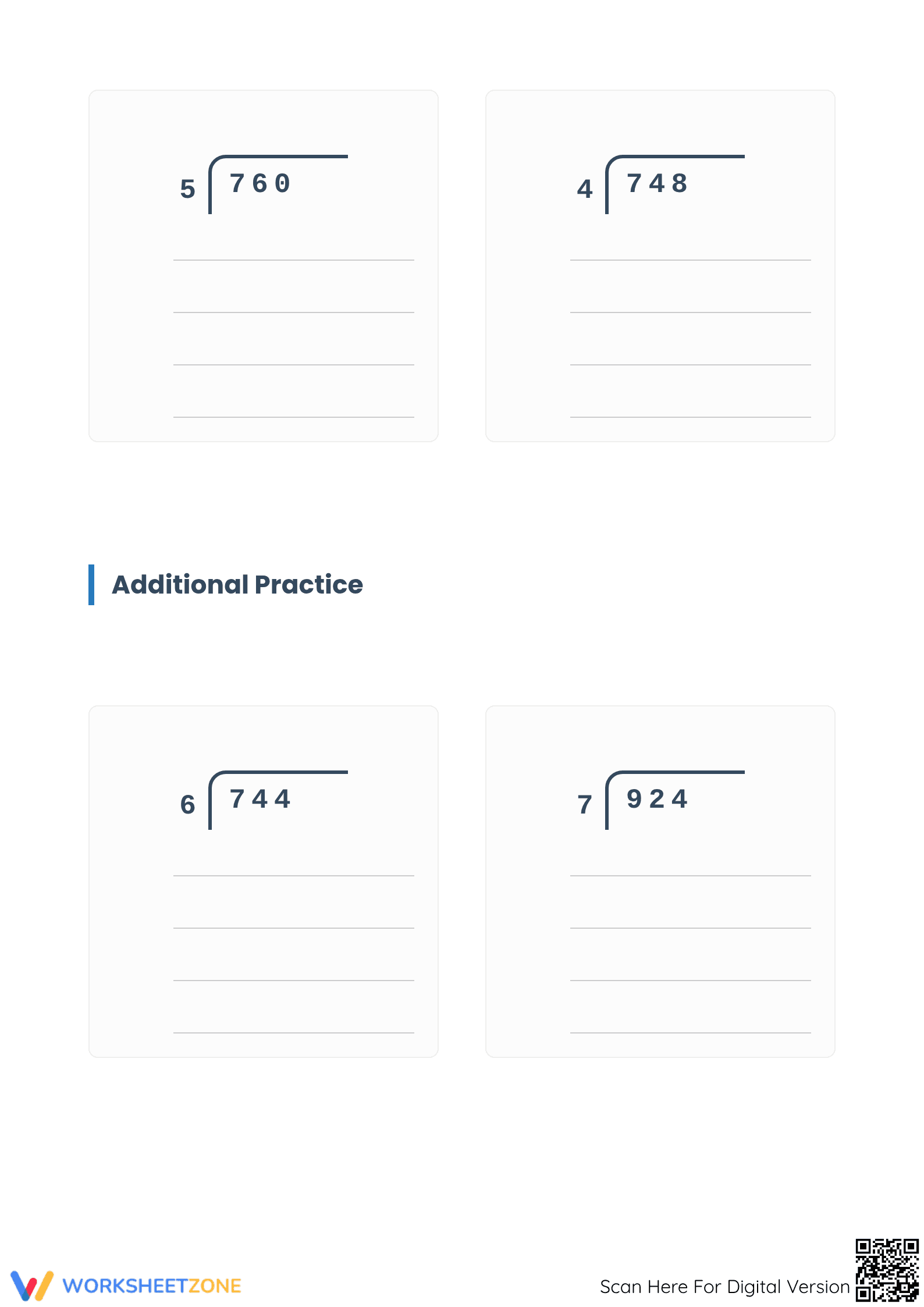
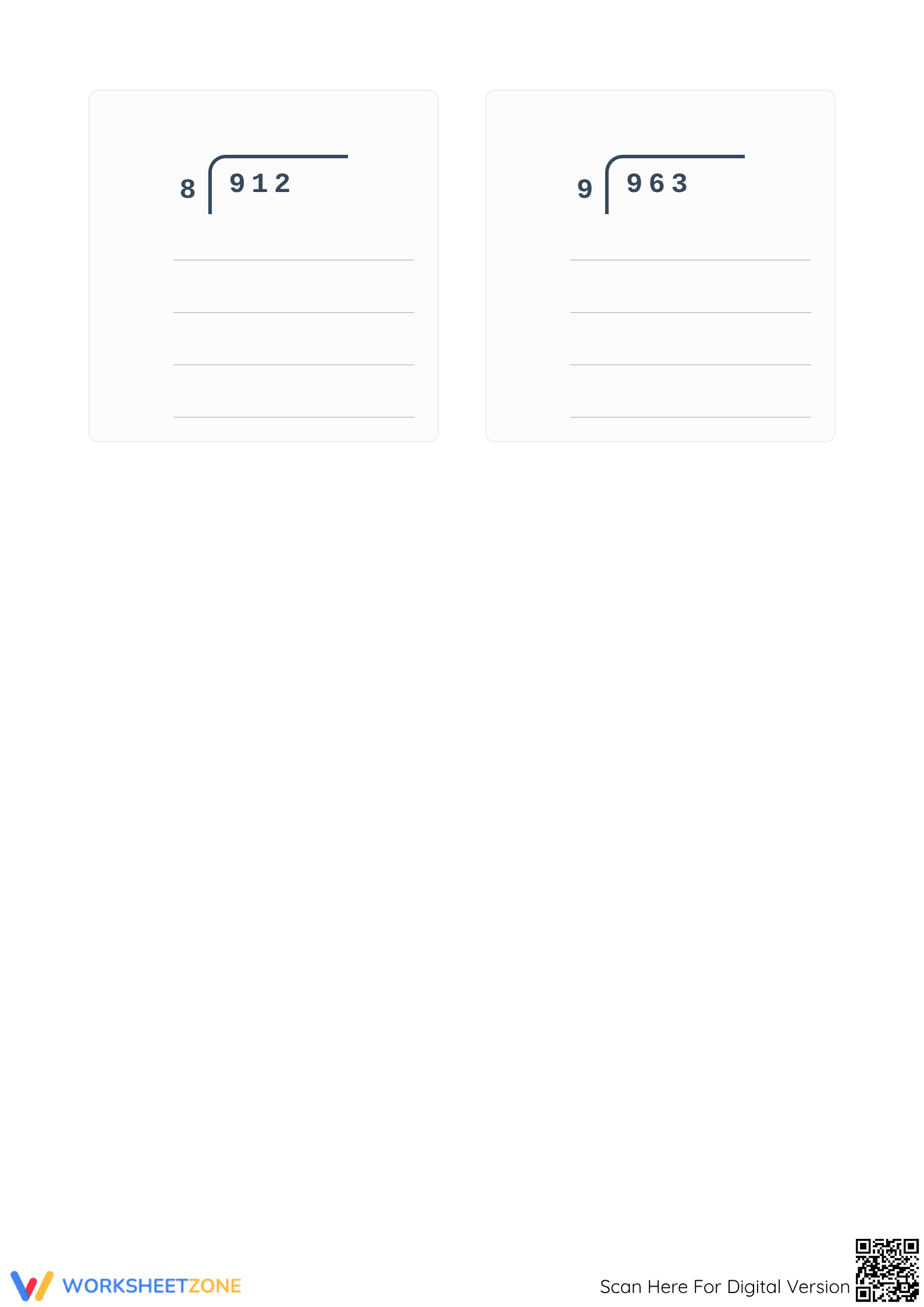

Grade 4 Long Division — Printable No-Prep Math Worksheet
Paste this activity's link or code into your existing LMS (Google Classroom, Canvas, Teams, Schoology, Moodle, etc.).
Students can open and work on the activity right away, with no student login required.
You'll still be able to track student progress and results from your teacher account.
Mastering the Long Division Algorithm
This printable long division worksheet helps Grade 4 students master 3-digit by 1-digit calculations without remainders. By providing clear workspace for multi-step subtraction and bringing down digits, the resource ensures students develop a fluid procedural understanding of whole-number quotients. It is a practical tool for building calculation speed and accuracy.
At a Glance
- Grade: 4 · Subject: Math
- Standard:
CCSS.MATH.CONTENT.4.NBT.B.6— Find whole-number quotients with up to four-digit dividends and one-digit divisors- Skill Focus: 3-Digit by 1-Digit Long Division
- Format: 3 pages · 8 problems · Answer key included · PDF
- Best For: Independent arithmetic practice and homework
- Time: 15–25 minutes
What's Inside
The packet includes three pages featuring eight long division problems. Each problem has a dedicated workspace box for showing vertical work, subtraction steps, and digit alignment. A comprehensive answer key is included for quick teacher grading. The clean layout supports students who struggle with organizational spacing during math tasks.
Zero-Prep Workflow
This resource offers immediate implementation with teacher prep under two minutes. Simply print the document and distribute copies to students; the clear instructions require no complex setup. Review the work using the included answer key for rapid assessment. Its self-contained design makes it an excellent choice for substitute plans or morning work.
Standards Alignment
The focus is CCSS.MATH.CONTENT.4.NBT.B.6, which requires students to find whole-number quotients and remainders with up to four-digit dividends and one-digit divisors using strategies based on place value. This worksheet specifically targets the vertical algorithm for division without remainders. This standard code can be copied directly into lesson plans, IEP goals, or district curriculum mapping tools to ensure instructional compliance.
How to Use It
Use this as a focused activity following direct instruction on the standard algorithm. It serves as a formative assessment; observe students as they bring down digits to identify place value errors. Alternatively, assign it as homework to reinforce procedural memory. Completion typically takes fifteen to twenty-five minutes depending on student fluency.
Who It's For
Tailored for Grade 4, it also serves as a review for Grade 5 learners needing foundational division practice. It benefits students requiring scaffolded workspaces to maintain organization during multi-step problems. The resource pairs naturally with place-value charts to bridge the gap between concrete and abstract models.
Mastery of the long division algorithm, as targeted in this CCSS.MATH.CONTENT.4.NBT.B.6 resource, is a critical academic milestone that successfully bridges the gap between basic arithmetic and more complex algebraic thinking. Research from the NAEP highlights that students developing early fluency in multi-digit calculation procedures are significantly better prepared for the rigors of rational number operations in middle school. According to EdReports (2024), high-quality printable resources providing dedicated vertical workspace are essential for reducing the cognitive load associated with common organizational errors. By focusing on 3-digit by 1-digit division without remainders, this worksheet allows students to internalize the repetitive cycle of division without the added complexity of fractional remainders. This targeted approach aligns perfectly with Fisher & Frey's (2014) principles of gradual release, ensuring students achieve complete procedural mastery through structured, independent practice before moving toward more complex four-digit dividend problems in future math lessons.


