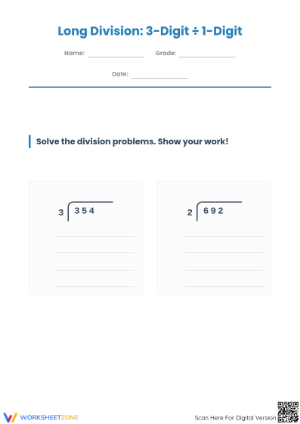
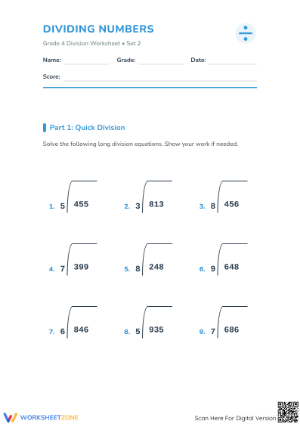
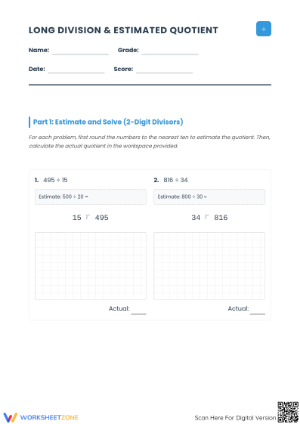
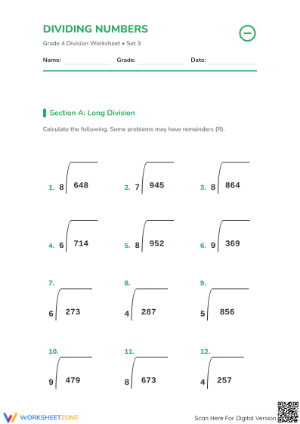
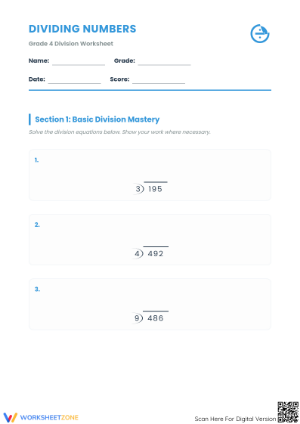
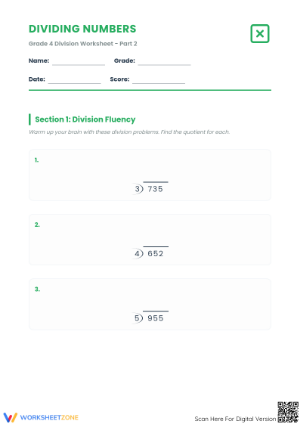
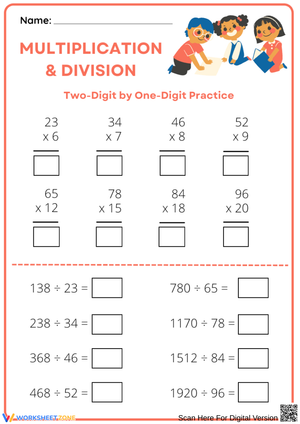
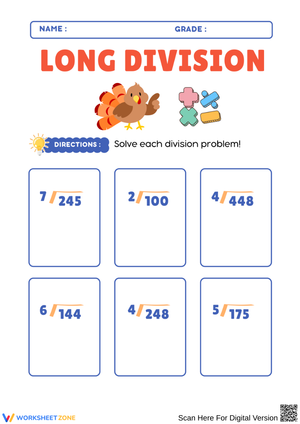
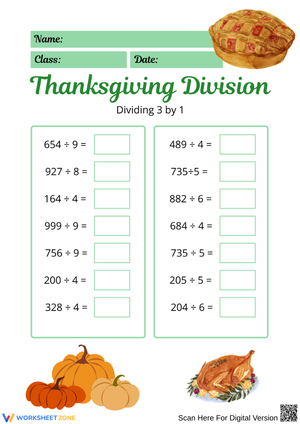
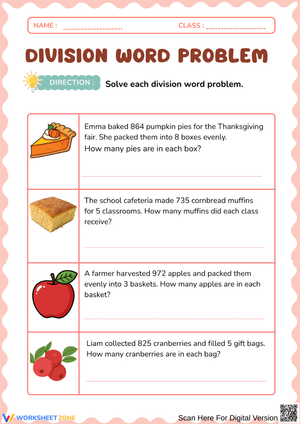
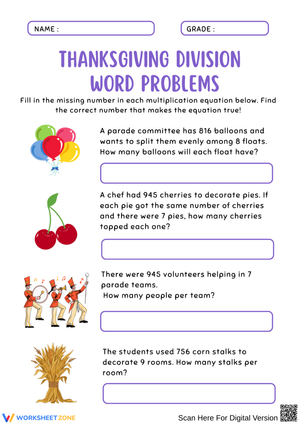
3 digit division worksheets for grade 4 help students move from basic division facts into more careful, multi-step problem-solving. At this stage, learners begin working with larger numbers such as 324 ÷ 3, 568 ÷ 4, or 945 ÷ 5. These problems require more than knowing the answer quickly. Students need to understand place value, use multiplication facts, subtract accurately, and follow each division step in the correct order.
Before students feel confident with 3-digit division, they need a strong foundation in basic facts. If a child struggles with 36 ÷ 6 or 42 ÷ 7, larger division problems can quickly become frustrating. Reviewing division facts worksheets can help students strengthen recall before moving into longer problems. Once the facts are more automatic, students can focus on the process of dividing hundreds, tens, and ones without getting stuck on every calculation.
Grade 4 learners often benefit from seeing division as both a written method and a real-world idea. A problem like 672 ÷ 6 can be explained as sharing 672 items equally among 6 groups. This helps students understand why each step matters. Worksheets can include standard long division, partial quotients, estimation, and word problems so students practice division from different angles. Teachers can also pair written practice with division math activities to make the concept more visual and interactive.
As students work through 3 digit division worksheets for grade 4, they also learn how to handle mistakes and check their answers. Estimation helps them decide whether an answer is reasonable, while multiplication helps them verify the final quotient. If remainders are included, students can learn how to interpret what is left over in a problem. This builds stronger number sense and prepares learners for future work with fractions, decimals, ratios, and multi-step math tasks.
Whether used in classrooms, homeschool lessons, tutoring sessions, or math review blocks, 3 digit division worksheets for grade 4 provide the repeated practice students need to build fluency. With clear layouts, gradual difficulty, and meaningful word problems, these worksheets can help fourth graders become more organized, accurate, and confident when solving larger division problems.
Frequently Asked Questions
Question 1: What skills do 3 digit division worksheets for grade 4 help students build?
These worksheets help students practice long division, place value, multiplication recall, subtraction, estimation, and problem-solving. Students learn how to divide hundreds, tens, and ones step by step. They also practice checking whether their answers make sense, which is important for building accuracy and confidence. These skills create a strong foundation for more advanced math topics in later grades.
Question 2: What should students know before starting 3-digit division?
Before starting 3-digit division, students should understand basic division facts, multiplication facts, place value, and simple division with smaller numbers. They should know that division can mean equal sharing or equal grouping. If students are not yet comfortable with basic facts, it is helpful to review those first so they can focus on the larger division process without becoming overwhelmed.
Question 3: How can teachers support students who find 3-digit division difficult?
Teachers can support students by breaking each problem into smaller steps and using visual tools such as place-value charts, base-ten blocks, or partial quotient models. It also helps to model one problem slowly, let students solve a similar problem with guidance, and then move into independent practice. Short, consistent review is often more effective than long practice sessions, especially for students who feel anxious about division.
Question 4: How can students check their answers in 3-digit division?
Students can check their answers by multiplying the quotient by the divisor. If the problem has a remainder, they add the remainder after multiplying. For example, if 758 ÷ 6 = 126 remainder 2, students can check by calculating 126 × 6 = 756, then adding 2 to get 758. This habit helps students catch errors and understand the connection between multiplication and division.













 Interactive Worksheet Maker
 Quiz Maker
 Word Search Maker
 Crossword Puzzle Maker
 Word Scramble Generator
 Sentence Scramble Generator
 Handwriting Worksheet Generator
 Name Tracing Generator
 Fill In The Blank Generator