


























Views
Downloads


Grade 4 Long Division — Essential Printable Worksheet
Paste this activity's link or code into your existing LMS (Google Classroom, Canvas, Teams, Schoology, Moodle, etc.).
Students can open and work on the activity right away, with no student login required.
You'll still be able to track student progress and results from your teacher account.
This comprehensive Grade 4 math worksheet builds student mastery in long division through a structured, multi-step progression. Students move from basic computational fluency to solving complex real-world word problems. By integrating diverse task types, the resource ensures learners develop a deep conceptual understanding of quotients and remainders, leading to independent mathematical confidence and classroom success.
At a Glance
At a Glance
- Grade: 4 · Subject: Math
- Standard:
4.NBT.B.6— Find whole-number quotients and remainders with up to four-digit dividends- Skill Focus: Long Division and Word Problems
- Format: 3 pages · 32 problems · Answer key included · PDF
- Best For: Independent practice or homework review
- Time: 30–45 minutes
What's Inside
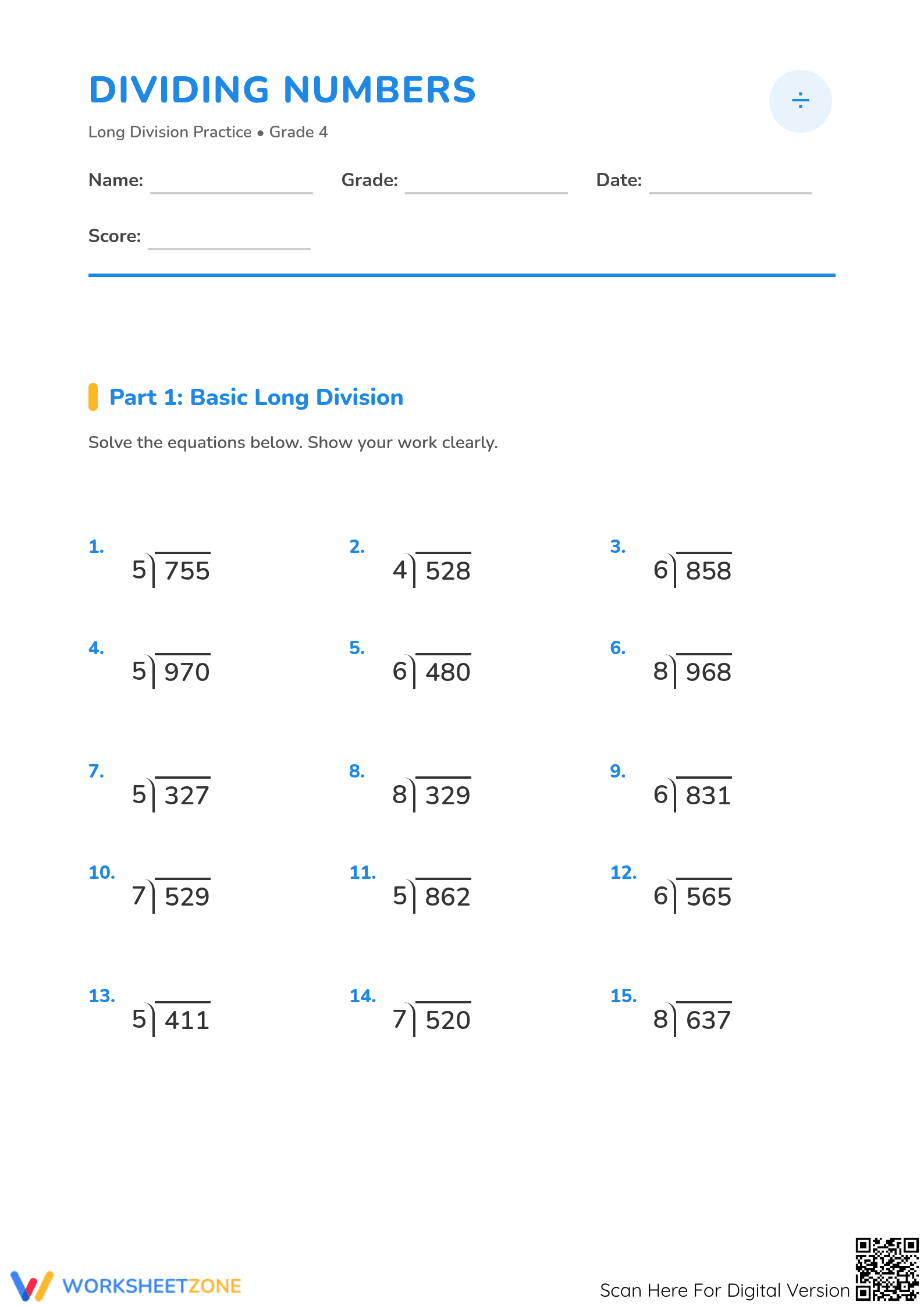
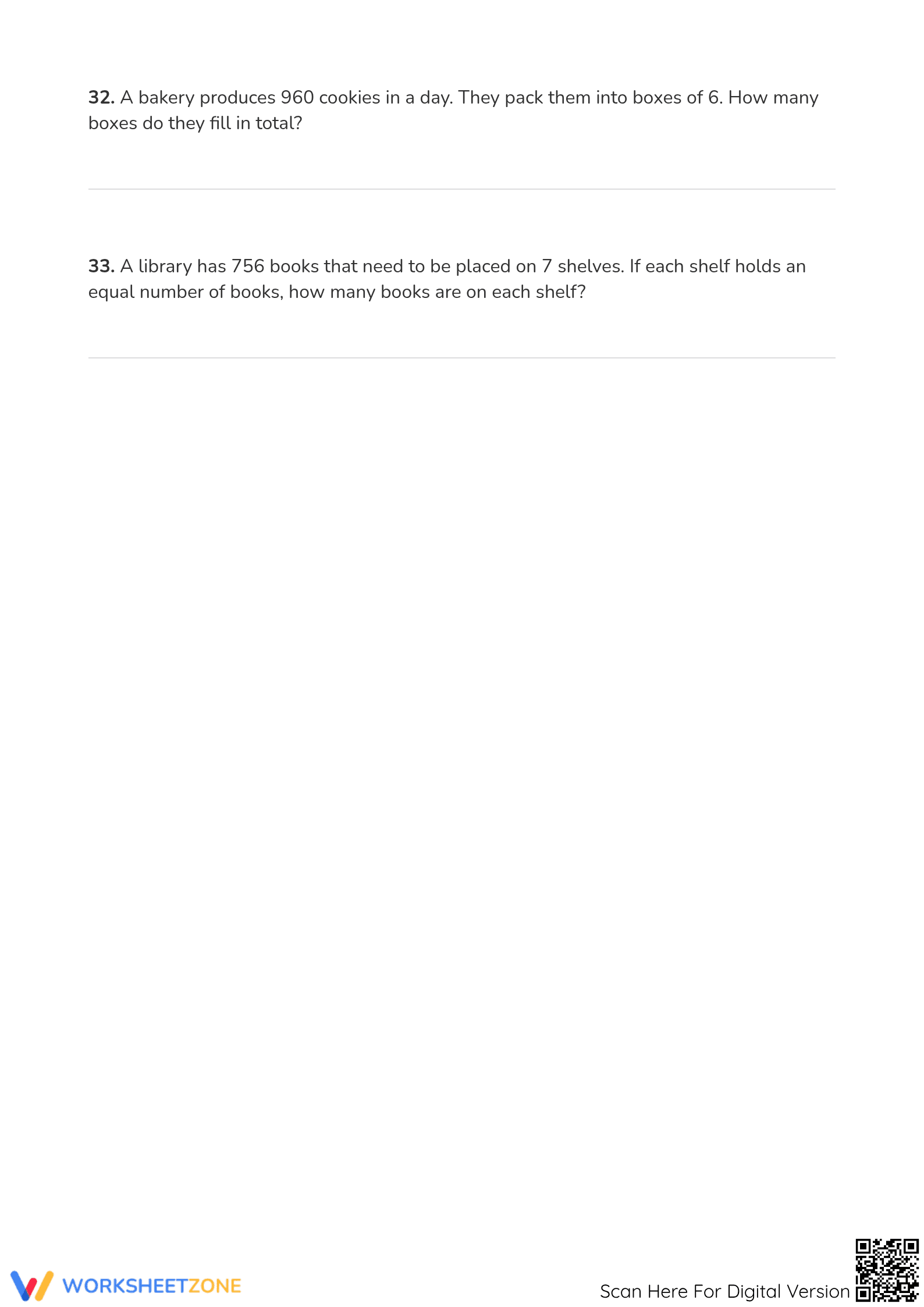
This three-page PDF offers a robust collection of 32 division tasks. Page one focuses on fifteen basic long division equations, while page two introduces six multi-step challenges and eight missing-value equations. The final sections provide three rigorous real-world word problems to test application skills. A complete answer key is provided for immediate grading and student self-correction.
Zero-Prep Workflow
The zero-prep design allows teachers to implement this resource in under two minutes. Simply print the three-page set (30 seconds), distribute the packets to the class (60 seconds), and use the provided answer key for a rapid end-of-lesson review (30 seconds). This streamlined workflow makes the worksheet an ideal solution for emergency sub plans or quick formative assessments.
Standards Alignment
This resource is strictly aligned to CCSS.MATH.CONTENT.4.NBT.B.6, which involves finding whole-number quotients and remainders with up to four-digit dividends. It also supports algebraic thinking by requiring students to find missing divisors and dividends. These standard codes can be copied directly into lesson plans or district curriculum mapping tools.
How to Use It
Assign this worksheet during the independent practice portion of a division unit to solidify procedural fluency. Alternatively, use the word problems as a "Problem of the Day" to observe how students translate verbal scenarios into mathematical operations. Most students will complete the full set within 45 minutes, providing clear evidence of their computational accuracy.
Who It's For
This practice set is designed for fourth-grade students mastering long division, but it also serves as an excellent remedial tool for fifth graders needing a skills refresh. The gradual increase in difficulty makes it a natural pairing for a direct instruction lesson or a supplementary resource to be used alongside a core math textbook.
Citation Capsule
Aligned with the CCSS.MATH.CONTENT.4.NBT.B.6 standard, this worksheet facilitates the development of computational fluency in long division, a critical milestone in upper elementary mathematics. Research from Fisher & Frey (2014) emphasizes the importance of a gradual release of responsibility, which this resource mirrors by transitioning students from scaffolded Basic Long Division to independent Real-World Applications. By engaging with 32 distinct tasks, including multi-step problems and missing-value equations, students move beyond rote memorization to achieve true procedural mastery. The inclusion of word problems aligns with NAEP recommendations for increasing mathematical literacy through context-heavy scenarios. This structured approach ensures that students can accurately calculate quotients and remainders while understanding the underlying relationship between multiplication and division. Teachers can utilize this printable to gather high-quality evidence of student progress, making it a reliable tool for standards-based grading and instructional planning.


