


























Views
Downloads


Essential Divisibility Rules 2 & 3 Worksheet | Grade 4-6
Paste this activity's link or code into your existing LMS (Google Classroom, Canvas, Teams, Schoology, Moodle, etc.).
Students can open and work on the activity right away, with no student login required.
You'll still be able to track student progress and results from your teacher account.
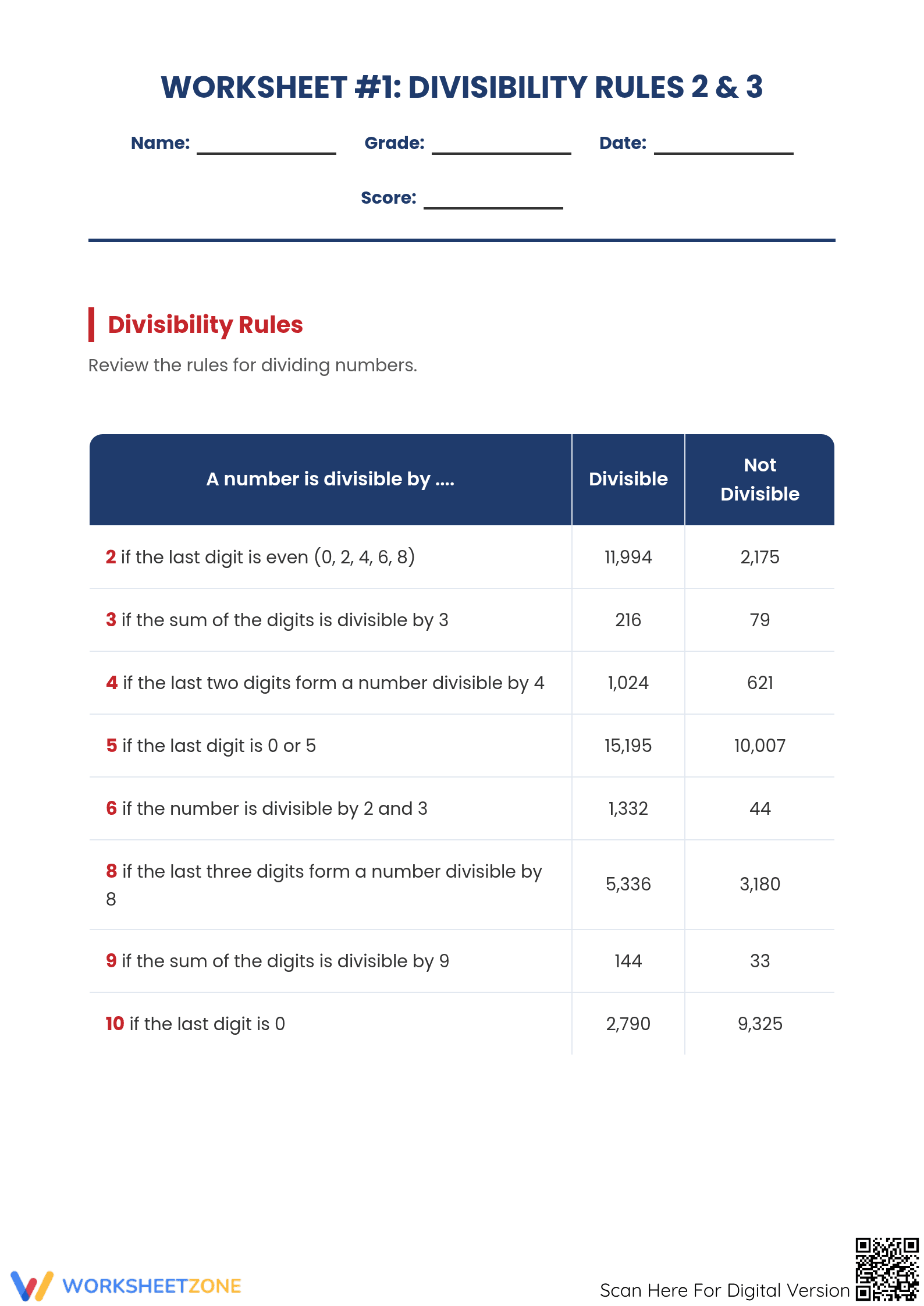
This comprehensive divisibility rules for 2 and 3 worksheet provides students with targeted practice to master foundational number theory. By applying clear mathematical criteria to determine factors without long division, learners develop mental math skills. This resource ensures students confidently identify multiples of prime numbers 2 and 3.
At a Glance
- Grade: 4–6 · Subject: Math
- Standard:
4.OA.B.4— Determine if a whole number is a multiple of a one-digit number- Skill Focus: Divisibility rules for 2 and 3
- Format: 4 pages · 23 problems · Answer key included · PDF
- Best For: Independent practice and mental math reinforcement
- Time: 15–25 minutes
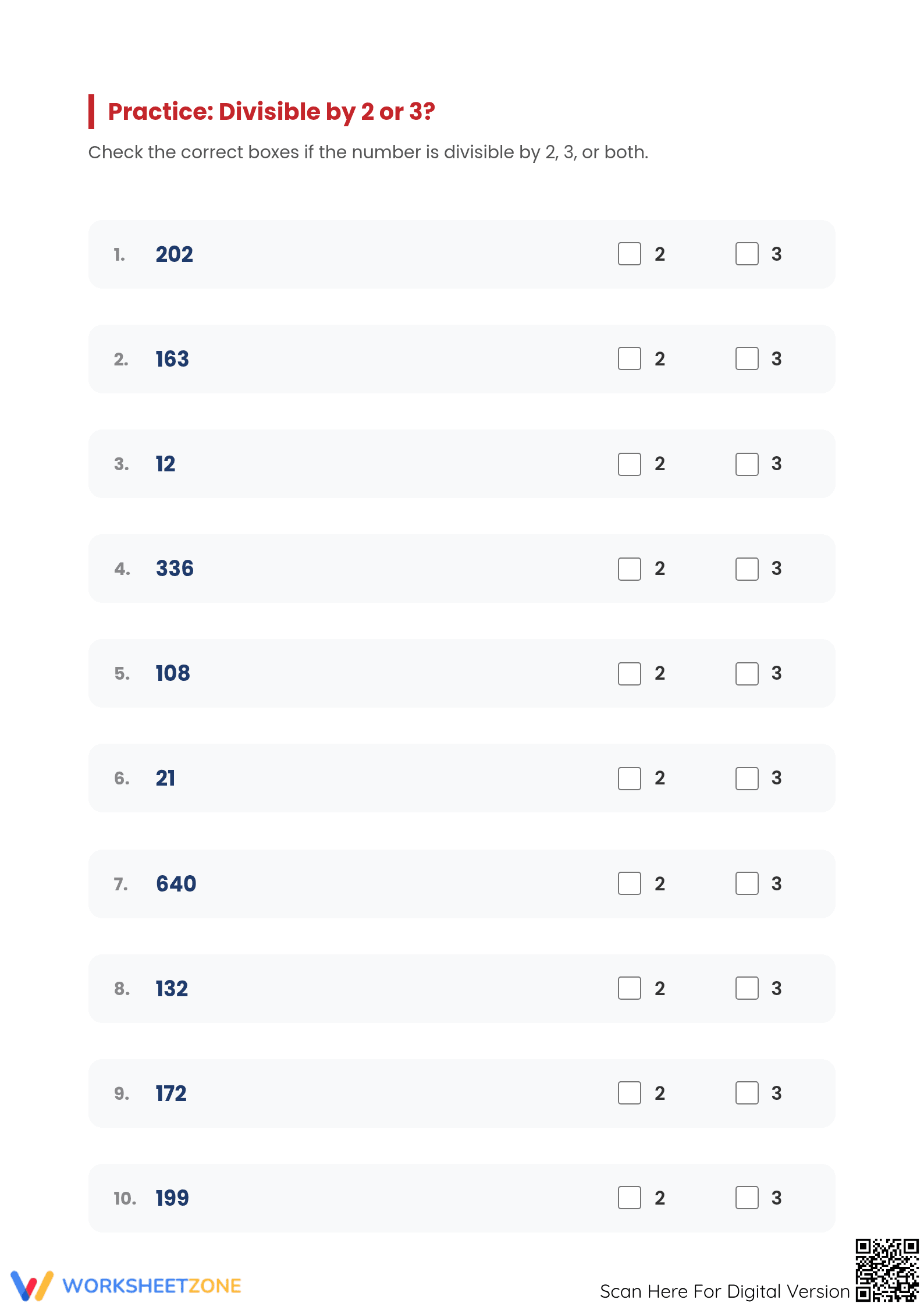
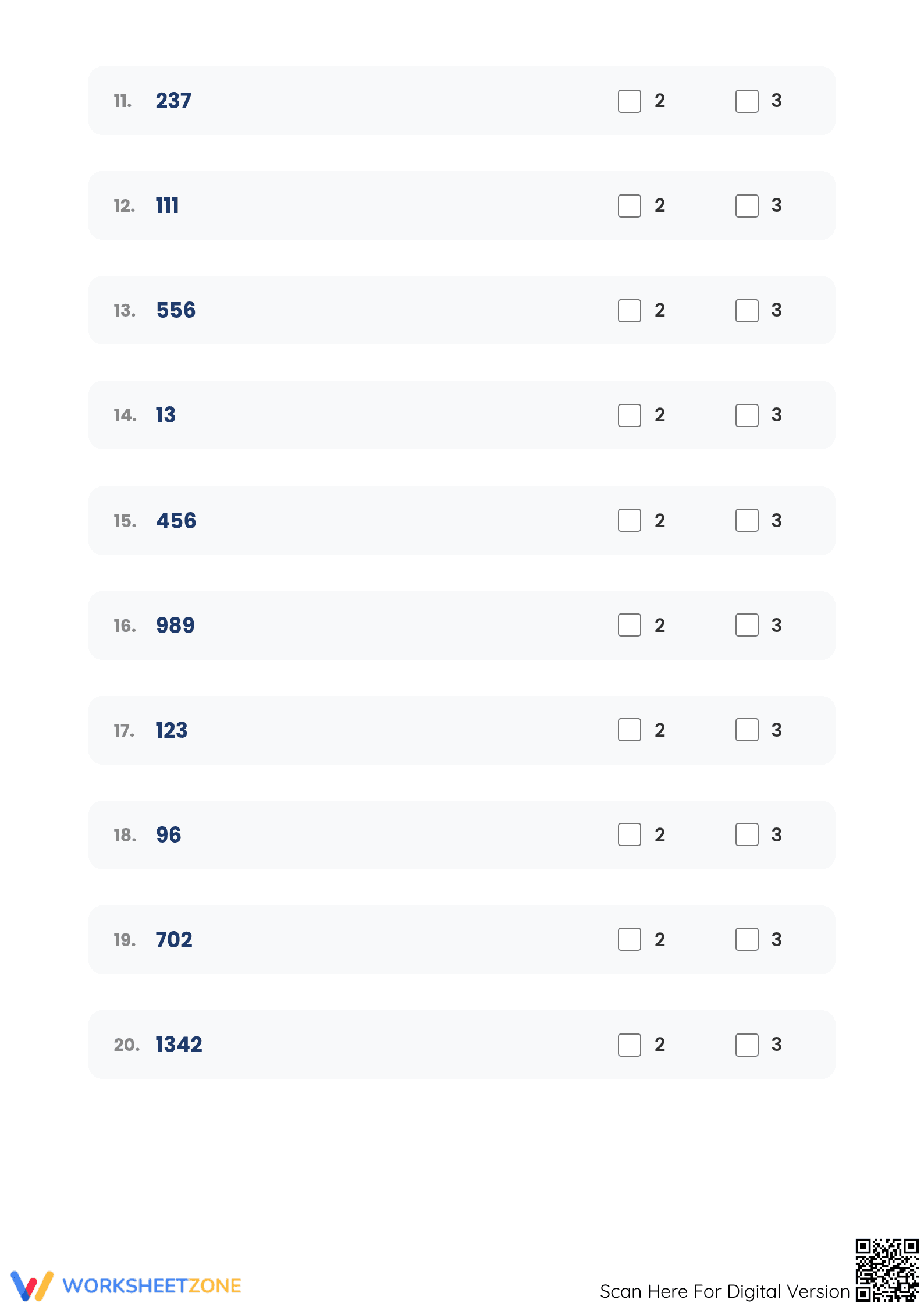
This four-page printable PDF features a structured layout for ease of use. The first page is a reference guide for divisibility rules, while the practice set focuses on 2 and 3. Students solve 23 problems ranging from two-digit to four-digit values, each with selection checkboxes. A complete answer key is provided to facilitate rapid grading or student self-correction.
Skill Progression
- Guided practice: The rule table gives students conceptual tools to analyze any whole number.
- Supported practice: Early problems use two-digit numbers for verification against known facts.
- Independent practice: Final tasks introduce four-digit values, requiring strict rule application without support.
This gradual-release model builds learner confidence as they transition from simple recognition to complex numerical analysis.
Standards Alignment
This resource aligns to `CCSS.MATH.CONTENT.4.OA.B.4`, requiring students to determine if a whole number is a multiple of a one-digit number. Students satisfy core requirements for recognizing factor pairs and multiples. Both standard codes can be copied directly into lesson plans, IEP goals, or district curriculum mapping tools.
How to Use It
Distribute this worksheet during the practice portion of a lesson on division or factors. It serves as an excellent bell-ringer to gauge understanding of divisibility shortcuts. Teachers should observe if students correctly apply the sum-of-digits rule for 3; if students struggle, a quick review is recommended before they attempt the larger four-digit problems.
Who It's For
This worksheet is ideal for students in Grades 4, 5, and 6 strengthening division fluency. It provides scaffolding for students struggling with long division by offering an alternative path to identifying factors. For advanced learners, pair this with an extension activity where they derive the rule for 6 by combining rules for 2 and 3.
According to RAND AIRS (2024), providing students with explicit procedural shortcuts like divisibility rules significantly reduces cognitive load during multi-step division tasks. This worksheet aligns with these findings by isolating the criteria for 2 and 3, allowing students to focus on numerical patterns rather than rote calculation. Research suggests that mastery of these shortcuts is a prerequisite for success in higher-order math, particularly when simplifying fractions or finding prime factorizations. By using this 23-task resource, educators provide the high-frequency practice necessary to move these rules into long-term memory. The reference table and clear answer key support the gradual release of responsibility framework, ensuring students have a fallback resource as they build independence. Aligned to the 4.OA.B.4 standard, this PDF provides measurable evidence of student proficiency in foundational number theory.


