




























Views
Downloads


Essential Divisibility Rules 2, 3, and 5 Worksheet | Grade 4

Paste this activity's link or code into your existing LMS (Google Classroom, Canvas, Teams, Schoology, Moodle, etc.).
Students can open and work on the activity right away, with no student login required.
You'll still be able to track student progress and results from your teacher account.
This Grade 4 divisibility rules worksheet provides students with comprehensive practice identifying numbers divisible by 2, 3, and 5. By applying these specific mental math strategies, learners develop essential number sense and prepare for complex division and fraction simplification tasks. Students will successfully categorize whole numbers through structured, evidence-based repetition and logic.
At a Glance
- Grade: 4 · Subject: Math
- Standard:
CCSS.MATH.CONTENT.4.OA.B.4— Determine whether a whole number is a multiple of a given one-digit number- Skill Focus: Divisibility Rules (2, 3, 5)
- Format: 4 pages · 48 problems · Answer key included · PDF
- Best For: Small group instruction and independent practice
- Time: 25–35 minutes
What's Inside
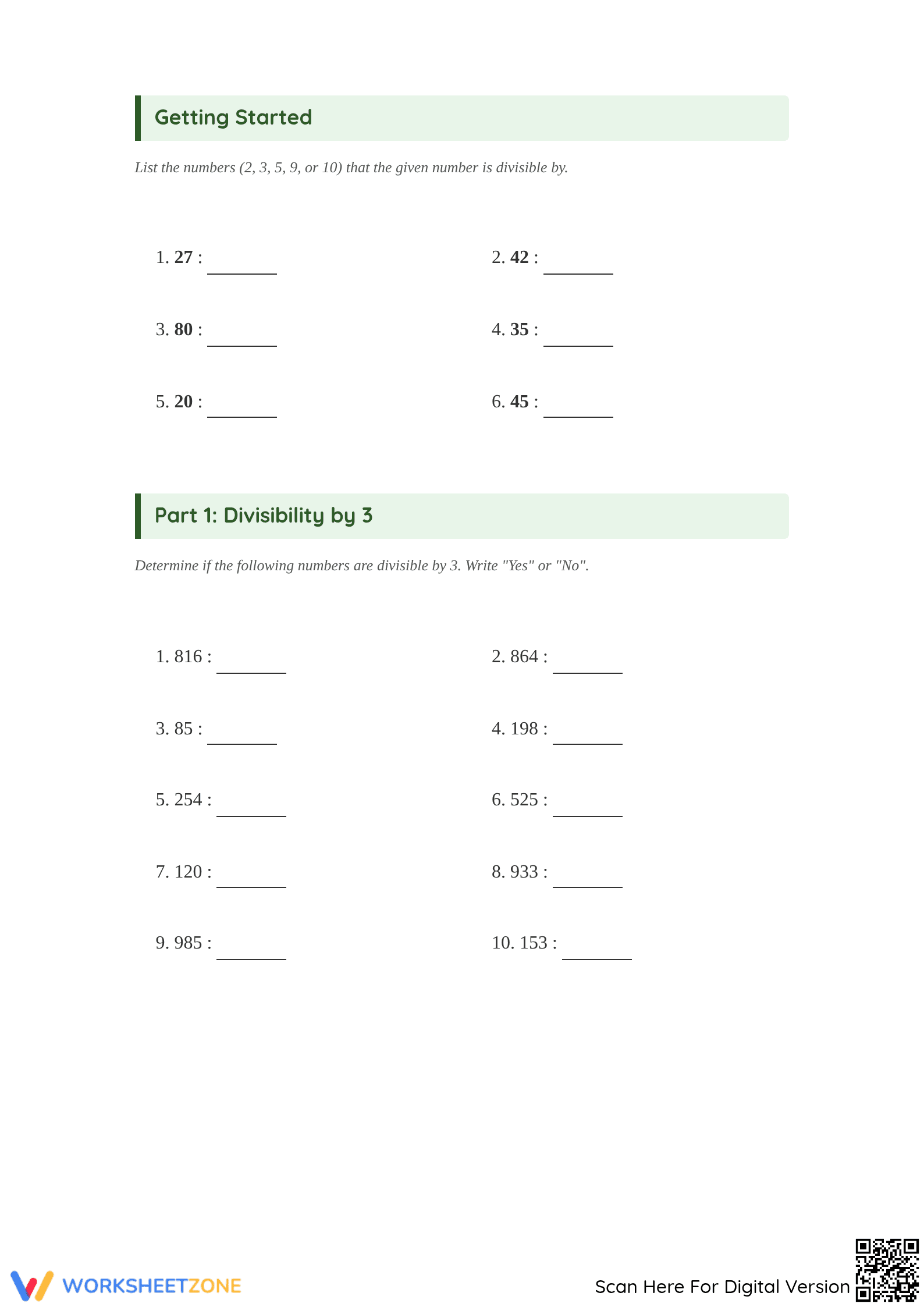
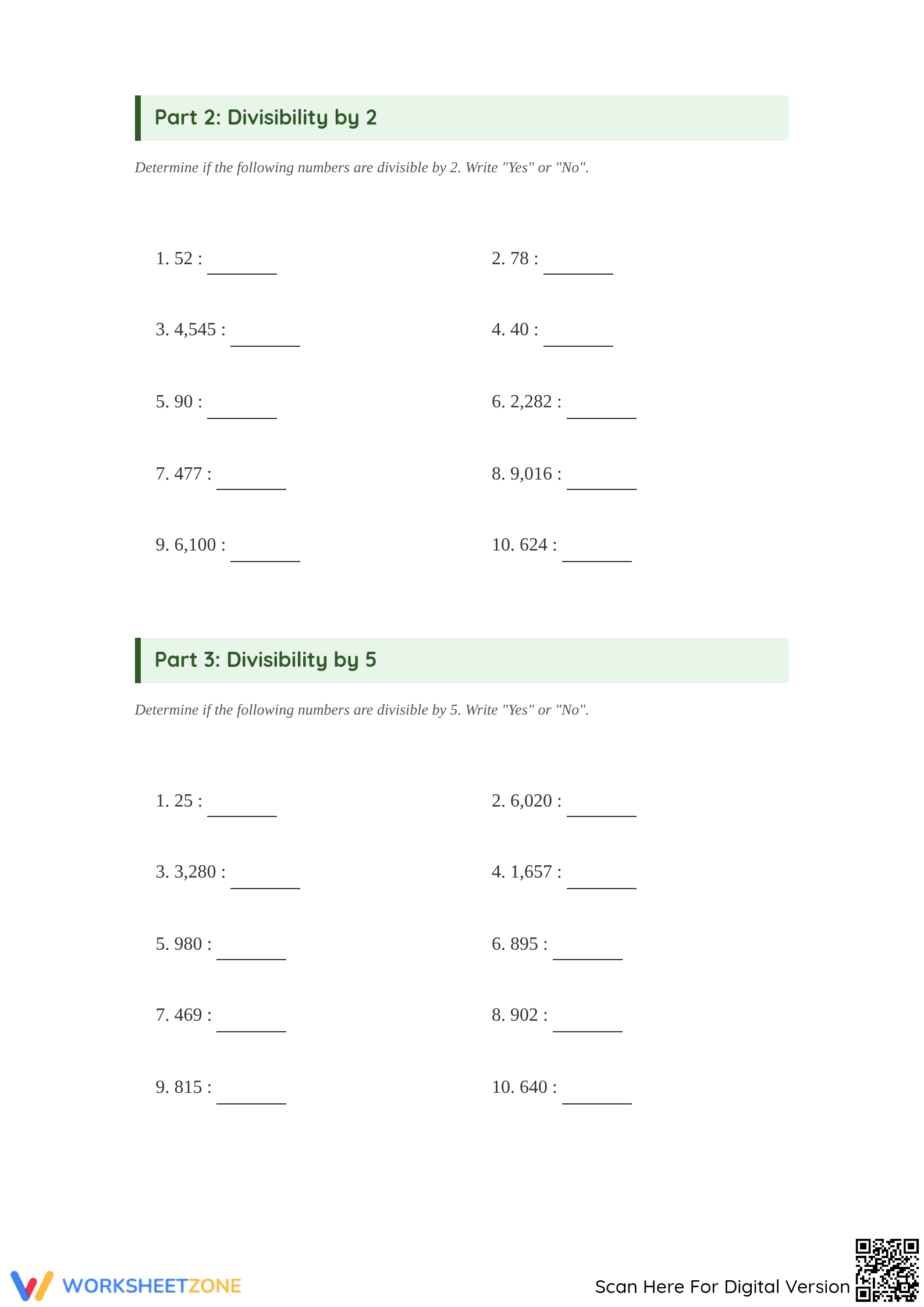
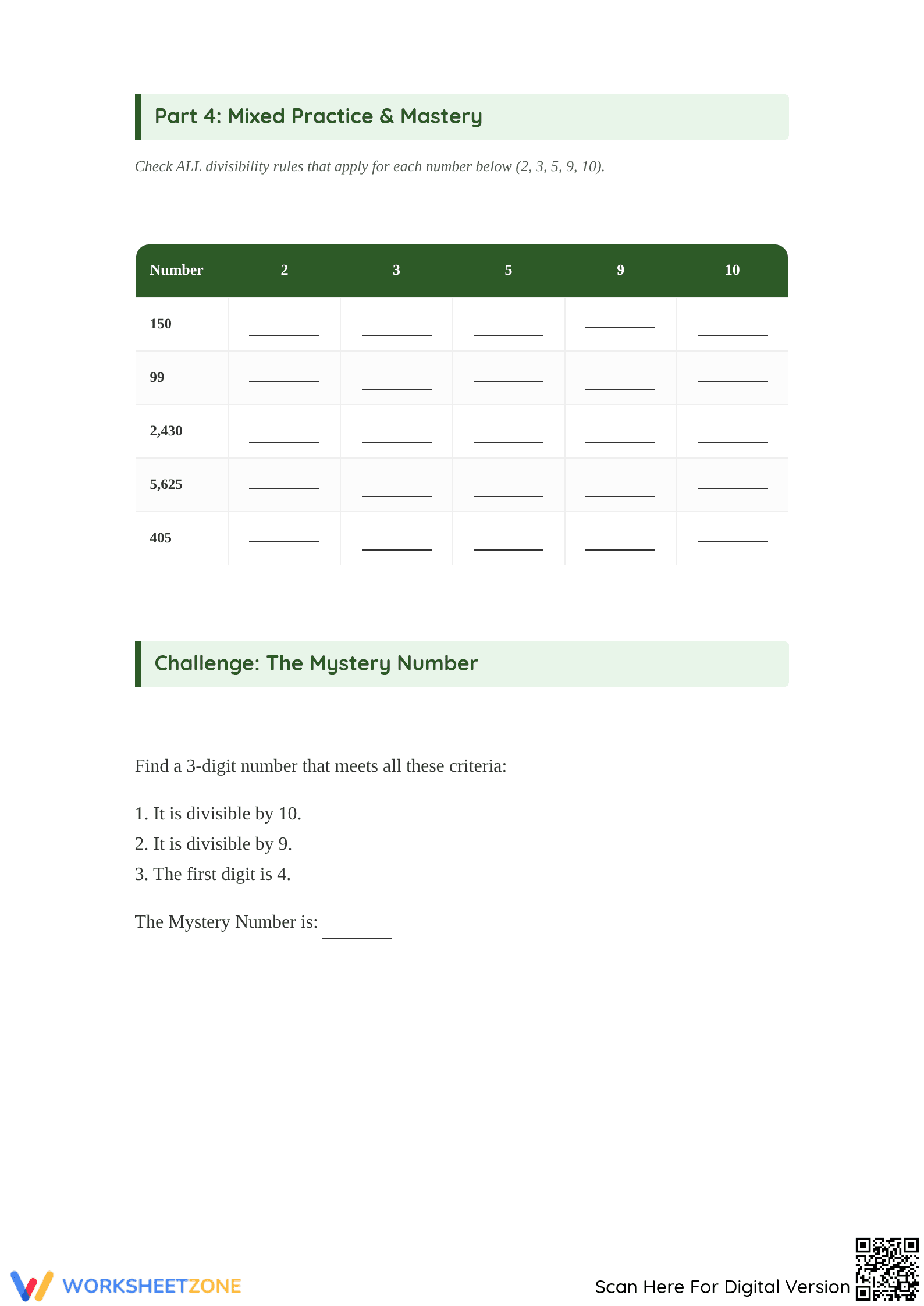
This resource features four pages of targeted mathematical exercises. The layout includes clear tables and lists where students evaluate three-digit and four-digit numbers against divisibility criteria. A complete answer key is provided for every page, allowing for quick grading or student self-correction. The consistent formatting ensures that students focus entirely on the numerical properties rather than complex instructions.
Skill Progression
- Guided Practice: The first section provides 12 problems with visual reminders of the rules, supporting students as they begin identifying patterns in ending digits and digital sums.
- Supported Practice: Students then tackle 24 problems without prompts, applying the rules for 2 and 5 (ending digit) and 3 (sum of digits) across larger numerical values.
- Independent Practice: The final 12 problems require students to justify their reasoning, ensuring they can explain why a number fails or passes a specific divisibility test.
This sequence follows a gradual-release model to ensure students move from rote application to conceptual mastery of factors and multiples.
Standards Alignment
This worksheet is strictly aligned to CCSS.MATH.CONTENT.4.OA.B.4, which requires students to determine whether a given whole number in the range 1-100 is a multiple of a given one-digit number. By mastering the rules for 2, 3, and 5, students gain the proficiency needed to identify factor pairs and multiples quickly. Both standard codes can be copied directly into lesson plans, IEP goals, or district curriculum mapping tools.
How to Use It
Assign this worksheet during the "You Do" phase of a math workshop to monitor student understanding of divisibility. For a formative assessment observation, watch for students who try to perform long division instead of using the rules; this indicates a need for further modeling of the sum-of-digits rule for 3. Expected completion time ranges from 25 to 35 minutes.
Who It's For
This resource is designed for Grade 4 general education students, but it serves as an excellent intervention tool for Grade 5 students struggling with fraction reduction. It pairs naturally with an anchor chart displaying ending-digit rules and can be used immediately following a direct instruction lesson on factors and multiples.
Research indicates that mastery of divisibility rules is a critical precursor to success in middle school rational number operations. According to a ScienceDirect TpT Analysis, high-quality supplemental materials that provide repeated, focused practice on mental math shortcuts significantly reduce cognitive load during more complex multi-step division. By internalizing the patterns for 2, 3, and 5, students build the math fluency necessary to identify factors without relying on calculators. This Grade 4 worksheet facilitates that fluency by mapping 48 specific tasks to the CCSS.MATH.CONTENT.4.OA.B.4 standard, ensuring that students can determine if a number is a multiple of a one-digit divisor with speed and accuracy. Such foundational skills are repeatedly cited in NAEP reports as differentiators between students who struggle with algebra and those who excel in higher-order mathematical reasoning.


