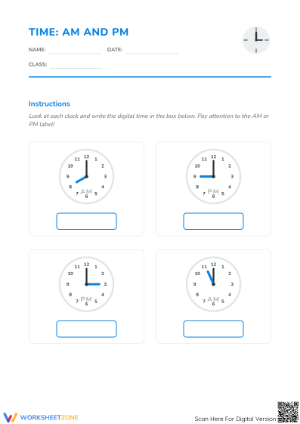
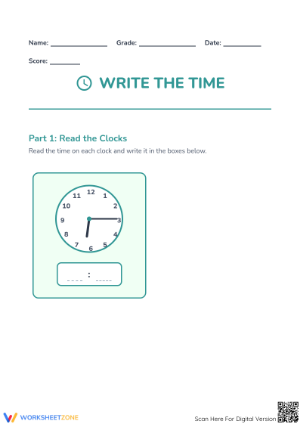
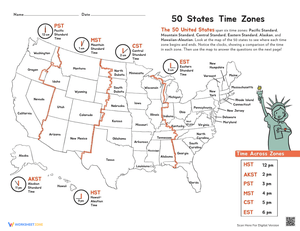
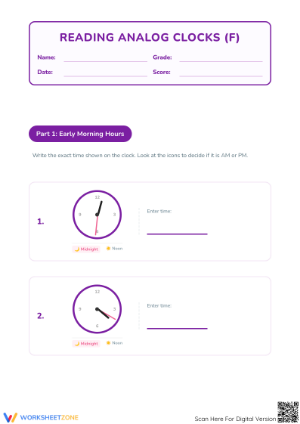
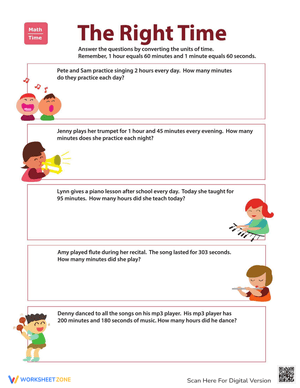
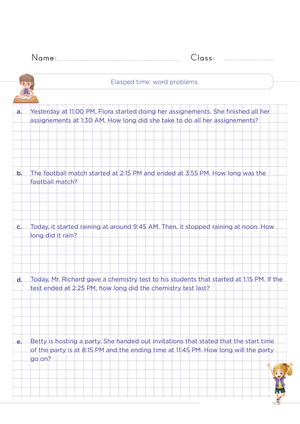
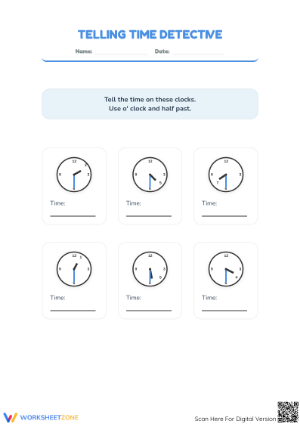
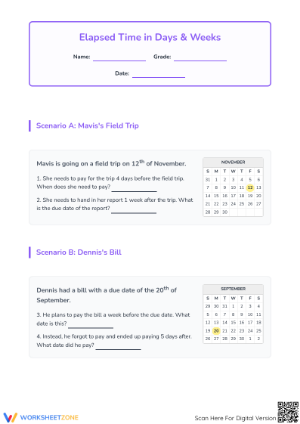
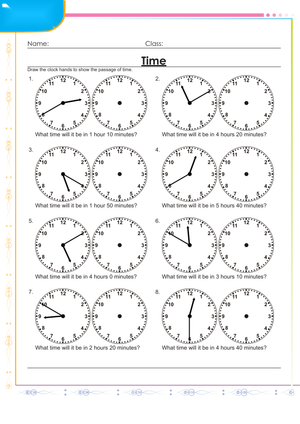
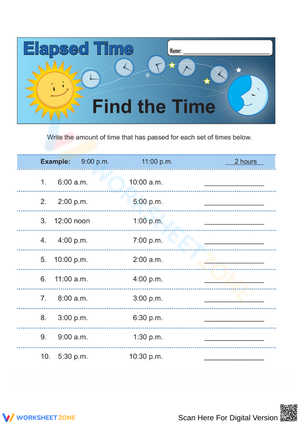
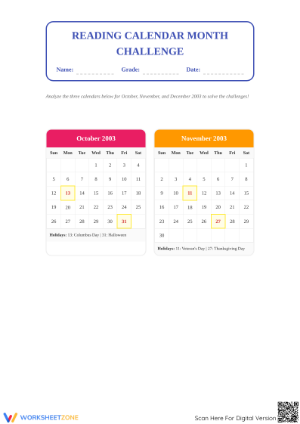
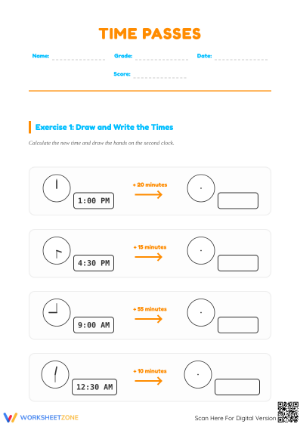
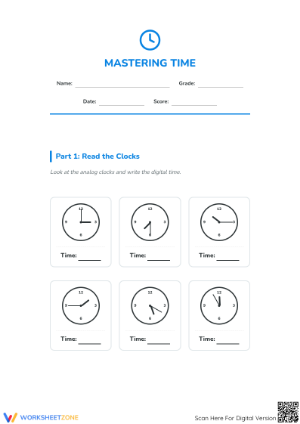
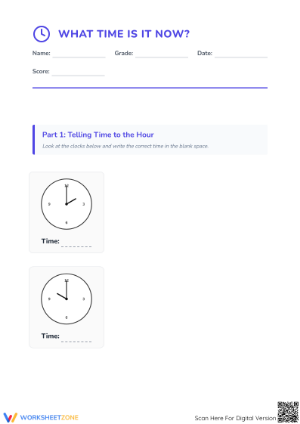
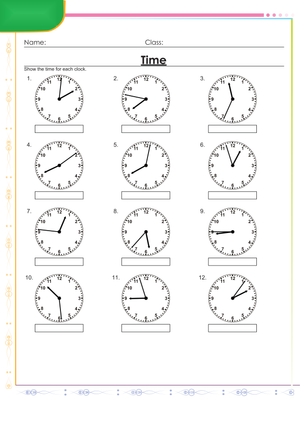
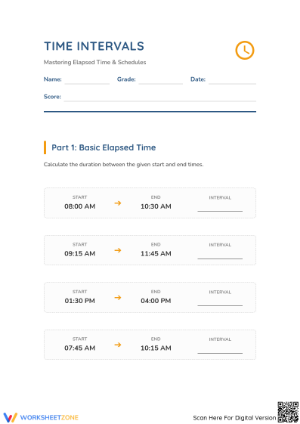
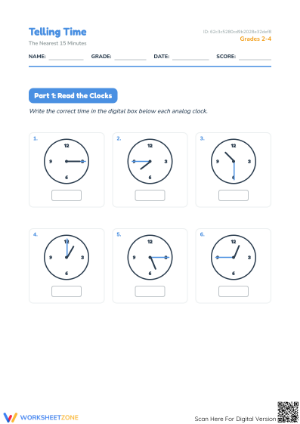
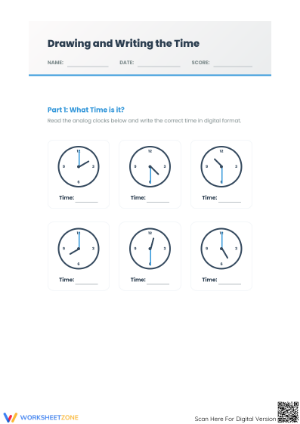
These 4th grade date and time printable worksheets cover the full skill arc from reading analog clocks to the nearest minute through solving multi-step elapsed-time problems that span the AM/PM boundary. Each worksheet targets a specific task, which gives teachers control over where to focus practice during a unit without wading through mixed content at the wrong moment. The set includes clock-reading exercises, digital-to-analog matching, calendar math, AM/PM interpretation, and word problems built around real schedules and daily routines.
Skills and Task Types Covered in the Set
Grade 4 is when time stops being about recognition and starts demanding reasoning. The worksheets address both levels:
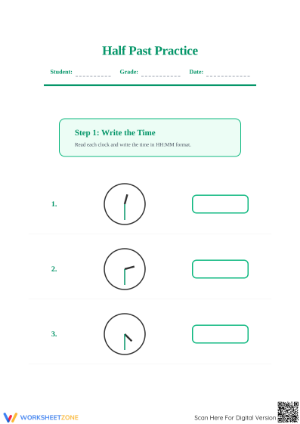
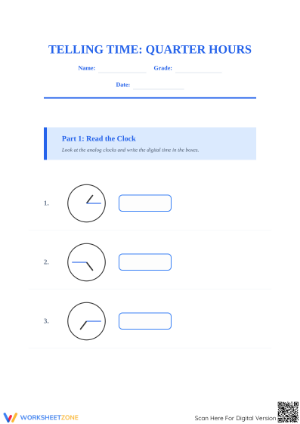
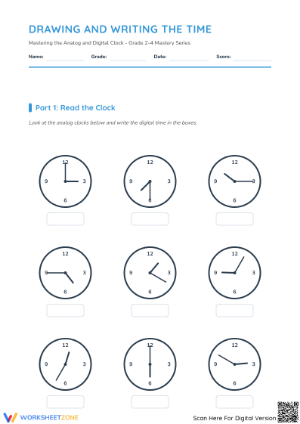
- Analog clock reading: students mark and record times to the nearest minute on clock-face diagrams
- Digital-to-analog matching: students draw hands on a blank clock face to match a given digital time, and reverse the process
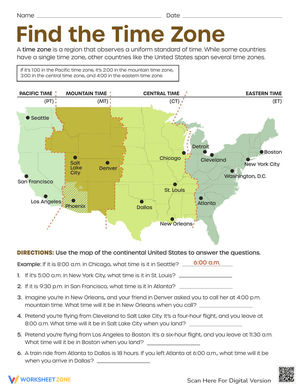
- Elapsed time: students find the interval between a given start time and end time
- Missing start or end time: students work backward from one known endpoint and an interval to find the other
- AM and PM: students assign the correct label using real-world events as anchors
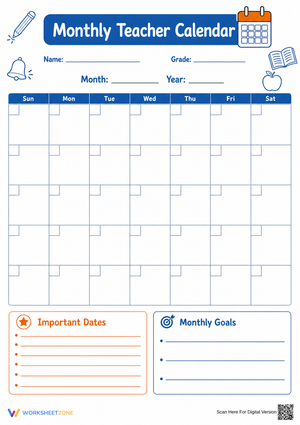
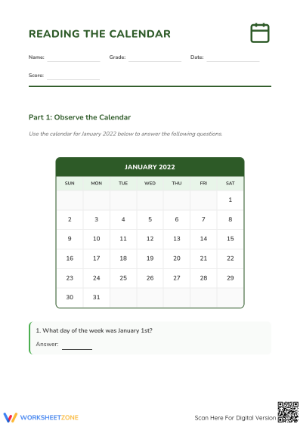
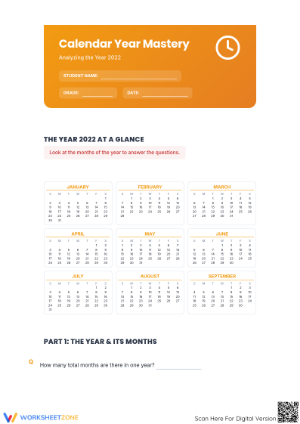
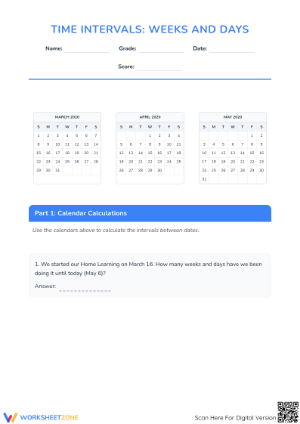
- Calendar math: locating specific dates, counting days between events, and identifying weekdays or weekends within a range
- Schedule-based word problems: multi-step problems that embed time calculations in realistic school and home scenarios
AM/PM problems deserve a separate note because they generate a predictable pattern of careless errors. Students who have no trouble saying school starts at nine in the morning will still write "9:00 PM" when moving quickly if they haven't paused to reason about the label. Worksheets that anchor the AM/PM choice to a real event — rather than presenting an abstract clock time and asking for a label — build that connection more reliably.
Student Errors Worth Catching Before They Compound
The errors we see most consistently in student work fall into two separate categories, and distinguishing them matters for instruction. The first is a reading error: a student misreads the minute hand by treating it the same way they'd read the hour hand — the hand points to 7 and they write 7 instead of 35. This is a visual tracking issue, not a conceptual one, and it gets addressed by returning to minute-mark counting before anything else. The second is a computational reasoning error: the student reads both times correctly but subtracts incorrectly across the hour boundary. Given a start time of 2:45 and an end time of 3:10, a student who stacks and subtracts often produces 65 minutes — they're applying base-ten logic to a base-sixty problem. Knowing which error a student is making tells a teacher exactly where to reteach.
Calendar counting produces a quieter but equally persistent mistake: students double-count the start date or drop the end date when tallying days between two events, landing one off in either direction. Walking through a model problem with a finger on a printed calendar — not a worksheet — resolves this faster than re-explaining the counting rule in the abstract.
Building These Worksheets Into a Teaching Week
Short, frequent practice beats occasional long sessions with time content. Ten minutes of clock and elapsed-time problems at morning work, three days running, will outpace a single forty-minute block once a week. Students need the repetition to lock in strategies, and teachers need it to catch recurring errors before the unit assessment arrives.
In a typical Grade 4 week, these worksheets fit naturally into at least three different slots. Morning work handles two or three review problems that revisit the previous day's skill — clock-face reading or calendar intervals work especially well here. Center rotations are a good place for analog clock tasks and calendar worksheets, where students can reference a model clock or a printed month at the station without disrupting the whole group. Exit tickets are where elapsed-time worksheets earn their keep: one or two problems at the end of a lesson reveal whether students took in the day's strategy or need re-teaching before the next session. Using 4th grade date and time printable worksheets that come in single-skill formats makes it easy to pull the right one for each slot without extra preparation time.
Standard Alignment
The foundational Common Core standard for this content is CCSS 3.MD.A.1, which requires students to tell and write time to the nearest minute and solve word problems involving time intervals in minutes. Fourth grade does not include a separate time standard in the CCSS framework, but elapsed time regularly resurfaces in Grade 4 instruction because third-grade mastery is uneven — many students arrive in fourth grade reading analog clocks slowly or still making systematic errors on elapsed-time problems. Several state standards frameworks address elapsed time and calendar skills explicitly at the fourth-grade level, including those in Texas and Florida. For CCSS teachers, these worksheets function as targeted spiral review and intervention support; for teachers in states with explicit Grade 4 time standards, the content maps directly to the measurement and data expectations at that level.
Tailoring the Practice for Different Student Readiness Levels
Students arrive at Grade 4 time work from very different places. Some learned elapsed time solidly in third grade and need only light review before moving on to multi-step applications. Others are still miscounting minute marks on analog clock faces, which means any elapsed-time problem will compound the difficulty. The same 4th grade date and time printable worksheets serve both groups when teachers select worksheets deliberately rather than assigning the full set in sequence.
For students who need more support, clock-reading worksheets with larger clock-face images and fewer problems per worksheet reduce visual and cognitive load. Starting elapsed-time practice with round-number intervals — whole hours, then half-hours — before introducing irregular minutes gives students a reliable mental model to build from. For students ready to go further, schedule-based word problems requiring two or three steps push them to apply time skills across multiple operations. These students can also work on problems that span midnight or that ask them to convert between hours and minutes, extending the concept without shifting to a different topic entirely.
Teachers can also vary the response format rather than the content. One group marks answers on a clock face or calendar; another writes out steps using a number line; a third explains their reasoning in a sentence. The underlying math stays constant — the level of visible thinking adjusts to match what each student needs to demonstrate.
Frequently Asked Questions
Do these worksheets cover elapsed time, or only clock reading?
The set includes both, along with calendar math and word problems. Clock-reading worksheets focus on reading analog and digital displays to the nearest minute. Elapsed-time worksheets ask students to find the interval between a start and end time. Missing-time worksheets reverse that process so students solve for an unknown endpoint. Calendar worksheets address date location and day-counting as a separate but related skill. Word problems weave these together using realistic scheduling contexts.
At what point in a unit should teachers introduce the word-problem worksheets?
After students can read analog clocks accurately and handle elapsed-time calculations with reasonable fluency. Assigning schedule-based word problems before those foundations are in place piles on difficulty in a way that makes it hard to diagnose where a student is actually stuck. Most teachers find the word-problem worksheets work best in the final phase of a unit or as enrichment during spiral review, once students can execute the individual skills reliably on their own.
How should teachers handle students who read digital clocks well but struggle with analog?
That gap is extremely common in Grade 4. The specific problem is almost always the minute hand — students read it as the numeral it points to rather than counting minute marks from twelve. Clock-reading worksheets that isolate the minute hand, paired with a brief demonstration of skip-counting by fives around the clock face, resolve most cases within a few practice sessions. Once students can accurately read analog times, the rest of the set becomes considerably more productive.
Are these worksheets practical for small-group intervention, or are they better suited to whole-class use?
They work well for intervention specifically because each worksheet addresses a single skill. An interventionist working with a student on elapsed time can pull only those worksheets without assigning clock-reading or calendar content the student has already handled. Short, focused sessions on one skill are more effective in intervention than mixed-review exercises that require students to toggle between unfamiliar tasks simultaneously. These 4th grade date and time printable worksheets make that kind of targeted small-group or pull-out work straightforward to plan and easy to track over time.













 Interactive Worksheet Maker
 Quiz Maker
 Word Search Maker
 Crossword Puzzle Maker
 Word Scramble Generator
 Sentence Scramble Generator
 Handwriting Worksheet Generator
 Name Tracing Generator
 Fill In The Blank Generator