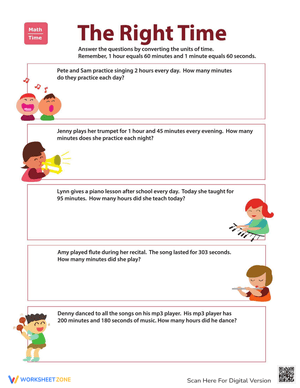
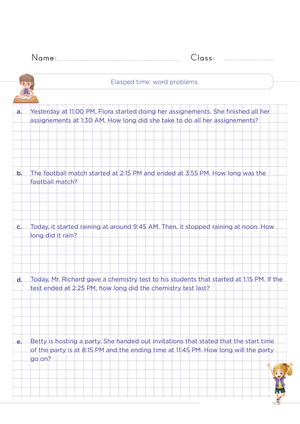
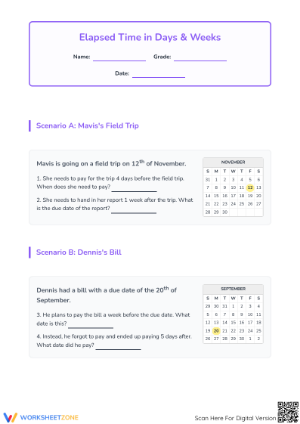
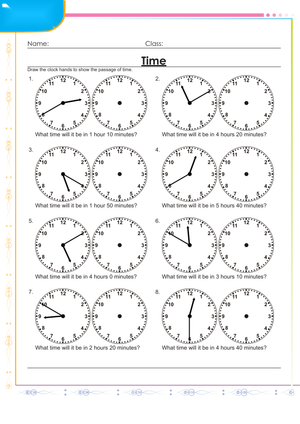
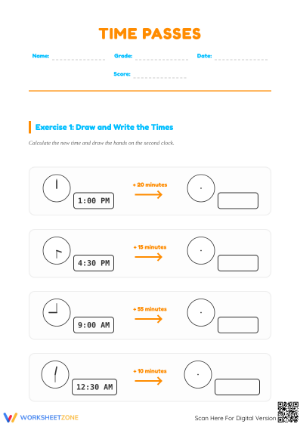
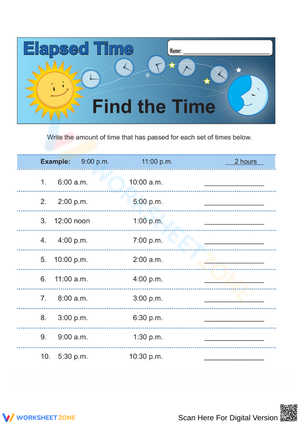
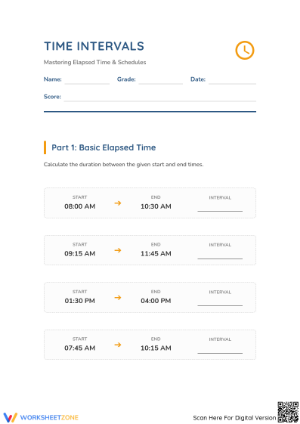
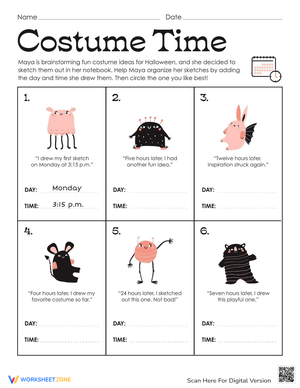
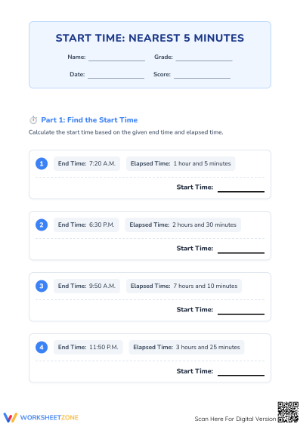
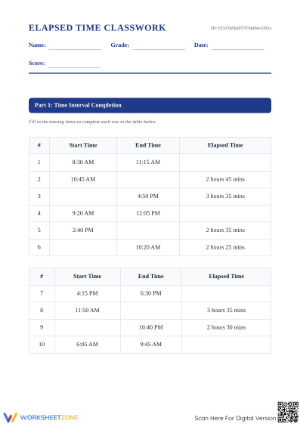
These elapsed time worksheets for 4th grade cover one of the more counterintuitive areas of elementary math — the gap between reading a clock accurately and actually computing how much time has passed between two points. The set includes analog clock-face problems, open number-line tasks, fill-in tables, word problems with real-world contexts, and multi-step calculations that cross AM and PM boundaries. Each worksheet stands alone, so teachers can assign exactly what a class needs rather than working through materials in a fixed sequence.
What's Inside the Set
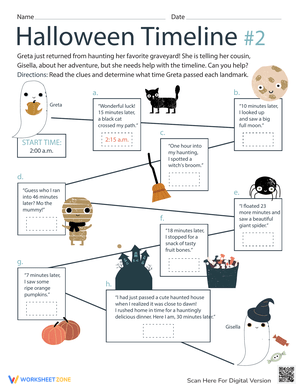
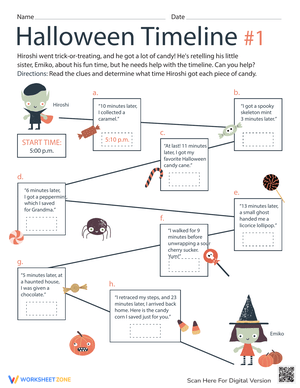
Across the elapsed time worksheets for 4th grade, five distinct problem formats give students repeated contact with the same underlying concept from different angles. This matters because students who master one format often stumble on another — a student who solves number-line problems with confidence may hesitate the first time identical information arrives inside a paragraph.
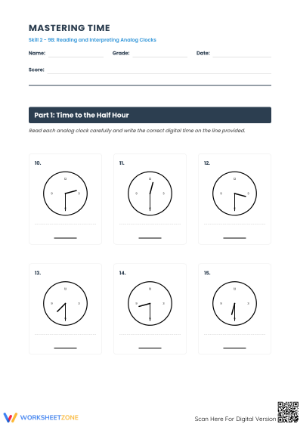
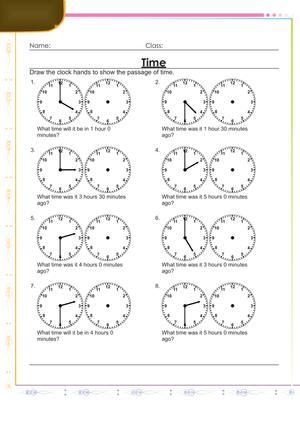
- Analog clock-face problems: Students read a clock showing a start time and determine the end time or elapsed duration. These surface students who are guessing at hand positions rather than reading the clock precisely — a distinction that matters for everything else in the unit.
- Open number-line problems: Students mark hops in friendly intervals between start and end times. Because the work is visible on the paper, teachers can see exactly where a student's reasoning breaks — whether it's an uneven interval, a miscounted hop, or stopping one step short of the endpoint.
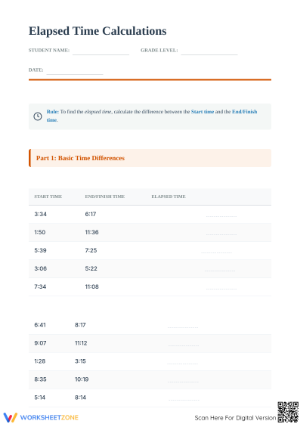
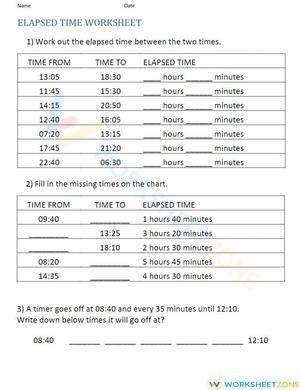
- Fill-in tables: Each row provides two of the three values — start time, end time, or elapsed duration — and students supply the missing one. The mixed direction within a single worksheet builds the habit of reading each problem before reaching for a strategy.
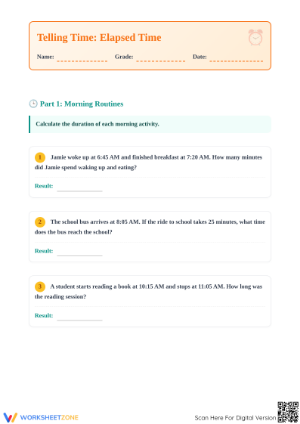
- Word problems: Contexts include school schedules, cooking times, travel, and after-school activities. The stronger problems require students to identify which values are given and which one is unknown before choosing a calculation approach — a step that reveals whether students are reasoning or just pattern-matching.
- Multi-step problems: Two elapsed-time calculations chained together in a single problem, matching the structure students encounter on 4th grade benchmark assessments.
Frequent Mistakes That Stall Progress
The most consistent error is applying base-10 subtraction to clock arithmetic. When a student needs to subtract 1 hour 50 minutes from 3 hours 20 minutes, the column-subtraction reflex produces 1:70 — borrowing as though an hour contains 100 minutes rather than 60. Number-line counting largely prevents this because students work in increments rather than stacking columns, but students with a strong written-algorithm habit will set down the number line mid-problem and reach for vertical subtraction anyway. This is worth naming out loud during instruction rather than assuming the format will handle it on its own.
Noon and midnight crossings are the other predictable trouble spot. A student who correctly identifies 12:00 PM as an interim hop on a problem running from 11:20 AM to 1:50 PM will sometimes stop recording AM/PM markers after the noon boundary and finish with a bare number — reporting the total without any label — uncertain whether the endpoint is PM or still AM. The confusion compounds on problems involving midnight, where students occasionally arrive at an answer that is exactly 12 hours off. Several worksheets in the set are built around noon-crossing problems precisely so students get deliberate repetition with that boundary before it appears under testing conditions.
Fitting These Worksheets Into Your Teaching Week
These elapsed time worksheets for 4th grade fit naturally at different points in the unit depending on which format each worksheet uses. Clock-face and basic number-line worksheets work well as independent practice immediately after direct instruction — when circulating, the most telling thing to watch is whether students draw their hops in even or uneven increments. Uneven hops usually mean a student is estimating rather than computing. Fill-in tables are reliable for math center rotations because they're self-contained and students can pace through them without waiting for redirection.
Word-problem worksheets land best mid-unit, once students have a stable strategy in place, so they can focus their attention on reading comprehension rather than splitting it between strategy recall and problem parsing. For a quick formative check in the last eight minutes of class, a three-problem number-line worksheet gives enough information to sort the room into two groups before the next lesson — those ready for AM/PM crossing problems and those who still need more practice with same-half-of-day intervals.
The Three-Hop Number-Line Approach
Students who struggle most often try to solve an elapsed time problem in a single mental move, which is exactly where errors accumulate. A more reliable routine breaks the calculation into three distinct hops: jump from the start time to the nearest whole hour and record that partial interval; count forward in full hours; then add the remaining minutes to reach the end time. Writing each hop value on the number line and summing separately keeps the calculation manageable even when the total elapsed time spans several hours. An anchor chart showing a labeled three-hop example — visible while students work through the worksheets — cuts down on the time students spend staring at a blank line before attempting anything, and it reinforces the habit until it runs automatically.
Standard Alignment
CCSS 4.MD.A.2 requires students to use the four operations to solve word problems involving quantities expressed in a single unit, including time intervals in hours and minutes. In most 4th grade pacing guides, elapsed time appears in the measurement unit after multiplication and division with whole numbers are secure — because multi-step time problems draw on both operations. The multi-step worksheets in this set are well-placed for that instructional window, and the single-operation worksheets provide the entry-point practice that makes the multi-step work accessible when students get there.
Pairing Worksheets to Student Readiness
The elapsed time worksheets for 4th grade span a wide enough complexity range that heavy modification is rarely necessary. For students still building accuracy, the clock-face worksheets and the number-line worksheets with pre-drawn interval markers let them practice the counting strategy without also having to construct the visual model from scratch. Keeping those students on problems with whole-hour or 30-minute intervals until the process runs automatically prevents the frustration that comes from too many variables at once.
Students ready for more can work through the multi-step word problems or any worksheet requiring conversion between hours and minutes within the calculation — for example, expressing a 90-minute duration as 1 hour 30 minutes before recording a final answer. One practical extension for students who finish early: have them write an original elapsed time problem using a blank template from the set, then trade with a partner and solve each other's version. Reversing the task forces a level of reasoning that standard fill-in problems do not require — students have to decide what information is necessary, what is extra, and whether their own problem is actually solvable.
Frequently Asked Questions
What elapsed time skills are expected by the end of 4th grade?
By the end of 4th grade, students should be able to find any one of three values — start time, end time, or elapsed duration — when the other two are given. They work with intervals expressed in hours and minutes, handle problems that cross noon or midnight, and solve multi-step scenarios. This extends the clock-reading work introduced in 2nd and 3rd grade and builds toward the broader measurement reasoning expected in 5th grade.
How do I help a student who keeps getting elapsed time problems wrong even after repeated practice?
Start by watching the strategy the student actually uses. If they're attempting column subtraction with clock times, move them back to the number line immediately — column subtraction applied to base-60 values produces reliable errors that additional practice alone will not correct. If they're using a number line but landing on the wrong answer, ask them to read their hops aloud. Most students identify the miscounted hop the moment they narrate it. The worksheets with pre-labeled number lines are especially useful here because the student's work is visible and specific rather than erased or reconstructed from memory.
Do these worksheets cover AM and PM problems?
Several worksheets include problems with both AM and PM times in the same calculation, specifically targeting the noon-crossing structure. These appear in the mid-to-late section of the set, after students have practiced with same-half-of-day intervals. Each worksheet that includes AM/PM problems stands independently — there is no requirement to complete earlier worksheets first if a student is already ready for that level of challenge.
Are these files ready to print?
Each worksheet downloads as a PDF at standard letter size and prints clearly in black and white, which keeps copying costs manageable when running full class sets. Because each worksheet is a separate file, teachers print only what they need for a given lesson or group rather than printing an entire collection at once.













 Interactive Worksheet Maker
 Quiz Maker
 Word Search Maker
 Crossword Puzzle Maker
 Word Scramble Generator
 Sentence Scramble Generator
 Handwriting Worksheet Generator
 Name Tracing Generator
 Fill In The Blank Generator