


























Views
Downloads

Printable Telling Time to 15 Minutes Worksheet | Grades 2-4
Paste this activity's link or code into your existing LMS (Google Classroom, Canvas, Teams, Schoology, Moodle, etc.).
Students can open and work on the activity right away, with no student login required.
You'll still be able to track student progress and results from your teacher account.
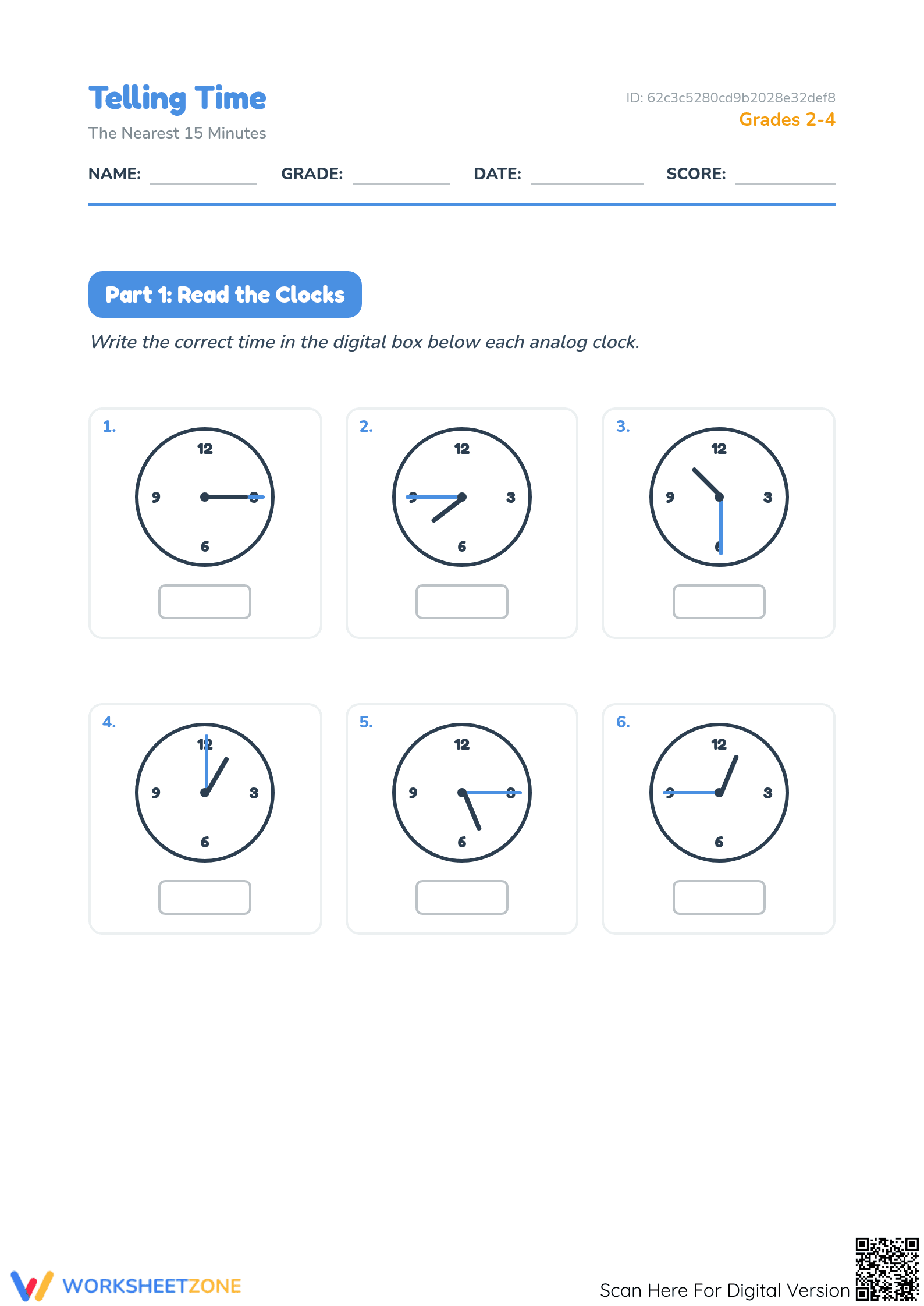
Mastering the clock is a fundamental life skill. This worksheet guides students through reading analog clocks to the nearest fifteen minutes, ensuring they can identify "quarter past," "half past," and "quarter to" intervals while effectively translating between analog and digital formats.
At a Glance
- Grade: 2–4 · Subject: Math
- Standard:
CCSS.MATH.CONTENT.2.MD.C.7— Tell and write time from analog and digital clocks to the nearest five minutes- Skill Focus: Telling time to the nearest 15 minutes (quarter-hour intervals)
- Format: 3 pages · 24 problems · Answer key included · PDF
- Best For: Independent math practice or substitute lesson plans
- Time: 25–35 minutes
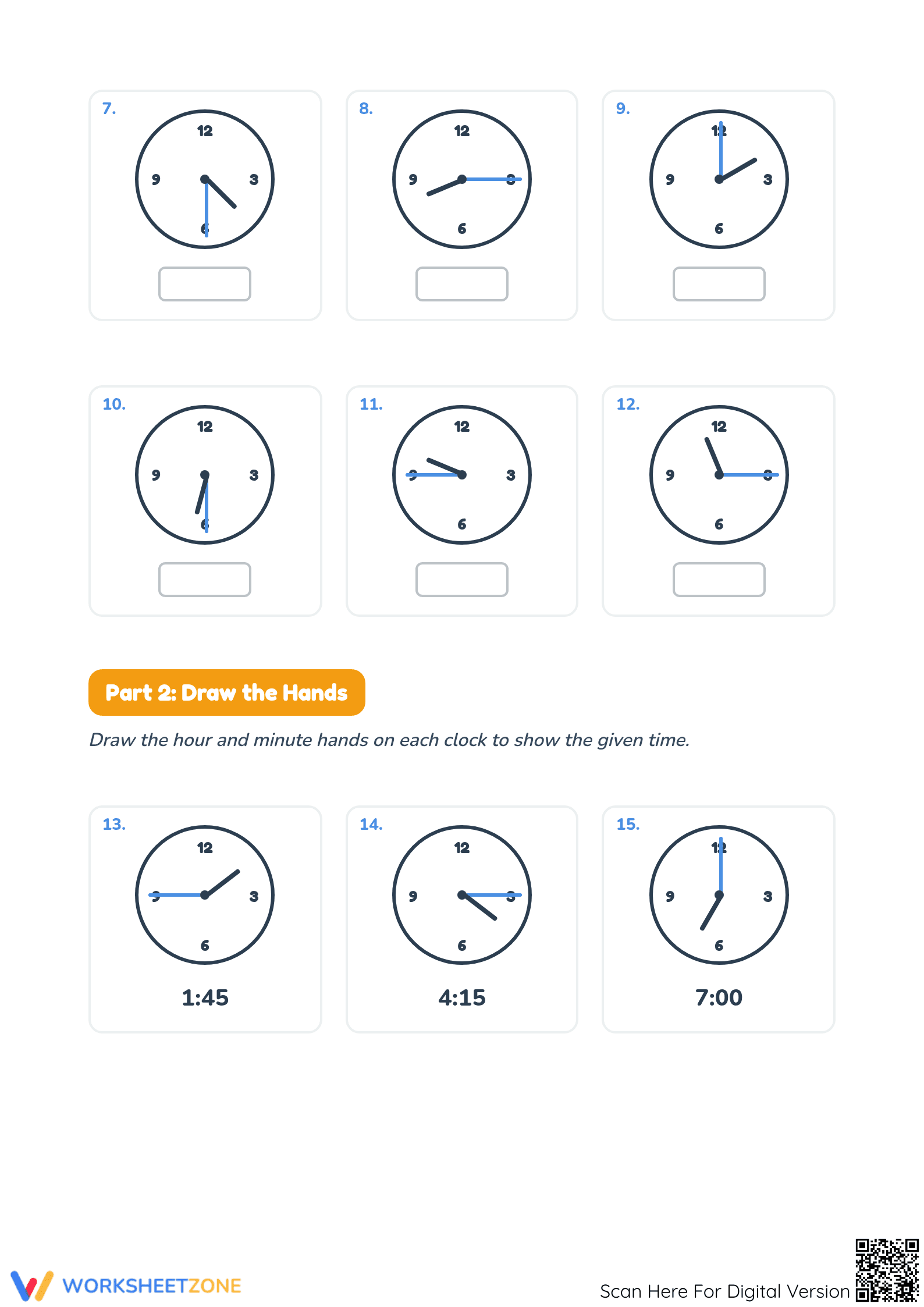
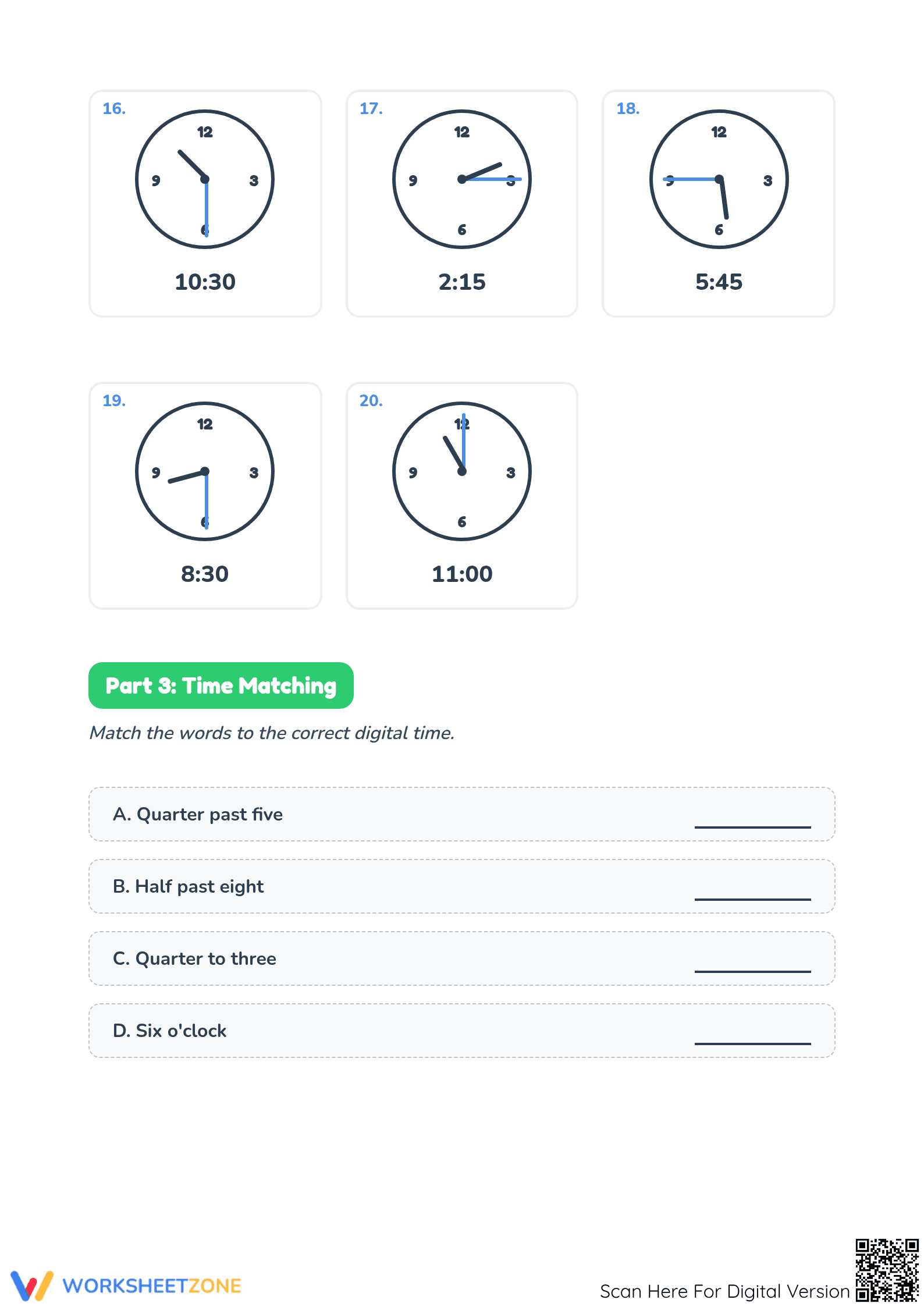
This three-page resource is organized into three parts. Part one features twelve clocks for reading analog faces and writing digital time. Part two requires drawing hands for eight times. Part three includes four word-based matching tasks to reinforce terminology like "quarter past" and "half past."
This resource offers a zero-prep workflow. Teachers can print the packet in seconds, distribute it immediately, and use the included answer key for rapid grading. The total preparation time is under two minutes, making it an ideal resource for substitute teachers or unexpected schedule changes.
Alignment is to CCSS.MATH.CONTENT.2.MD.C.7, requiring students to "tell and write time from analog and digital clocks to the nearest five minutes." This worksheet builds scaffolding for mastery of clock-reading. Standard codes can be copied directly into lesson plans, IEP goals, or district curriculum mapping tools.
Assign page one after a mini-lesson on quarter-hours to observe accuracy. Alternatively, use page three as an exit ticket to verify students internalized time vocabulary. The structured tasks allow for easy observation of whether students confuse hour and minute hand placement.
This is suited for second through fourth-grade students developing time-management skills. It serves as an intervention for older students or a practice set for younger learners. Pair this with a physical clock for a multi-modal learning experience.
The ability to accurately tell time to the nearest fifteen minutes is a critical developmental milestone that correlates with broader achievement in measurement and data domains. According to the Fisher & Frey (2014) Gradual Release of Responsibility framework, the shift from reading (observing) to drawing (constructing) and finally matching (categorizing) mirrors the cognitive progression required for long-term retention of complex procedural skills. Research indicates that frequent, low-stakes practice with varied formats—such as the 24 tasks provided in this resource—significantly reduces "clock-reading anxiety" and improves student fluency with non-decimal measurement systems. Furthermore, aligning these tasks to CCSS.MATH.CONTENT.2.MD.C.7 ensures that students are meeting nationally recognized benchmarks for mathematical proficiency. This specific focus on quarter-hour intervals provides a necessary bridge between whole-hour concepts and the minute-by-minute precision required in later grades, as highlighted in the EdReports 2024 curriculum reviews.


