


























Views
Downloads



Printable Telling Time to the Hour and Half Hour Worksheet
Paste this activity's link or code into your existing LMS (Google Classroom, Canvas, Teams, Schoology, Moodle, etc.).
Students can open and work on the activity right away, with no student login required.
You'll still be able to track student progress and results from your teacher account.
Mastering Time with Analog Clocks
Help your students build essential measurement skills with this comprehensive 14-task telling time collection. This five-page resource focuses on foundational clock reading, ensuring students can accurately identify positions of the hour and minute hands. By practicing both hour and half-hour increments, learners develop the temporal fluency needed for higher-level math and real-world scheduling independence.
At a Glance
- Grade: 2-4 · Subject: Math
- Standard:
CCSS.MATH.CONTENT.2.MD.C.7— Tell and write time from analog clocks to the nearest half hour.- Skill Focus: Telling time to the hour and half-hour
- Format: 5 pages · 14 problems · Answer key included · PDF
- Best For: Independent practice and formative assessment
- Time: 20–30 minutes
What's Inside
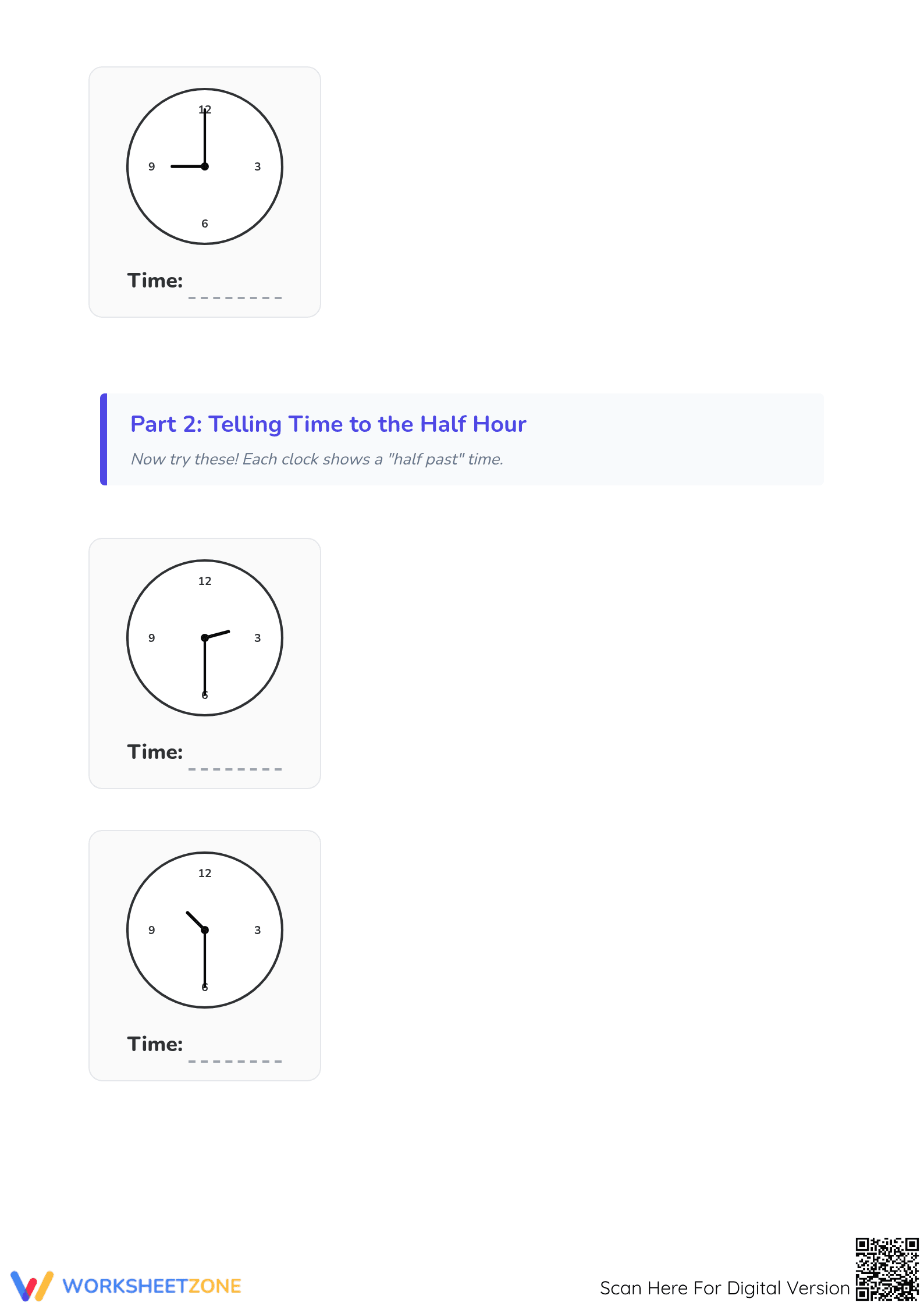
This instructional packet contains five structured pages designed to reinforce chronological awareness. Part 1 features 12 tasks dedicated to telling time to the hour, while Part 2 introduces the concept of the half-hour with two targeted problems. Each page provides large, clear analog clock faces with plenty of space for students to write their numerical answers, plus a full answer key for easy grading.
Zero-Prep Workflow
- Print: Select the pages needed for your lesson and print the PDF directly from your device (under 1 minute).
- Distribute: Hand out the worksheets for individual seatwork, math centers, or as a reliable sub-plan activity (under 1 minute).
- Review: Use the included answer key to quickly verify student accuracy or facilitate a peer-grading session (under 2 minutes).
Standards Alignment
This resource is primary aligned to `CCSS.MATH.CONTENT.2.MD.C.7`, which requires students to "tell and write time from analog and digital clocks to the nearest five minutes." This worksheet provides the essential scaffolding by focusing on hour and half-hour intervals. This standard code can be copied directly into lesson plans, IEP goals, or district curriculum mapping tools.
How to Use It
Use this set as a during-instruction activity to check understanding after a lesson on clock hands. Assign pages as morning work to keep skills sharp. During the activity, observe if students correctly identify the "half-past" position of the hour hand between two numbers. This is a key indicator of readiness for five-minute intervals. Completion takes 20-30 minutes.
Who It's For
This collection is ideal for second-grade students starting their time unit, or older learners requiring remediation. It serves as a perfect companion to a classroom demonstration clock. For fast finishers, challenge them to write the time for their next three daily activities.
According to RAND AIRS 2024, consistent exposure to analog clocks is vital for developing temporal reasoning skills in primary students. This Grade 2-4 worksheet aligns with CCSS.MATH.CONTENT.2.MD.C.7, focusing on the foundational skill of telling and writing time to the hour and half-hour. By requiring students to read clock faces and translate the position of the long and short hands into numerical time, the resource bridges the gap between visual spatial awareness and mathematical literacy. Fisher & Frey (2014) emphasize the importance of scaffolded practice in building fluency with complex measurement systems like time. This five-page collection provides 14 structured tasks that guide learners through the essential mechanics of clock reading. The inclusion of both whole and half-hour increments ensures a comprehensive introduction to the base-60 system. Educators can utilize this printable resource to provide rigorous, evidence-based practice that meets the diverse needs of elementary learners in diverse classroom settings.


