




























Views
Downloads
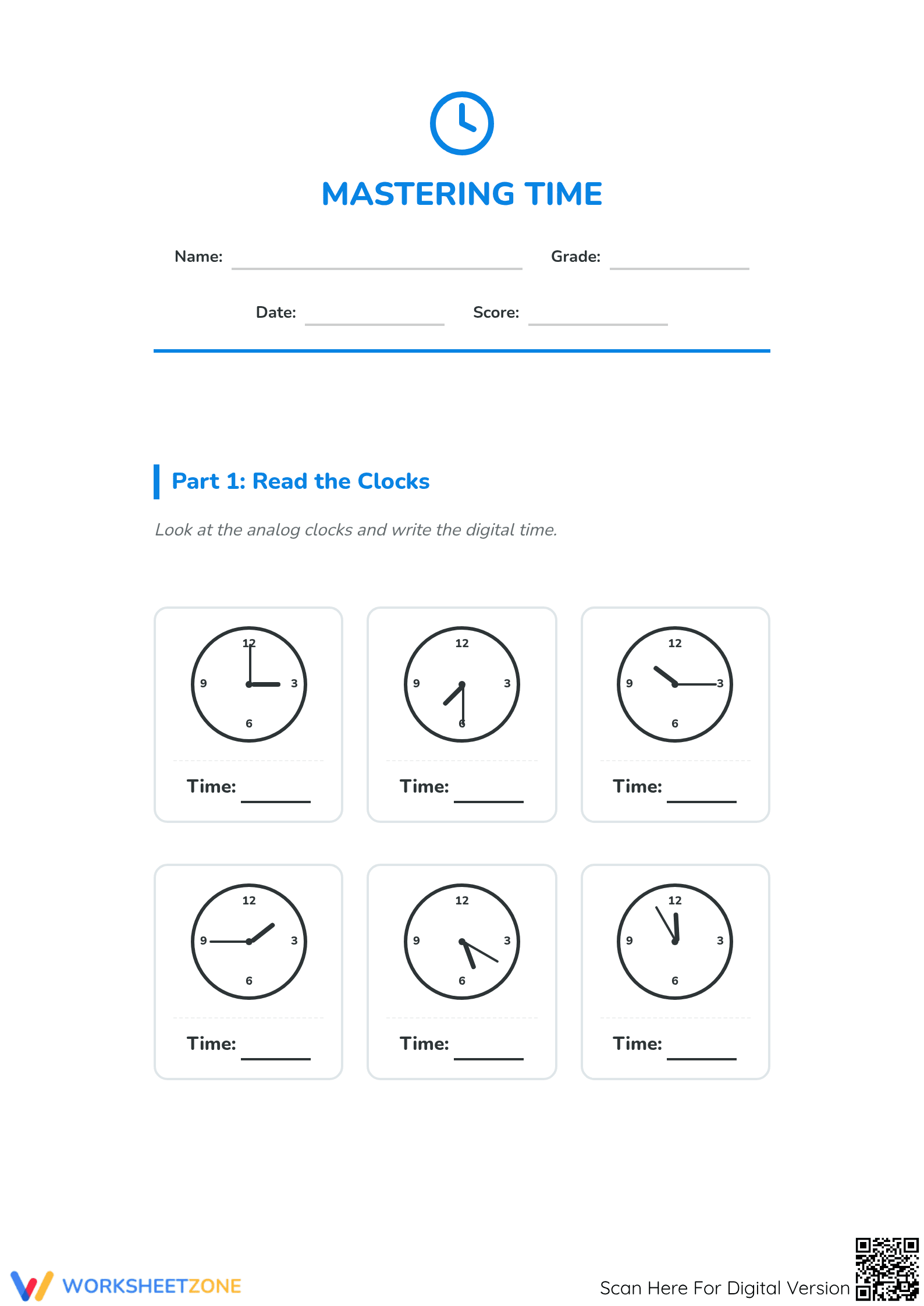



Printable Mastering Time Worksheet | Grade 2-5 Math

Paste this activity's link or code into your existing LMS (Google Classroom, Canvas, Teams, Schoology, Moodle, etc.).
Students can open and work on the activity right away, with no student login required.
You'll still be able to track student progress and results from your teacher account.
Mastering the concept of time is a critical developmental milestone for elementary students. This comprehensive worksheet provides a structured pathway for students to practice reading analog clocks, representing digital time visually, and solving real-world elapsed time challenges. By engaging with 21 distinct problems, learners build the cognitive fluency needed for daily scheduling and measurement.
At a Glance
- Grade: 3 · Subject: Math
- Standard:
CCSS.MATH.CONTENT.3.MD.A.1— Tell and write time to the nearest minute and solve time interval word problems- Skill Focus: Clock reading and elapsed time
- Format: 3 pages · 21 problems · Answer key included · PDF
- Best For: Independent practice or formative assessment
- Time: 25–35 minutes
What's Inside: This three-page instructional resource features four specialized sections. It begins with analog-to-digital identification, moves into drawing clock hands for specific timestamps, and concludes with multi-step word problems and verbal-to-digital matching. The layout includes clear clock faces and dedicated workspace for calculating time intervals, accompanied by a full answer key for immediate feedback.
Skill Progression
- Guided Identification: Students start with 6 analog clocks to decode, focusing on the relationship between the hour and minute hands in five-minute increments.
- Representational Drawing: Learners translate 6 digital times back onto analog faces, requiring precise placement of hands to show understanding of temporal orientation.
- Independent Application: The final sections challenge students with 5 word problems involving arrival times and duration, followed by 4 matching tasks to bridge vocabulary with numeric data.
This sequence follows a gradual-release model, moving from basic recognition to complex abstract reasoning.
Standards Alignment
This resource is aligned to CCSS.MATH.CONTENT.3.MD.A.1: "Tell and write time to the nearest minute and measure time intervals in minutes. Solve word problems involving addition and subtraction of time intervals in minutes." This standard code can be copied directly into lesson plans, IEP goals, or district curriculum mapping tools.
How to Use It
Use this worksheet as a summative assessment at the end of a measurement unit to verify student mastery of both analog and digital formats. Alternatively, assign Part 3 as a small-group challenge to observe how students calculate elapsed time during a school day. Completion typically takes 30 minutes, making it an ideal choice for a comprehensive math center activity.
Who It's For
This set is designed for Grade 2 through Grade 5 students, specifically those transitioning from simple hour-reading to complex interval calculations. It serves as an excellent resource for general education classrooms, RTI groups, or as a targeted intervention tool when paired with a physical manipulative clock for tactile support.
This resource aligns with CCSS.MATH.CONTENT.3.MD.A.1, focusing on telling time to the nearest minute and solving elapsed time word problems. Effective time instruction requires a transition from perceptual clock reading to conceptual interval measurement. Fisher & Frey (2014) emphasize the 'gradual release of responsibility' model, where students move from scaffolded clock identification to independent application in complex scenarios. By integrating 21 diverse tasks, including drawing hands and calculating school day duration, this worksheet reinforces the mental number line required for temporal reasoning. Research indicates that students who master both analog and digital representations demonstrate higher fluency in multi-step word problems involving schedules and arrival times. This curriculum-aligned tool provides the structured practice necessary for building these foundational life skills. It is designed to be extractable for lesson planning and curriculum mapping, ensuring students achieve the mastery required for upper elementary mathematics and real-world autonomy.


