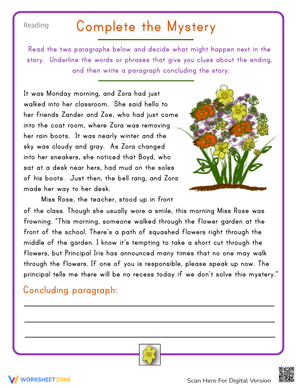
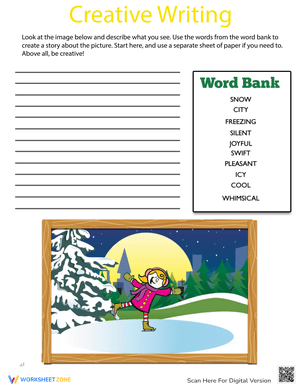
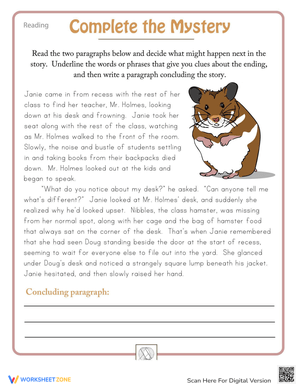
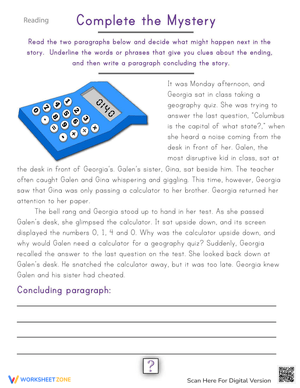
These 4th grade writing a strong ending worksheets give teachers a direct entry point into one of the most consistently weak spots in upper-elementary writing — the conclusion. Students who produce solid body paragraphs often collapse at the close, defaulting to "The End," copying their opening sentence back verbatim, or rushing out with something hollow like "So that is why dogs are the best pet." This set targets that pattern with exercises built around specific ending strategies, guided revision of weak closings, and graphic organizers that show writers what a conclusion is supposed to do before they draft one.
The Five Ending Strategies Students Practice
Each worksheet anchors practice around one or more of five ending types that work across the genres fourth graders write — narrative, informational, and opinion. Giving these types names matters as much as explaining them: students make better decisions when they can choose from a concrete menu rather than chase a vague directive to "write a stronger ending."
- Feeling ending: The writer names a specific emotion tied to the experience — not just "I was happy" but something earned, like "Relief washed over me the moment I heard my name called."
- Lesson-learned ending: The writer states what they came to understand. Works especially well in narrative and opinion pieces.
- Hope or wish ending: The writer looks forward, often effective in informational and persuasive writing where the author wants to leave the reader with a sense of possibility.
- Memory ending: The writer circles back to a detail introduced earlier — a specific object, image, or moment — creating a loop that readers find satisfying.
- Decision ending: The writer tells the reader what they will do next, or what they think the reader should do. Common in opinion writing but effective in narrative too.
Student Errors Teachers Need to Anticipate
The most common pattern is what teachers might call the summary-that-isn't: "I learned about the water cycle. The water cycle is important. I hope you liked my report." Each sentence is technically on topic, but together they don't conclude anything — they just stop. A related error shows up in feeling endings, where students stay so vague the emotion carries no weight: "It was amazing" or "I felt good" rather than a specific feeling connected to a specific moment. When students see these examples named and labeled on a revision worksheet, they start catching the same patterns in their own drafts.
Opinion writers have their own version. A fourth grader who argues confidently through three body paragraphs will sometimes undercut everything with a hedged final line: "So maybe schools should think about having longer recess if they feel like it." That one word — maybe — erodes the conviction built throughout the body. The before-and-after revision worksheets ask students to identify that exact weakness and then rewrite with more authority.
How to Work These Worksheets Into Your Writing Unit
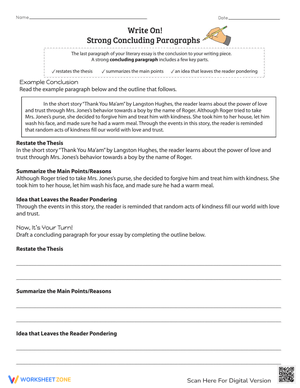
A five-day sequence fits most fourth-grade writing blocks and moves students from observation to application without rushing the skill. Day one is mentor text work: read two or three short published pieces aloud, ask students to identify which ending strategy the author chose, and chart the results on an anchor chart that stays posted for the rest of the unit. Day two uses the graphic organizer worksheet — a layered format that separates the restated main idea, a brief summary of key evidence, and the final thought or feeling. Modeling the fill-in process with a class-generated topic before releasing students independently prevents most writers from stalling.
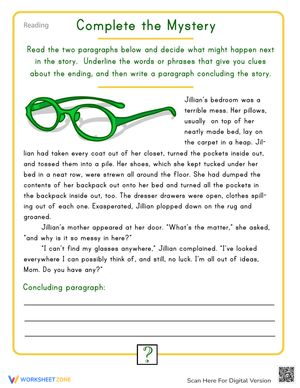
Day three is revision. The before-and-after worksheet presents the kind of weak endings students actually write — "Then I went to sleep" or "That is why I think this is important" — and asks them to rewrite each one using a named strategy. Pairs work well here because students catch weakness more reliably in someone else's writing than in their own. Days four and five move into students' own current pieces. The 4th grade writing a strong ending worksheets set includes a peer checklist for day five: each writer reads only their conclusion aloud while a partner decides whether the main idea of the whole piece comes through from the ending alone. That single check builds audience awareness more efficiently than a full peer-editing conference does.
Genre matters when selecting worksheets from this set. Narrative endings reach toward emotion or personal growth; informational endings restate the thesis in fresh language and draw together key evidence; opinion endings frequently close with a direct call to action. Each worksheet is labeled by writing type, so teachers can match it to whichever genre is currently on the writing calendar without any additional preparation.
Adjusting the Set for Different Writers in the Room
Emerging writers benefit from sentence starters printed directly on the worksheet — frames like "I felt ___ because ___" or "From that experience, I decided to ___" remove the blank-page problem without removing the thinking. On-level writers use the standard graphic organizer and revision sheets as written. The 4th grade writing a strong ending worksheets files are print-ready, so running two or three versions in a single print session requires no extra prep beyond deciding which version each student receives.
Advanced writers get the most out of a challenge version: write two different endings for the same piece using two different named strategies, then write three or four sentences explaining which ending is stronger and why. That metacognitive step produces more growth than a second revision of the same ending, and it generates strong material for a closing class discussion.
Standard Alignment
These worksheets address W.4.1c (provide a concluding statement or section related to the opinion presented), W.4.2e (provide a concluding statement or section related to the information or explanation presented), and W.4.3e (provide a conclusion that follows from the narrated experiences or events). All three standards target the same underlying competency — ending a piece with intention — which is why one genre-spanning set covers all of them within a single unit. In classroom terms, these worksheets belong in the organization and structure portion of the writing block, typically after students have established control of topic sentences and body paragraphs but before independent publishing work begins.
Frequently Asked Questions
How do I help students stop writing "The End" or other generic closings?
The fastest fix is establishing a named menu of alternatives before students draft. When students know that a "feeling ending" and a "lesson-learned ending" are real, chooseable options, "The End" loses its grip as the default. The revision worksheets reinforce that shift by showing weak endings side by side with stronger rewrites, each labeled with the specific strategy used.
How do narrative conclusions differ from informational and opinion conclusions in fourth grade?
Narrative conclusions are personal and reflective — they reach for a specific emotion or a moment of growth. Informational conclusions restate the main idea in fresh wording and draw together key evidence. Opinion conclusions reinforce the writer's position and often close with a direct call to action. Each worksheet addresses one writing type separately, so students learn that ending well means adapting the same skill to different purposes rather than applying one formula across the board.
Do these worksheets work as homework, or are they better used in class?
The graphic organizer and revision worksheets work best as guided or partner practice the first time students encounter a new ending strategy — they need to see it applied before working independently. After that initial in-class session, the same worksheet format transfers well to homework or center work. Teachers who need to use this set of 4th grade writing a strong ending worksheets resources as take-home practice typically introduce each worksheet type during the lesson first, then send home a parallel version for reinforcement.
What graphic organizer format works best for teaching concluding paragraphs?
The layered organizer — sometimes called a "conclusion hamburger" — gives each part of the conclusion its own visual space: the restated main idea at the top, the supporting summary in the middle, and the final thought or feeling at the bottom. A transition-word bank printed alongside it helps students connect the layers without interrupting their drafting to search for the right phrase.












 Interactive Worksheet Maker
 Quiz Maker
 Word Search Maker
 Crossword Puzzle Maker
 Word Scramble Generator
 Sentence Scramble Generator
 Handwriting Worksheet Generator
 Name Tracing Generator
 Fill In The Blank Generator




 BACK TOSCHOOL