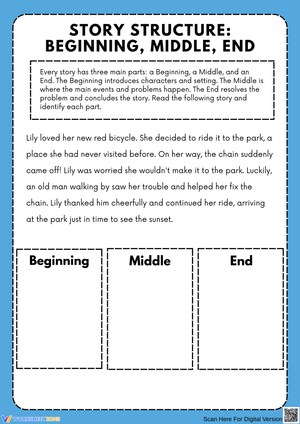
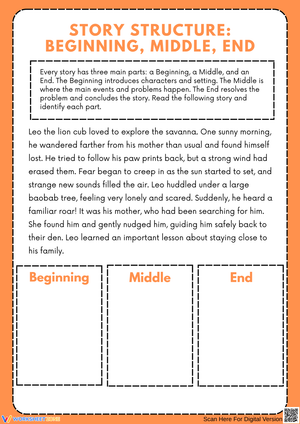
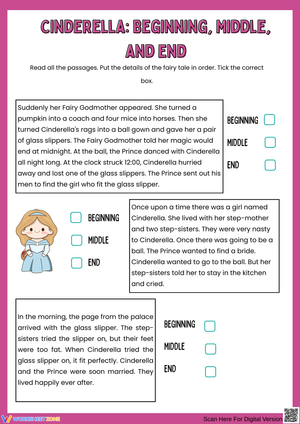
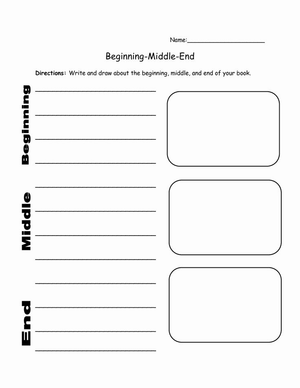
Fourth grade students walk into narrative writing with big story ideas and very little sense of how to organize them on the page. A beginning-middle-end worksheet gives them a low-stakes place to sort those ideas before a single sentence of the actual draft gets written. Rather than staring at a blank page, students fill in three boxes or sections, and suddenly a sprawling idea about a soccer tournament or a family road trip becomes something they can actually write toward.
Why Beginning Middle End Structure Needs for 4th Graders
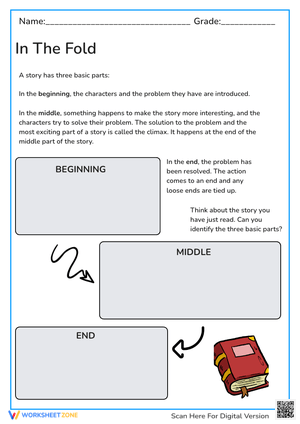
Fourth grade is the year narrative writing expectations jump. Students are asked to do more than tell what happened; they need to orient a reader, build an event sequence that unfolds naturally, and land on an ending that actually follows from the story. A beginning-middle-end worksheet breaks that big ask into three manageable questions: How does the story start? What happens in the middle? How does it end? That structure matches the way CCSS.ELA-LITERACY.W.4.3 frames narrative writing, which calls for students to write narratives using effective technique, descriptive details, and clear event sequences.
W.4.3.a specifically calls for orienting the reader by establishing a situation and introducing characters or narrators, then organizing an event sequence that unfolds naturally from there. A beginning-middle-end worksheet operationalizes that exact standard: the beginning box asks students to set the scene and introduce who is in the story, the middle box asks them to sequence the key events, and the end box asks them to resolve the situation. Teachers do not need to explain the abstract standard language to students at all; the worksheet format already does that translation work for them.
Building In Transitional Language
Structure alone does not make a narrative flow. W.4.3.c requires students to use a variety of transitional words and phrases to manage the sequence of events, things like first, next, meanwhile, and finally. Pairing a beginning-middle-end worksheet with a short list of these transition words gives students a toolkit they can pull from as they move between sections. Some teachers add a transition word bank directly onto the worksheet itself, sorted loosely by where in the story each word tends to appear.
It also helps to spend five minutes before independent writing time pointing out that a story does not need to introduce every transition word in a list. Overusing them, stacking first, then, next, after that, finally into every paragraph, can make a narrative feel mechanical. The goal is variety and natural placement, not a checklist.
Classroom Implementation
A practical routine looks like this: introduce the organizer with a shared story the class already knows, filling in the three boxes together as a model. Next, have students complete an organizer independently or in pairs using their own story idea, keeping the boxes short, just phrases or a sentence or two rather than full paragraphs. Confer briefly with students whose organizers show a gap, particularly a missing or rushed ending. Only after the organizer is reasonably solid should students move to drafting full paragraphs from each section. Keep organizers on hand as a reference students can return to mid-draft if they lose track of where their story is headed.
Frequently Asked Questions
1. How do beginning-middle-end worksheets align with 4th grade CCSS narrative writing standards?
They translate the sequencing and orientation requirements of CCSS.ELA-LITERACY.W.4.3 into a concrete three-part planning structure, giving students a scaffold for meeting the standard's expectations around establishing a situation, organizing events, and reaching a logical conclusion.
2. How should teachers introduce beginning-middle-end structure before a full narrative writing unit?
Model the organizer with a familiar shared story first, filling in each section as a class, before asking students to apply the same structure independently to their own story ideas.
3. What transitional words should 4th graders use to connect beginning, middle, and end sections?
Words like first, next, meanwhile, and finally, as outlined in W.4.3.c, help students manage the sequence of events. A short word bank tied to each section of the organizer gives students easy access to this language without overusing it.
4. How can beginning-middle-end worksheets be used for struggling writers or small-group intervention?
In small groups, teachers can use the organizer to target a specific gap, such as a weak or missing ending, working through a few examples together and talking through the reasoning out loud before students try one independently.
5. How do beginning-middle-end worksheets differ from full five-paragraph narrative organizers?
Beginning-middle-end organizers are an earlier, simpler prewriting step focused only on sequencing the story at a high level, while five-paragraph organizers ask students to plan out specific paragraphs, transitions, and often craft elements in more detail.












 Interactive Worksheet Maker
 Quiz Maker
 Word Search Maker
 Crossword Puzzle Maker
 Word Scramble Generator
 Sentence Scramble Generator
 Handwriting Worksheet Generator
 Name Tracing Generator
 Fill In The Blank Generator




 BACK TOSCHOOL