


























Views
Downloads
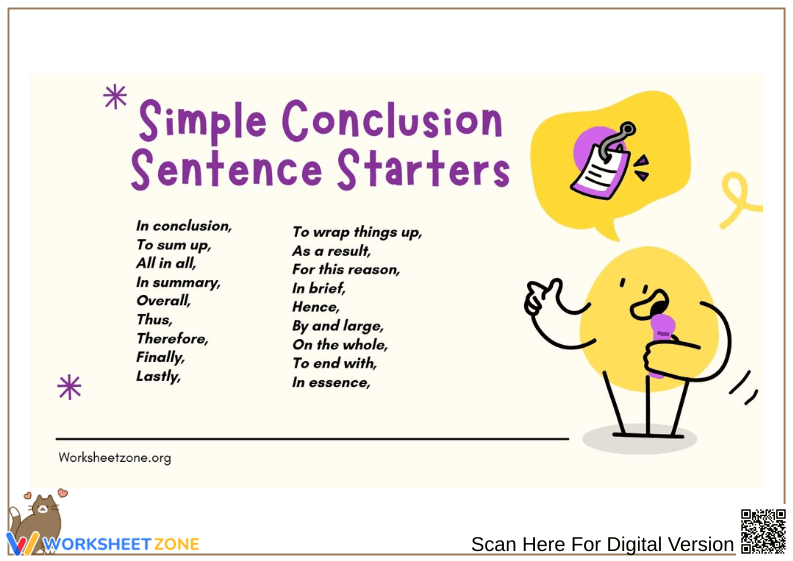

Essential Conclusion Sentence Starters | Grades 3-5
Paste this activity's link or code into your existing LMS (Google Classroom, Canvas, Teams, Schoology, Moodle, etc.).
Students can open and work on the activity right away, with no student login required.
You'll still be able to track student progress and results from your teacher account.
This printable writing reference sheet helps elementary students craft strong concluding sentences for essays and paragraphs. By providing structured transition options, the resource supports students in summarizing their main points and delivering clear closure. Writers use these transition phrases to signal the end of their composition, improving overall organization and readability.
At a Glance
- Grade: 3-5 · Subject: Writing Organization
- Standard:
CCSS.ELA-LITERACY.W.4.2.E— Provide a concluding statement or section related to the information presented- Skill Focus: Conclusion transitions
- Format: 1 page · 18 transition phrases · Reference chart · PDF
- Best For: Writing workshop anchor chart
- Time: 5–10 minutes
This single-page PDF contains 18 carefully selected transition phrases designed for elementary writers. The layout features two columns of clear, legible text, making it highly accessible for young learners. It includes common starters like "In conclusion" alongside more sophisticated options such as "Therefore" and "On the whole." The clean design serves as a distraction-free visual aid.
Teachers can integrate this resource into their daily writing routine with zero preparation. First, print the single-page PDF or display it digitally on a projector screen in under 1 minute. Second, distribute copies to students to place in their writing folders, taking less than 1 minute. Third, review the list during a brief 2-minute mini-lesson, highlighting how to select different starters. This workflow requires less than 2 minutes of total teacher setup time, making it an ideal tool for sub plans or quick writing warm-ups.
This resource aligns directly with CCSS.ELA-LITERACY.W.4.2.E, which requires students to provide a concluding statement or section that supports the information presented. It also supports CCSS.ELA-LITERACY.W.3.1.D and CCSS.ELA-LITERACY.W.5.1.E by helping students establish clear organizational structures. Both standard codes can be copied directly into lesson plans, IEP goals, or district curriculum mapping tools.
Use this reference sheet during the drafting or revising phase of the writing process. During direct instruction, model how to replace repetitive transitions with options from the list. For a quick formative assessment, observe students during independent writing and check if they can select an appropriate starter that matches their paragraph's context. The activity takes 5 to 10 minutes to introduce.
This resource is designed for students in grades 3, 4, and 5 who need visual scaffolding during independent writing. It is particularly beneficial for English language learners and struggling writers who require concrete sentence frames. Pair this anchor chart with a persuasive writing prompt or an informational text graphic organizer to maximize student output.
This writing reference tool aligns with evidence-based practices for teaching writing organization, specifically targeting the transition from body paragraphs to final conclusions. According to the Fisher & Frey (2014) framework for gradual release of responsibility, providing structured scaffolds like sentence starters helps novice writers transition from guided practice to independent mastery. By offering 18 distinct transition options, the resource prevents repetitive language and encourages students to analyze the relationship between their evidence and final thoughts. This scaffold supports the development of cohesive text structures, which is a critical indicator of writing proficiency in elementary standards. Educators can utilize this tool to support diverse learners, ensuring all students have access to the academic vocabulary necessary for formal writing. The clear layout makes it a reliable reference for daily writing workshops.


