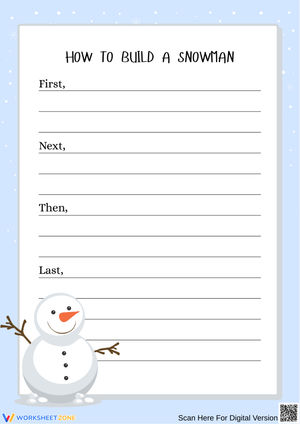
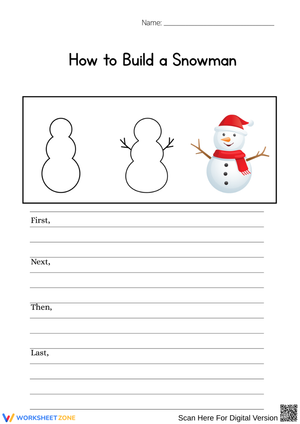
These informational writing printable worksheets for 4th grade give teachers a set of standalone, print-ready resources that address every major component of W.4.2 — topic introduction, body paragraph development, transition language, and concluding statements. Each worksheet targets a specific move in the informational writing process, so teachers can assign exactly what a lesson needs without following a fixed sequence.
The Specific Skills Each Worksheet Targets
W.4.2 is not a single skill — it's a cluster of interdependent writing moves that students have to develop in combination. Each worksheet isolates one of those moves while keeping the larger purpose visible: producing clear, fact-based explanatory text for a real audience.
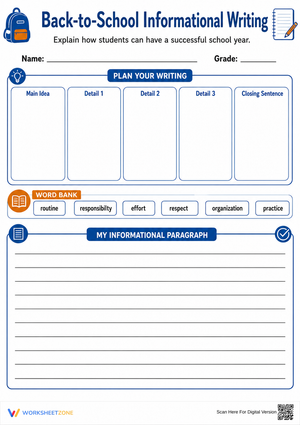
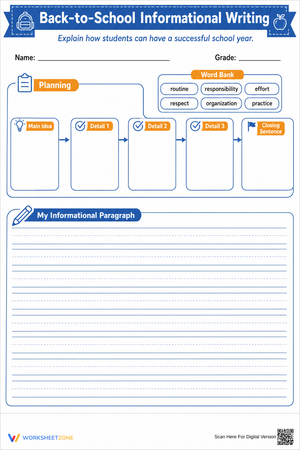
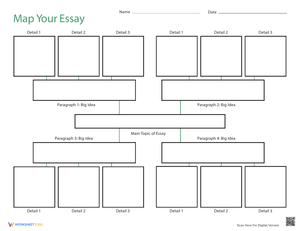
- Graphic organizer planning sheets: Labeled sections walk students through the introduction, two or three body sections with evidence slots, and a conclusion prompt. Each slot specifies whether the detail should come from a source or can draw on prior knowledge, so students don't fill the organizer with opinion by accident.
- Transition word practice: Students choose, insert, or revise linking language — moving beyond "also" and "and then" toward phrases like "as a result," "in contrast," and "to illustrate" — within authentic-sounding informational passages.
- Fact vs. opinion sorting: Each worksheet in this category presents 12 to 15 mixed statements. Students label each one and, in the more demanding version, revise the opinion statements into verifiable factual claims.
- Concluding statement practice: Students receive a completed body paragraph and write a conclusion that summarizes key information without copying the topic sentences word-for-word — a constraint that forces genuine synthesis rather than repetition.
- Self-editing checklists: Criteria mapped directly to W.4.2 sub-standards let students evaluate their own drafts before turning anything in, and the same checklist doubles as a peer review tool during revision.
Errors Worth Watching For Before Students Draft
The most persistent error in 4th grade informational writing is not weak transitions or a missing conclusion — it's the blur between opinion and fact at the sentence level. A student will write "Dolphins are amazing creatures" in what is supposed to be an informational opening, and genuinely not recognize that "amazing" is a judgment rather than a characteristic. The fact vs. opinion sorting worksheet catches this pattern before it runs through an entire draft. Once students have worked through 15 labeled statements, they read their own opening sentences with noticeably sharper eyes.
The second pattern worth flagging: students who have learned to write topic sentences will still front-load every body paragraph with the same phrase — "Another fact about [topic] is that..." Three consecutive body paragraphs starting with "Another fact" signals that the student absorbed a formula rather than developed real organizational thinking. The transition worksheets address this by requiring varied linking language, but teachers should name that pattern explicitly during the checklist conference rather than leaving students to discover it on their own.
Fitting These Worksheets Into the Writing Block
The fact vs. opinion worksheet runs cleanly as an 8-minute bell-ringer before the writing mini-lesson. By the time direct instruction on evidence selection begins, students have already made one pass at distinguishing facts from judgments, and the concept lands faster. The graphic organizer works best during the prewriting phase after a mentor text read-aloud — give students 15 to 20 minutes to fill it in so you can collect and check their plans before they're halfway through a first draft that will need to be restructured.
One sequencing move worth building into your routine: project a short informational passage and have students circle every transition word before they touch the practice worksheet. Students who see linking language in an authentic text before working on isolated exercises transfer the skill more reliably than those who complete the worksheet cold. Teachers working through a two-week informational writing unit can use these informational writing printable worksheets for 4th grade in a natural arc — the planning organizer and fact-sorting worksheet in week one, the transition practice and self-editing checklist in week two once students have a draft to evaluate.
Standard Alignment
Each worksheet maps to a specific sub-standard within CCSS.ELA-LITERACY.W.4.2. The planning organizer addresses W.4.2a, which requires students to introduce a topic clearly and group related information in paragraphs and sections with possible headings — a structural demand that appears for the first time at Grade 4 and was not present in W.3.2. That developmental jump is why a visible organizational structure matters at this grade: students are being asked to think in sections for the first time, and they need a concrete model of what that looks like before they can produce it independently. The transition worksheets target W.4.2c; the fact vs. opinion sort and evidence-selection work address W.4.2b; the concluding statement worksheet addresses W.4.2e. All of these informational writing printable worksheets for 4th grade include a standards tag so teachers can document alignment in lesson plans without additional cross-referencing.
Adjusting These Worksheets Across Ability Levels
The fact vs. opinion worksheet has two tiers built into its design: the basic task asks students only to label each statement; the extended task asks them to rewrite opinion statements as factual ones. That revision work is considerably harder and keeps faster finishers productively occupied without requiring a separate resource.
For students who need more structured support, the graphic organizer becomes more accessible when sentence starters are added to each section — "My topic is..." for the introduction, "One important fact is..." for the first body section. That language support focuses cognitive effort on selecting relevant information rather than on generating sentence structure from scratch. English learners benefit from a printed word bank of key vocabulary attached to the planning organizer; if the class is writing about animal adaptations, a short list of terms (camouflage, habitat, predator, behavior) at the top of the worksheet removes the friction of stopping mid-planning to search for spelling.
Students working above grade level can be required to cite at least two sources in their body sections and to include a text feature — a labeled diagram, a glossary entry, or a sidebar — in their final piece. The self-editing checklist can be extended for this group with an additional criterion for domain-specific vocabulary, nudging the task toward W.4.2d in a way that previews what 5th grade will demand.
Frequently Asked Questions
Are these worksheets topic-specific, or can they be used for science and social studies writing?
The graphic organizers and planning sheets are topic-neutral — they work with any informational subject. The fact vs. opinion sorting worksheets use general statements rather than content-area passages, so they transfer to science, social studies, or any other context where students are writing to explain or inform.
Do these work as station activities without direct teacher oversight?
The fact vs. opinion sorting worksheet and the self-editing checklist both run independently at a station. The graphic organizer works better when a mini-lesson has already introduced the task, because students who have not received instruction on what "supporting details" means will fill the evidence slots with thin or off-topic notes. Front-load the instruction, then send students to the station with the organizer.
Are these appropriate for 3rd graders working ahead or 5th graders reviewing foundational skills?
Third graders working ahead can use the planning organizer and transition sheets; the concluding statement worksheet may be a stretch because W.3.2 does not require a formal concluding statement or section. Fifth graders reviewing foundational informational structure will find these informational writing printable worksheets for 4th grade a workable starting point before moving on to W.5.2 expectations, which add a stronger emphasis on elaboration and a more systematic requirement for domain-specific vocabulary within body sections.












 Interactive Worksheet Maker
 Quiz Maker
 Word Search Maker
 Crossword Puzzle Maker
 Word Scramble Generator
 Sentence Scramble Generator
 Handwriting Worksheet Generator
 Name Tracing Generator
 Fill In The Blank Generator




 BACK TOSCHOOL