


























Views
Downloads
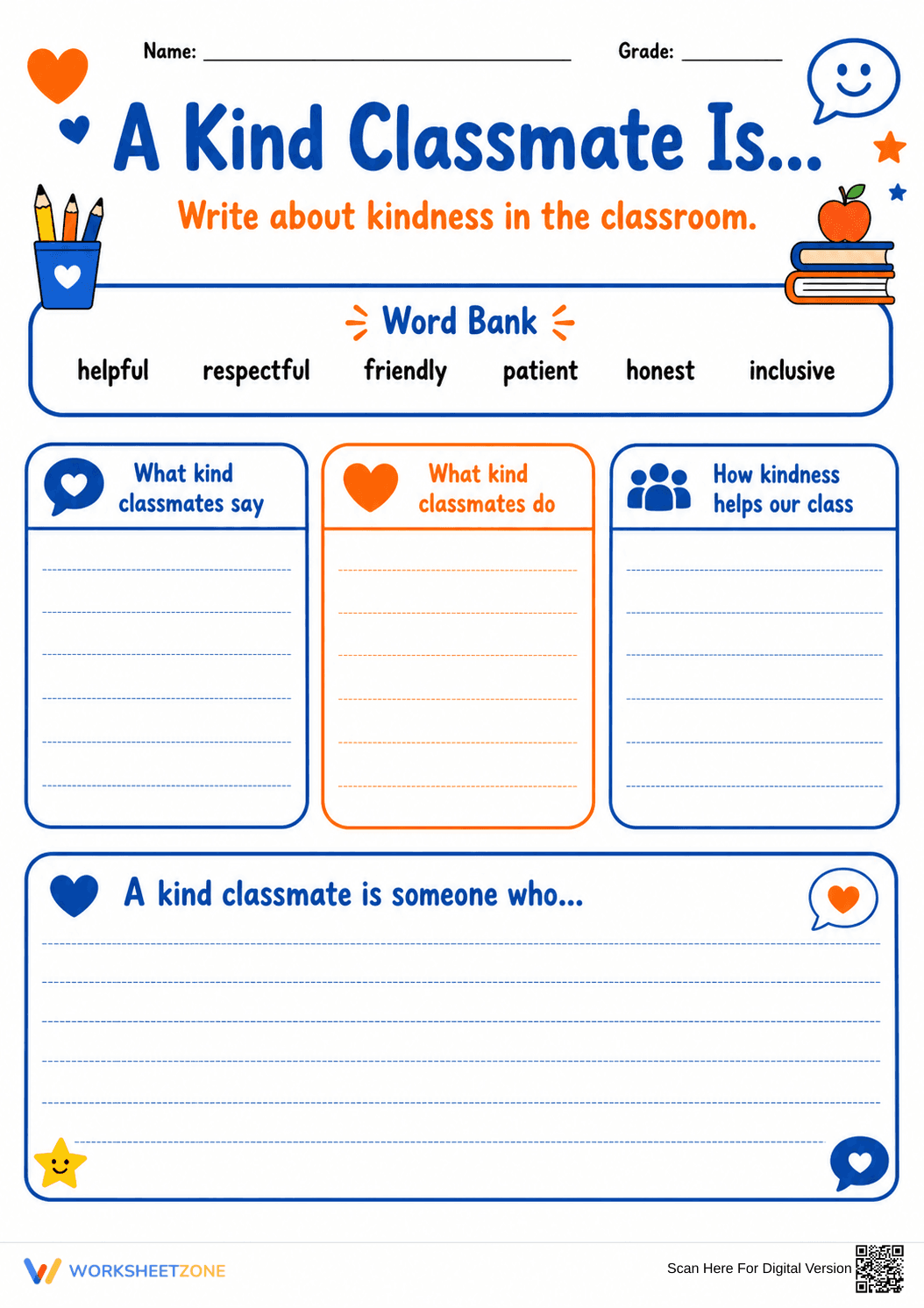

A Kind Classmate Is... Printable Writing Worksheet
Paste this activity's link or code into your existing LMS (Google Classroom, Canvas, Teams, Schoology, Moodle, etc.).
Students can open and work on the activity right away, with no student login required.
You'll still be able to track student progress and results from your teacher account.
This Grade 3 writing worksheet helps students define and practice kindness through structured brainstorming and reflective writing. By identifying specific behaviors and speech patterns, learners develop a concrete understanding of positive classroom culture. This resource bridges social-emotional learning with formal writing practice to improve school climate and student empathy.
At a Glance
- Grade: 3 · Subject: ELA & SEL
- Standard:
CCSS.ELA-LITERACY.W.3.2— Write informative texts to examine a topic and convey ideas clearly- Skill Focus: Character Traits & Descriptive Writing
- Format: 1 page · 5 tasks · No answer key · PDF
- Best For: Morning meetings or character education lessons
- Time: 20–30 minutes
This single-page PDF features a vibrant, student-friendly layout with blue and orange accents. It includes a word bank containing six essential vocabulary terms like "inclusive" and "respectful." Three distinct planning boxes prompt students to categorize kindness into what they say, what they do, and how it helps the class. A final lined section provides a sentence starter for a cohesive paragraph.
The zero-prep design allows for immediate implementation. 1. Print the single-page PDF (30 seconds). 2. Distribute to students during a morning meeting or ELA block (1 minute). 3. Review student responses or share aloud to build community (10 minutes). This resource is an ideal emergency sub plan or a quick Friday reflection activity that requires no teacher setup.
Primary alignment is `CCSS.ELA-LITERACY.W.3.2`, focusing on writing informative texts to convey ideas. It also supports `CCSS.ELA-LITERACY.L.3.6` by encouraging the use of grade-appropriate conversational and academic words. Both standard codes can be copied directly into lesson plans, IEP goals, or district curriculum mapping tools.
Use this as a formative assessment for social-emotional growth during the first week of school. Observe if students can translate abstract concepts like "respect" into concrete actions in the planning boxes. It also works well as a pre-writing organizer before a larger narrative project about community heroes. The expected completion time is 20 to 30 minutes.
Designed for Grade 3 students, this worksheet is also adaptable for Grades 2-5. It is particularly effective for English Language Learners who benefit from the provided word bank and sentence frames. Pair this with a picture book about empathy or a classroom anchor chart on "Bucket Filling" to deepen the instructional impact.
Research by Fisher & Frey (2014) emphasizes the importance of scaffolding writing tasks through "gradual release of responsibility," which this worksheet facilitates via its word bank and planning boxes. By providing specific vocabulary and categorical prompts, the resource reduces the cognitive load on Grade 3 learners, allowing them to focus on the conceptual application of social-emotional skills. According to the NAEP, students who engage in regular reflective writing demonstrate higher levels of engagement and better mastery of informational text structures. This worksheet aligns with these findings by requiring students to synthesize their observations of classroom behavior into a structured paragraph. The inclusion of the `CCSS.ELA-LITERACY.W.3.2` standard ensures that while students are developing empathy, they are also meeting rigorous academic expectations for clear communication. This dual-purpose approach is essential for modern classrooms where instructional time is limited and cross-curricular integration is a priority for teacher efficiency.


