


























Views
Downloads
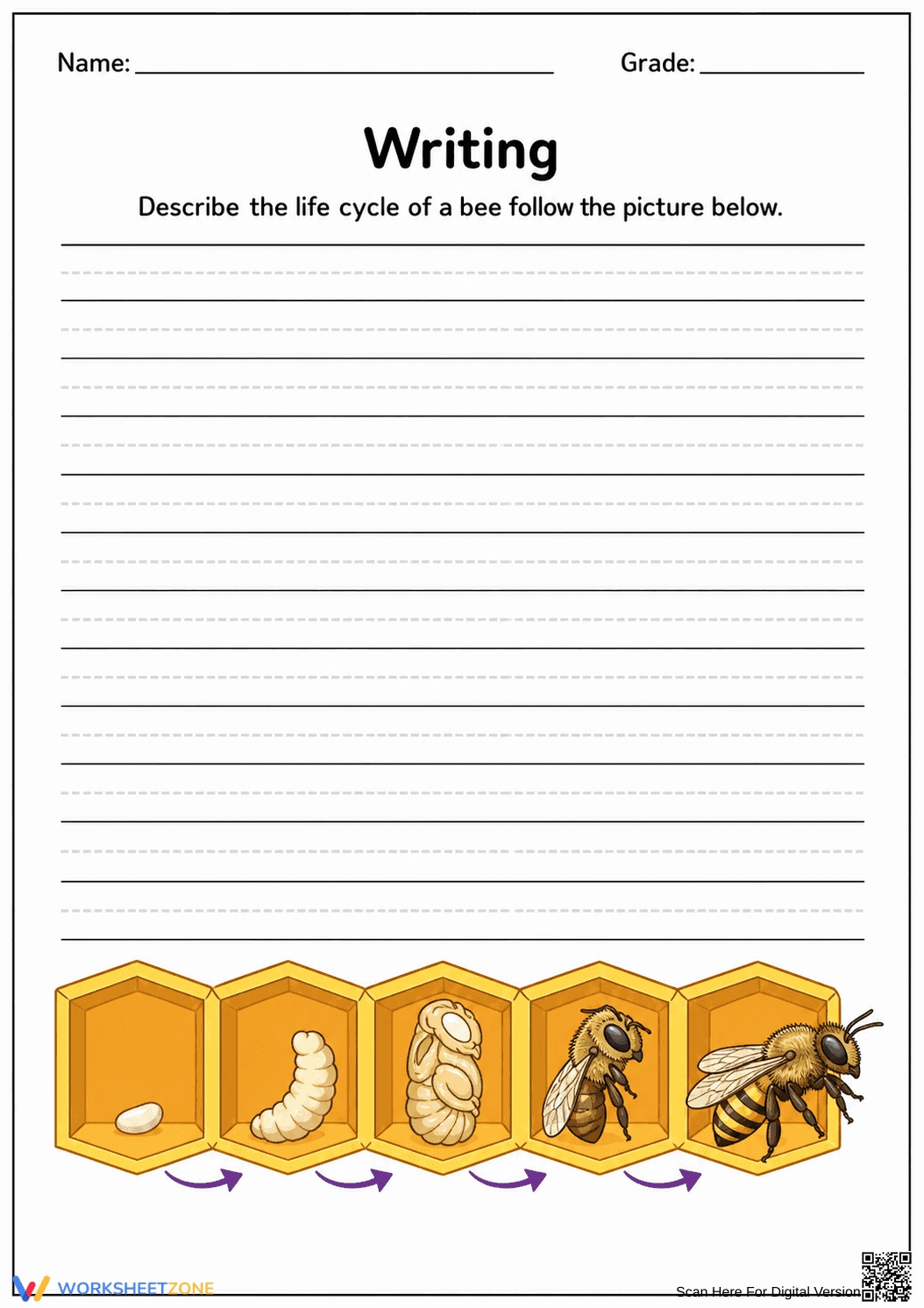

Bee Life Cycle Writing Worksheet | Printable Grade 4
Paste this activity's link or code into your existing LMS (Google Classroom, Canvas, Teams, Schoology, Moodle, etc.).
Students can open and work on the activity right away, with no student login required.
You'll still be able to track student progress and results from your teacher account.
This cross-curricular Grade 4 worksheet combines science and language arts by asking students to describe the life cycle of a bee. Using a detailed five-stage visual diagram, learners practice writing informative texts that sequence events accurately. This resource builds both biological vocabulary and foundational paragraph-writing skills.
At a Glance
- Grade: 4 · Subject: Science & ELA
- Standard:
CCSS.ELA-LITERACY.W.4.2— Write informative texts to examine a topic clearly- Skill Focus: Informational Writing
- Format: 1 page · 1 task · No answer key · PDF
- Best For: Independent practice or science centers
- Time: 15–20 minutes
What's Inside
Inside this single-page resource, educators will find a structured writing prompt paired with a clear illustration of a bee's developmental stages. The bottom features five frames showing the egg, larva, pupa, emerging bee, and adult bee, connected by arrows. Above the diagram, dashed writing lines provide ample space for students to draft their paragraphs, ensuring neat handwriting while they explain the process.
Zero-Prep Workflow
- Print (1 minute): Print the single-page PDF.
- Distribute (1 minute): Hand out during a science block or writing center. The visual diagram makes the task clear.
- Review (3 minutes): Collect responses to assess sequence words and life cycle concepts. Total teacher prep time is under two minutes, making this an excellent option for sub plans.
Standards Alignment
Aligned to primary standard CCSS.ELA-LITERACY.W.4.2: Write informative/explanatory texts to examine a topic and convey ideas and information clearly. It also supports NGSS concepts related to organism life cycles. Both standard codes can be copied directly into lesson plans, IEP goals, or district curriculum mapping tools.
How to Use It
Use this worksheet as independent practice after direct instruction on insect life cycles. Students can reference the diagram to write a chronological paragraph using transition words. Alternatively, assign it as a formative assessment to evaluate how well students translate visual data into written text. Teachers can observe whether students identify all five stages. Expected completion time is 15 to 20 minutes.
Who It's For
This resource is designed for Grade 4 students, though it can easily be adapted for Grades 5 and 6 students needing extra scaffolding in informational writing. The visual supports make it particularly effective for English Language Learners and visual learners who benefit from having a concrete sequence to follow. Pair this worksheet with a nonfiction reading passage about honeybees or a classroom anchor chart on transition words.
Integrating visual diagrams into writing tasks improves student comprehension and output quality. According to Fisher & Frey (2014), providing students with clear visual scaffolds during writing instruction helps them organize their thoughts and produce more coherent informative texts. This worksheet applies that research by pairing a sequential illustration with structured writing lines. By addressing CCSS.ELA-LITERACY.W.4.2, students practice how to write informative texts to examine a topic clearly. The combination of science content and literacy skills ensures instructional time is maximized. Students reinforce their understanding of biological processes and develop the critical ability to communicate scientific observations in writing, supporting deeper cognitive processing.


