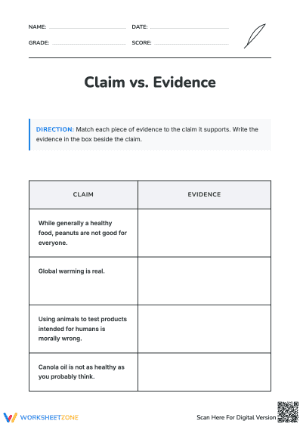
These 4th grade text evidence worksheets give students structured practice with one of the sharpest skill shifts in the intermediate grades — moving from summarizing what a text says to proving, in specific words, why their answer is supported. Each worksheet pairs a short reading passage with targeted questions that require students to locate, underline, and cite the exact detail that backs their thinking. The set covers both literary and informational passages, which matters because the way evidence functions differs between the two.
The Skills Each Worksheet Targets
Grade 4 is the year "I think..." stops being a complete answer. Two categories of evidence practice run through the set: explicit evidence, where the author directly states the information students are asked about, and inferential evidence, where the support is present in the text but requires the reader to connect a detail to a conclusion. Both types appear throughout the grade, but Grade 4 is typically when teachers begin requiring students to name which kind they are using — and that distinction alone surfaces confusion worth addressing early.
Fiction and informational passages develop slightly different evidence habits, and the set includes both. On the literary side, students practice treating character dialogue, internal reactions, and the narrator's specific word choices as legitimate evidence sources rather than just summarizing plot. On the informational side, they pull facts, cause-effect relationships, and procedural details from nonfiction passages connected to content areas students encounter in science and social studies. Several worksheets ask students to answer a single question using a paired literary and informational passage on the same theme, pushing them to notice how evidence looks different depending on text type.
Constructed Responses and the RACE Framework
A pattern that becomes visible around October in Grade 4 written responses: students who understood the passage completely still turn in one-sentence answers. They are not guessing — they simply have no internalized model for what a complete response looks like. The worksheets in this set that target constructed response writing use the RACE framework — Restate, Answer, Cite, Explain — to give students a repeatable sequence. Each step is labeled separately with dedicated writing space, so students work through one move at a time rather than holding the entire paragraph structure in working memory simultaneously.
The Cite step receives the most focused practice. Grade 4 students frequently collapse Cite and Explain together — they write a solid answer, then jump directly to explaining their reasoning without ever quoting or pointing to specific text. Several worksheets isolate this step, providing the Restate, Answer, and Explain portions already filled in, and asking students to write only the evidence sentence using a signal phrase such as "According to the passage" or "The text states." Repeating that isolated practice across a few sessions closes the gap faster than correcting the problem after students have already developed the habit of skipping it.
How to Build These Worksheets Into Your Lesson Plans
Small group instruction during the literacy block is where these resources show the most direct return. When a student underlines the wrong sentence, catching it in the moment — rather than when the worksheet comes back corrected — changes the instructional value entirely. A teacher can ask, "What question were you trying to answer? Now read only that sentence. Does it answer the question?" That exchange in a small group takes thirty seconds. Written feedback on a returned worksheet rarely produces the same correction.
For independent practice, 4th grade text evidence worksheets work well as a Monday morning warm-up when the passage is one students heard read aloud the previous Friday. Familiar text removes decoding load and lets students focus on locating and citing evidence rather than tracking the story for the first time — which matters for students still building fluency alongside comprehension. Later in the year, switching to cold passages for warm-up tasks increases the challenge without changing the worksheet format at all.
Grade 4 Evidence Errors Worth Addressing Early
The most consistent error in Grade 4 evidence work is what happens when students find the general section of the text where the answer lives but stop short of identifying which specific detail carries it. They underline three or four sentences — sometimes a full paragraph — because each one feels related to the question. The fix is not telling them they underlined too much. It is asking: "Which one of these sentences, by itself, answers the question?" Worksheets that require a single underlined sentence, followed by a written explanation of why that sentence was chosen, make that discrimination part of the task itself rather than feedback delivered after the fact.
A second error surfaces specifically in inference questions. Students write "I know this because bears hibernate in winter" and cite nothing from the passage — they are answering from background knowledge rather than from the text. The passage may have pointed directly at that conclusion, but they never marked it. This matters for RI.4.1 specifically, because the standard requires inferences drawn from the text, not from what students already knew walking in. A useful structure for addressing it: ask students to circle the word "text" in the question prompt, physically mark the evidence in the passage before writing anything, then compose their answer with the marked text still visible. Slowing that sequence down makes the distinction concrete before it hardens into a recurring pattern.
Standard Alignment
The set directly addresses CCSS RL.4.1 and CCSS RI.4.1, both of which require Grade 4 students to refer to details and examples in a text when explaining what the text says explicitly and when drawing inferences. These two standards are load-bearing for the rest of the Grade 4 Reading strand — a student who cannot cite evidence cannot adequately respond to questions about theme (RL.4.2), main idea (RI.4.2), or point of view (RL.4.6). Most teachers introduce evidence citing formally in the first quarter and return to it as a supporting skill through every subsequent unit. Because each worksheet in the set is a contained, standalone practice task, it fits alongside any passage the class is currently reading — not only the texts included here.
Differentiating the Set for a Range of Readers
For students still developing reading fluency, read the passage aloud before they begin the evidence task. Separating decoding from evidence location keeps struggling readers in the actual thinking work rather than losing them at the reading stage. A second support: pre-underline the evidence in the passage and ask students to write only the explanation — the Explain step in RACE. This targets the side of the response where some students need the most practice, while setting aside the locating task they can already handle independently.
For students ready to move beyond the structure, 4th grade text evidence worksheets become more demanding when students must cite evidence from two separate passages for a single claim — a task that previews the Grade 5 expectation in CCSS RI.5.9. Another extension that pushes thinking further: ask advanced students to identify two pieces of evidence from the same passage and write a sentence explaining which one is stronger and why. That judgment task moves the cognitive work from retrieval into analysis, keeping the worksheets genuinely challenging for students who have already internalized the basics of citing.
Frequently Asked Questions
How do the worksheets handle the distinction between explicit and inferential evidence?
Questions are labeled by type so students know which reading move the task requires. Many Grade 4 students do not realize they are making two different cognitive moves when they answer both question types on the same passage. Making the distinction visible in the task itself builds metacognitive awareness alongside the evidence skill — students begin to notice, on their own, whether a question asks them to quote directly or to connect a detail to a conclusion.
Can these be assigned as homework?
Yes, with one planning consideration: send home worksheets covering a skill already introduced in class, paired with passages students have already encountered. Students working alone at home do better when the reading itself is not the obstacle — the evidence task is the practice. 4th grade text evidence worksheets assigned as homework land most effectively when students have already seen the skill modeled that day or the day before.
When in the year should teachers introduce this set?
Worksheets targeting the locate-and-underline skill are strong choices for the first two to three weeks of school, since RL.4.1 and RI.4.1 underpin every other reading standard that follows. RACE-based constructed response worksheets typically come four to six weeks later, once students have a reliable sense of what evidence looks like in text before they are asked to write about it in a formal structure.















 Interactive Worksheet Maker
 Quiz Maker
 Word Search Maker
 Crossword Puzzle Maker
 Word Scramble Generator
 Sentence Scramble Generator
 Handwriting Worksheet Generator
 Name Tracing Generator
 Fill In The Blank Generator