




























Views
Downloads


RI.4.1 Worksheet: RACE Strategy — Grade 4 Aligned

Paste this activity's link or code into your existing LMS (Google Classroom, Canvas, Teams, Schoology, Moodle, etc.).
Students can open and work on the activity right away, with no student login required.
You'll still be able to track student progress and results from your teacher account.
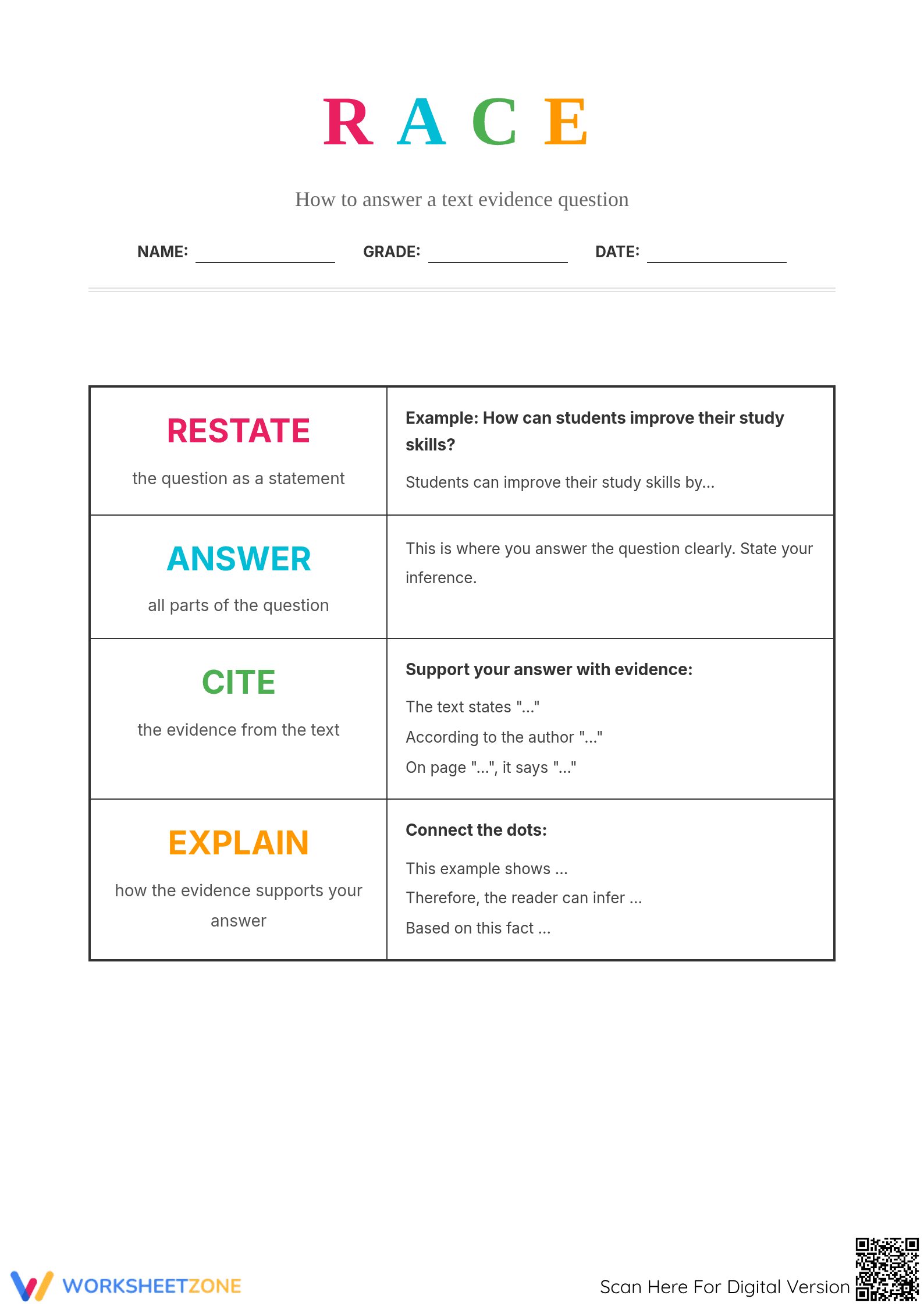
This Grade 4 ELA worksheet provides a structured framework for students to master text evidence through the RACE strategy. By breaking down the writing process into four clear steps, students learn to construct high-quality responses that meet rigorous academic standards. This resource ensures students can effectively restate questions, provide clear answers, cite specific evidence, and explain their reasoning.
At a Glance
- Grade: 4 · Subject: ELA
- Standard:
CCSS.ELA-LITERACY.RI.4.1— Refer to details and examples in a text when explaining what it says- Skill Focus: RACE Writing Strategy
- Format: 2 pages · 1 multi-part task · Answer key included · PDF
- Best For: Test prep and constructed response practice
- Time: 20–30 minutes
The download includes a comprehensive two-page PDF designed for immediate classroom use. The first page serves as a visual anchor chart, defining each component of the RACE acronym with helpful sentence starters and concrete examples. The second page features an engaging reading passage titled "The Helpful Neighbor," followed by a specific prompt that guides students through the application of the strategy using designated lines for each step.
Mastery Evidence
This worksheet serves as a bridge to mastery by providing a clear progression from conceptual understanding to independent application. Each task within the RACE framework maps to specific sub-skills of the primary standard, such as identifying explicit details and drawing logical inferences. Teachers can use the structured response lines to evaluate student performance across four distinct tiers: Restating, Answering, Citing, and Explaining. These specific data points can be entered directly into gradebooks or used to track progress toward IEP goals related to evidence-based writing.
Standards Alignment
The primary focus is `CCSS.ELA-LITERACY.RI.4.1`, which requires students to refer to details and examples in a text when explaining what the text says explicitly and when drawing inferences. Additionally, it supports CCSS.ELA-LITERACY.W.4.9 by having students apply grade-level reading standards to writing. Both standard codes can be copied directly into lesson plans, IEP goals, or district curriculum mapping tools.
How to Use It
Use this resource during the "Guided Practice" phase of a lesson on constructed responses. After introducing the RACE acronym, have students use the anchor chart page as a desk reference while they complete the "Helpful Neighbor" passage. It also functions as an effective formative assessment tool; by reviewing the "Explain" section of the student response, teachers can quickly identify if a student understands the connection between evidence and their claim. Expect completion in 25 minutes.
Who It's For
This worksheet is ideal for general education students in grades 3 through 5, as well as English Language Learners who benefit from the provided sentence frames. It pairs naturally with a short informational text or a teacher-led modeling session on a whiteboard.
The RACE strategy is a widely recognized pedagogical tool designed to scaffold the complex cognitive task of evidence-based writing. According to Fisher & Frey (2014), providing students with structured mnemonics and sentence frames significantly improves their ability to synthesize information from a text and articulate their reasoning in a formal format. This worksheet aligns with CCSS.ELA-LITERACY.RI.4.1 by requiring students to move beyond simple recall toward a more sophisticated analysis of textual details. By isolating the "Cite" and "Explain" components, the resource addresses common student pitfalls in standardized testing environments where evidence is often omitted or left unconnected to the main argument. Research from the NAEP indicates that students who utilize structured writing frameworks consistently outperform peers in constructed response tasks. This 2-page PDF provides the necessary scaffolding to transition students from basic comprehension to the rigorous demands of evidence-based academic discourse.


