




























Views
Downloads


Grade 4 Hanging Gardens — Printable No-Prep Worksheet

Paste this activity's link or code into your existing LMS (Google Classroom, Canvas, Teams, Schoology, Moodle, etc.).
Students can open and work on the activity right away, with no student login required.
You'll still be able to track student progress and results from your teacher account.
This Grade 4 reading comprehension worksheet helps students practice finding text evidence. By reading about the Hanging Gardens of Babylon, learners develop essential skills in locating facts and making inferences to improve their reading proficiency.
At a Glance
- Grade: 4 · Subject: ELA
- Standard:
CCSS.ELA-LITERACY.RI.4.1— Refer to details and examples in a text.- Skill Focus: Reading Comprehension and Text Evidence
- Format: 3 pages · 6 problems · Answer key included · PDF
- Best For: Independent practice and reading centers
- Time: 20–30 minutes
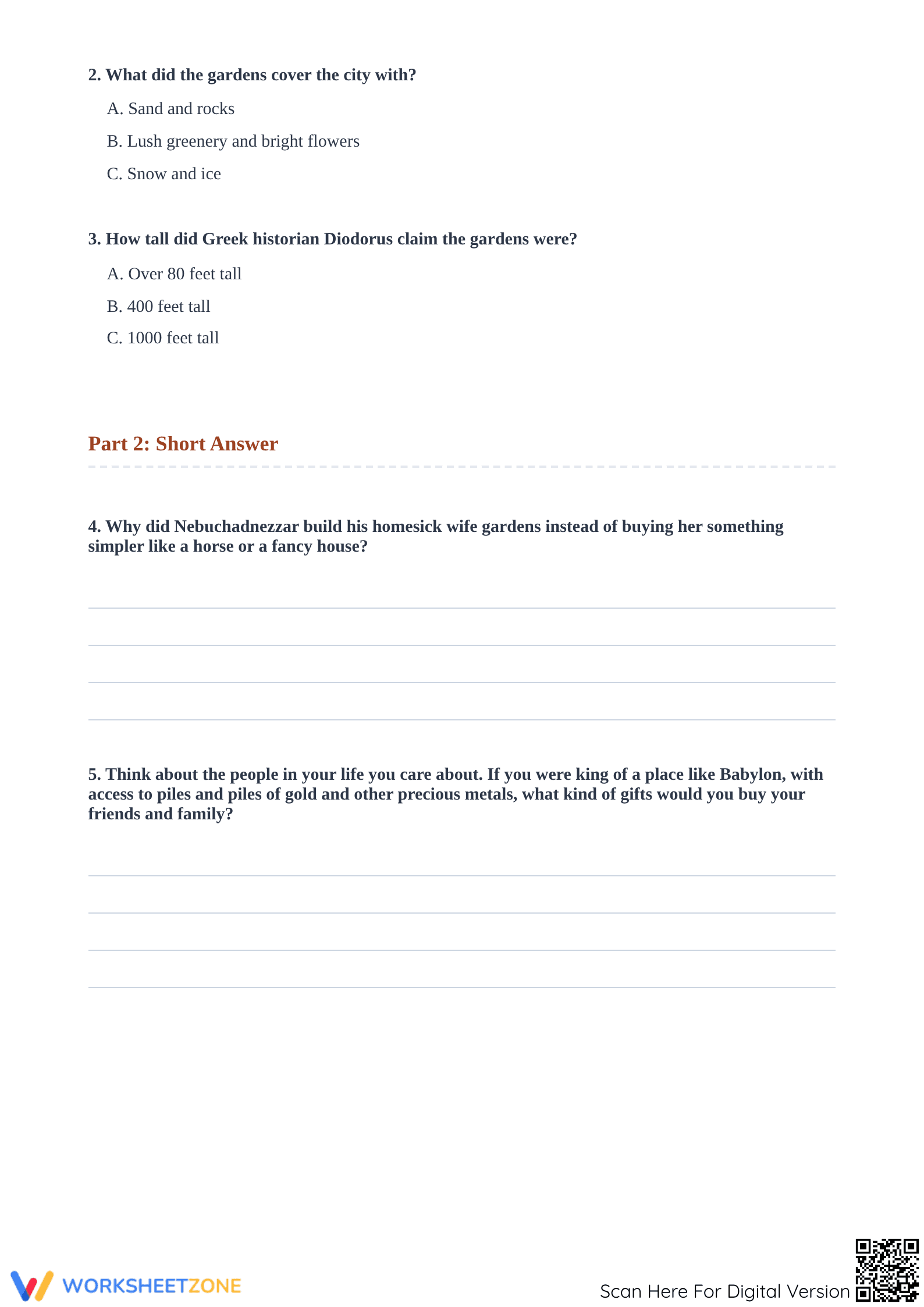
This resource features an informational passage about King Nebuchadnezzar and the Hanging Gardens. Students tackle three multiple-choice questions to check basic comprehension, two short-answer prompts requiring text evidence, and one creative drawing task to illustrate the gardens based on descriptive details. A complete answer key is provided.
This resource offers a zero-prep workflow for busy educators.
- Print (1 minute): Download the PDF and print the three-page packet.
- Distribute (1 minute): Hand out packets during your literacy block. Instructions are self-explanatory.
- Review (3 minutes): Use the included answer key to quickly check responses.
With teacher prep time under two minutes, this activity is perfect for emergency sub plans.
This worksheet is aligned to CCSS.ELA-LITERACY.RI.4.1, requiring students to refer to details and examples in a text when explaining what it says explicitly. By answering short-response questions and visualizing the text, students demonstrate their grasp of the material. Both standard codes can be copied directly into lesson plans, IEP goals, or district curriculum mapping tools.
Teachers can utilize this reading passage as an independent reading center activity after direct instruction on finding text evidence. Alternatively, assign it as meaningful homework. As a formative assessment tip, observe if students return to the text to find specific details rather than relying on memory. Expected completion time is 20 to 30 minutes.
This resource is designed for fourth-grade students developing informational reading skills. The straightforward layout makes it accessible for on-level readers, while the drawing component offers an outlet for visual learners. It pairs wonderfully with a social studies unit on ancient civilizations or a lesson on identifying main ideas.
Developing strong reading comprehension skills requires consistent practice with engaging, informational texts. Aligning instruction with CCSS.ELA-LITERACY.RI.4.1 ensures students can refer to details and examples in a text to support their understanding and explain explicit facts. According to Fisher & Frey (2014), providing students with structured opportunities to interact with complex texts significantly improves their ability to extract evidence, make accurate inferences, and synthesize information. This worksheet supports that pedagogical framework by combining a high-interest historical passage about the Hanging Gardens of Babylon with targeted questions that demand textual evidence. By integrating multiple-choice, short-response, and visual interpretation tasks, educators can effectively assess comprehension across different cognitive domains. Regular engagement with these types of evidence-based reading activities builds the foundational literacy skills necessary for future academic success across all subject areas, ensuring students become critical readers.


