Comparatives and Superlatives printable worksheets for 4th Grade
These comparatives and superlatives printable worksheets for 4th grade address a skill that students technically encounter in third grade but still mishandle well into fourth — the exact conditions that call for -er/-est versus more/most, how spelling shifts under modification, and why irregular forms like good refuse to follow the standard pattern. The set moves students through recognition, word-building, and sentence production, so teachers can match a specific worksheet to the lesson stage rather than re-teaching from scratch each time the skill resurfaces.
Where Grade 4 Students Predictably Go Wrong
The double comparative — more taller, most fastest — is the most visible error, but it rarely signals the deepest confusion. A harder mistake to catch is using a superlative when only two items are being compared. A student will write "She is the tallest of the two sisters" with full confidence, because the word form sounds right even though the comparison group demands taller. That error lives in reading comprehension as much as grammar: the student has to notice how many things are actually being compared before choosing a form.
Irregular forms produce their own cluster of mistakes. Students who have internalized the -er/-est rule overapply it — gooder, baddest, worser — even after a lesson that covers good/better/best and bad/worse/worst explicitly. These forms need repeated exposure in varied sentence contexts. A single matching exercise after initial instruction is not enough, and the errors resurface in free writing weeks later.
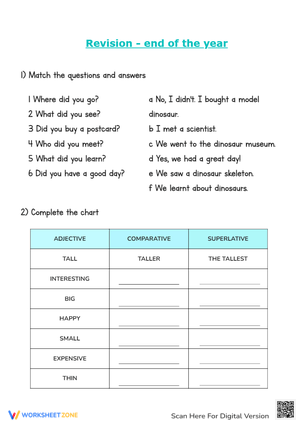
Spelling changes are a third category worth targeting directly. Students who spell big correctly will still write biger or leave happyest uncorrected, because the consonant-doubling and y-to-i rules are not yet automatic at this grade. A word-building worksheet — one where students start from the base word and produce both comparative and superlative forms — surfaces this more reliably than a sentence-level task, because the spelling change is isolated as the primary decision rather than buried inside a longer sentence task.
The Specific Skills Covered in the Set
Each worksheet targets one or two related skills, which makes it easier to match the resource to where a class actually is in a unit rather than assigning a general review sheet and hoping it addresses the right gap.
- Identification tasks: Students underline the comparative or superlative form in a sentence and mark whether it compares two items or a group of three or more.
- Word-building exercises: Starting from a base adjective or adverb — including words with consonant doubling and y-to-i changes — students produce both the comparative and superlative forms.
- Sentence completion: Students choose between two forms based on close reading, where the comparison group is embedded in the sentence rather than labeled for them.
- Error correction: Students identify and fix mistakes including double comparatives, wrong-size comparisons, and irregular substitutions like gooder or worser.
- Original sentence writing: Students produce their own sentences using a target word list that includes at least two irregular forms alongside regular adjectives and adverbs.
The writing tasks do the most diagnostic work. Students who complete a word-building drill correctly will still write "the most colder day" in a paragraph — the sentence-production worksheets reveal that gap in a way the earlier exercises do not.
Where These Worksheets Fit in a 4th Grade ELA Week
Most fourth-grade grammar instruction runs in short blocks — 10 to 15 minutes of a language period — and these worksheets are built for that rhythm. A practical weekly sequence: identification on Monday as a warmup after morning meeting, word-building on Tuesday, sentence completion on Wednesday during a center rotation, error correction on Thursday as partner work, and a short writing task as a Friday exit ticket. That last piece takes about 8 minutes and gives an accurate read on transfer before the weekend.
The comparatives and superlatives printable worksheets for 4th grade slot cleanly into substitute plans as well. Each worksheet has a self-contained task and a short worked example at the top, so students can begin without teacher modeling. A sub does not need subject-area background to manage the session.
For small-group intervention, start with the word-building and error-correction worksheets rather than re-explaining the concept. Students in a pull-out group typically know what a comparative is; the breakdown is in applying the spelling rules or reading the sentence for the comparison group size. Targeting that specific failure point moves the session faster than beginning at the definition.
Printable format also earns its place here because comparison grammar involves close reading decisions. Students annotate directly on the worksheet — crossing out double comparatives, underlining the comparison group, circling the spelling change — and that physical process makes the decision visible in a way that clicking a multiple-choice answer does not. The marked-up worksheet also serves as a clear artifact for parent conferences or conversations with support staff.
Serving a Range of Learners Without Extra Prep
The comparatives and superlatives printable worksheets for 4th grade cover a wider ability range than they first appear to. Students still building the foundational skill start with identification and word-building worksheets, where sentences are short, comparison groups are clearly stated, and the task requires one decision at a time. Students who already control the basic pattern move directly to error-correction and writing worksheets, which ask them to analyze and produce rather than simply recognize.
For students who need extra support with irregular forms, pair a sentence-completion worksheet with a reference strip listing the most common irregulars: good/better/best, bad/worse/worst, many/more/most, and little/less/least. That keeps the cognitive load on reading the comparison context rather than retrieving an unfamiliar word form from memory. Remove the strip after two sessions where the student is choosing correctly — most students no longer reach for it by the third practice.
Advanced students benefit most from the writing tasks, particularly with a constraint added: produce a short paragraph comparing three characters from a recent class novel using at least four superlative forms. That version surfaces whether a student can control comparison language across connected sentences rather than isolated examples, and it tends to produce more interesting writing, which matters for motivation at this grade.
Standard Alignment
The core standard these worksheets address is CCSS.ELA-LITERACY.L.3.1.G: form and use comparative and superlative adjectives and adverbs, and choose between them depending on what is to be modified. That standard is formally introduced at third grade, but fourth grade practice is not review for its own sake — at this grade, the expectation is that students control these forms accurately in independent writing, not just pick the right answer from a structured list.
The broader standard CCSS.ELA-LITERACY.L.4.1 covers command of standard English grammar conventions in writing and speaking. Error-correction and sentence-writing worksheets directly support L.4.1 because students must produce accurate forms in context, identify what makes a sentence incorrect, and revise it — exactly the kind of work the standard demands at this grade level.
Frequently Asked Questions
What is the difference between a comparative and a superlative?
A comparative form compares exactly two nouns or pronouns — taller, more careful — using -er or more. A superlative form identifies the one that ranks highest or lowest within a group of three or more — tallest, most careful — using -est or most. Grade 4 students are expected to choose between forms based on how many items are actually in the comparison, not just how a sentence sounds.
How should irregular forms be introduced and practiced?
Introduce irregular forms as a short separate set — three or four forms at a time — before connecting them to the regular pattern. Start with good/better/best because students use these words constantly and recognize immediately that gooder sounds wrong. Matching and sentence completion worksheets build initial exposure; error-correction worksheets, where students catch and fix irregular substitutions in realistic sentences, reinforce the deeper recognition that keeps these mistakes out of student writing.
When should students use more/most instead of -er/-est?
As a general rule, one-syllable adjectives and most two-syllable adjectives take -er/-est, while adjectives with three or more syllables use more/most. There are exceptions, and a sorting worksheet helps students notice the pattern without memorizing a rule statement verbatim. More important than the rule itself is exposure to enough varied examples that the correct form begins to sound right — that sense of correctness develops through sentence-level practice, not word lists alone.
Are these worksheets appropriate for grades other than fourth?
The comparatives and superlatives printable worksheets for 4th grade are written at a fourth-grade vocabulary and sentence-complexity level, but the identification and word-building worksheets serve third graders who are meeting the concept for the first time. The error-correction and original writing worksheets work well for fifth graders who need focused review of forms they should have mastered but still apply inconsistently in longer writing tasks.
Clear All