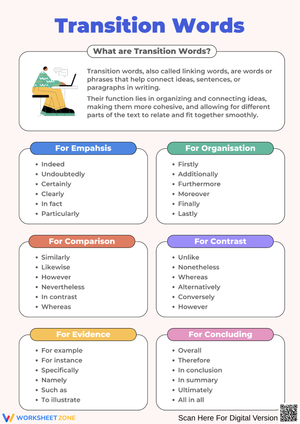
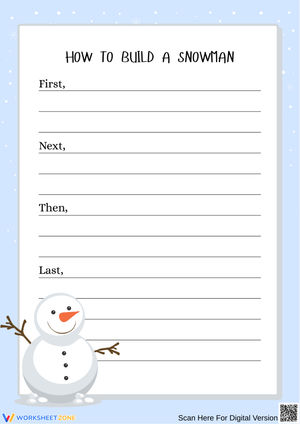
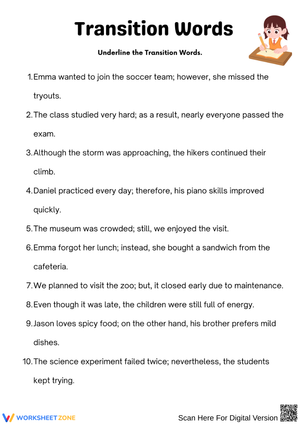
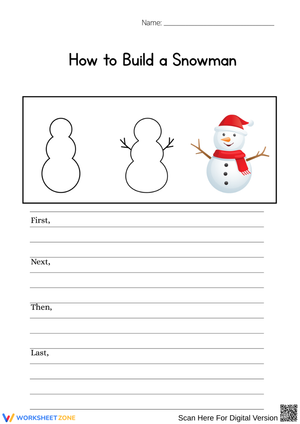
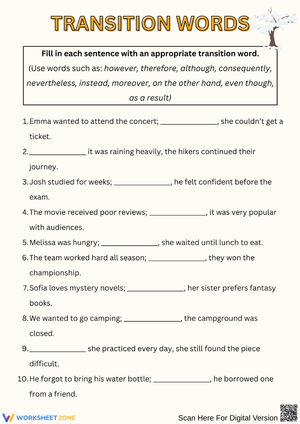
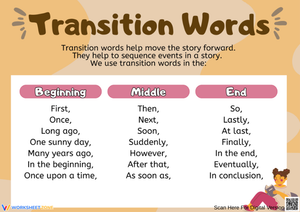
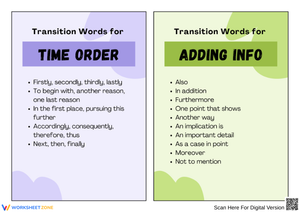
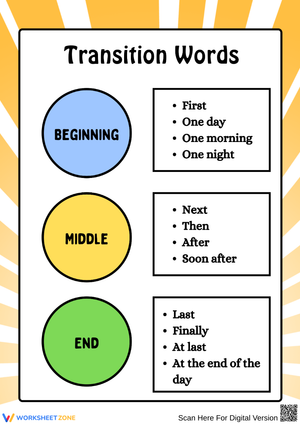
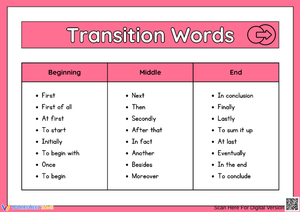
These transition words worksheets for 4th grade address a gap that shows up in student writing around October of every school year: kids can draft paragraphs, but those paragraphs sit next to each other like separate islands. Each worksheet targets a specific function — sequencing events in time, stacking supporting evidence, signaling contrast, or closing an argument — so teachers can assign exactly what a class needs after looking at a set of drafts, rather than teaching transitions as one undifferentiated block.
The Specific Skills Covered
The set organizes transition language into four categories, and keeping those categories separate is part of the teaching strategy. When fourth graders see "however," "furthermore," and "finally" in the same undifferentiated list, they treat the words as interchangeable. These worksheets build the habit of asking what logical job a transition needs to do before choosing a word.
- Sequence and time: Words like "subsequently," "meanwhile," "prior to," and "eventually" — not just the "first/next/last" trio students already know, but the vocabulary that creates actual narrative pacing and separates strong storytelling from a list of incidents.
- Addition: "Moreover," "furthermore," and "in addition" — the connectors that extend an argument past a single supporting detail. Students who know only "also" lean on it for every sentence.
- Contrast: "However," "although," "despite," and "on the other hand" — the hardest category at this level because students must hold two competing ideas in mind simultaneously and choose a word that names the relationship between them.
- Conclusion and cause-effect: "Therefore," "as a result," "consequently," and "in summary" — the transitions students most often skip, choosing instead to just stop a paragraph cold and hope the reader follows.
Several worksheets also ask students to identify a transition's function in an existing sentence, then explain how swapping in a word from a different category would change the meaning. That reflective step moves students from pattern-matching to actual understanding.
How These Worksheets Work Across All Three Writing Genres
Most 4th-grade writing instruction rotates through narrative, informational, and opinion writing across the school year. The exercises here are sorted by genre, which makes it practical to pull the relevant worksheet during a specific unit rather than adapting a general activity to fit.
In narrative work, the focus is on time markers that create pacing — not just sequence. Students who rely on "then... then... then..." produce stories that read like incident reports. Exercises ask students to choose between "suddenly," "by the time," and "later that evening" and explain how each word changes the feel of a scene, not just the order of events in it.
For informational writing, the worksheets target cause-effect connectors like "consequently" and "as a result," which are chronically underused in 4th-grade reports. A common exercise pairs two related facts and asks students to write the sentence that joins them using a connector that shows causation — not just co-occurrence. That distinction between "and then" and "as a result" is exactly what separates competent informational writing from strong informational writing at this grade.
In opinion work, the logical chain between a claim and its evidence is often invisible in student drafts. Students list reasons but never signal how those reasons connect to the argument. Targeted practice with "this demonstrates that," "specifically," and "for instance" builds the habit of making that connection explicit rather than leaving it for the reader to infer.
Building These Worksheets Into Your Writing Block
The most reliable placement is as the five-minute opener to a drafting session. A short cloze exercise activates the specific vocabulary students are about to use, so they arrive at independent writing with concrete word choices already in working memory rather than defaulting to "and" or "then" out of habit. That's a more purposeful warm-up than asking students to free-write cold or reread yesterday's draft without a clear task.
A second strong use is the targeted follow-up after returning marked drafts. When a student's opinion paragraph lists three reasons with no connective language between them, assigning the addition-transitions worksheet alongside that feedback gives a concrete fix rather than a vague note to "improve flow." Students generally respond better to a direct vocabulary tool than to general revision advice, especially at nine and ten years old when abstract feedback doesn't translate into action.
For peer review, have students use a category checklist derived from the worksheets to mark transitions in a partner's draft: underline sequence words in one color, contrast words in another, cause-effect words in a third. If one color is absent from the whole draft, that's the revision target. It converts an abstract peer comment into a specific editing task with a clear scope.
Mistakes Students Make That These Worksheets Help You Catch
The most persistent error at this grade level is punctuation, not vocabulary. Students learn that "however" signals contrast before they learn that "however" used as a conjunctive adverb requires either a semicolon before it or a new sentence — not just a comma. The result is the comma splice: "We wanted to go outside, however it was raining." This construction is extremely common in 4th-grade writing and will persist into middle school if not addressed directly. The sentence-correction exercises in the set target this explicitly, but naming the error before distributing the worksheet prevents confusion about why a student's answer was marked wrong when the word choice was correct.
A second pattern: students who correctly use "although" in a controlled exercise will write "Although it was raining. We went outside anyway." in their own drafts — treating the dependent clause as a complete sentence. The worksheets address this by requiring students to complete the full sentence structure, not merely supply the connecting word in a blank. That structural demand is what makes the practice transfer.
There is also the category-confusion error, which is easy to miss during grading because it produces grammatically correct sentences. A student writes "I like soccer. However, I also like basketball" — using a contrast word when the two ideas are simply coexisting, not competing. The categorization exercises, which ask students to name the relationship between two ideas before selecting a connector, surface this confusion before it solidifies into habit.
Standard Alignment
Three Common Core standards converge on this skill. W.4.1.c requires students to link opinions and reasons using transitional words and phrases. W.4.2.c asks students to use precise language and transitional devices to connect information in explanatory texts. W.4.3.c calls for temporal words and phrases that signal event order in narrative writing. The fact that transition instruction appears across all three writing standards — not just one — is exactly why a single lesson on connecting words doesn't cover the standard. The genre-sorted transition words worksheets for 4th grade map directly to this three-mode structure, so teachers address each standard in context rather than treating transitions as a grammar topic separate from writing instruction.
Differentiating These Worksheets Across Ability Levels
For students who need more support, work through the categorization exercises orally before assigning the written version. Having a student explain aloud why "meanwhile" belongs in the time category forces the reasoning rather than the rote matching. Keeping a laminated reference card of the four categories on their desk during independent writing also reduces the strain of managing new vocabulary and sentence construction at the same time — two cognitively demanding tasks that compete for limited working memory.
Students who move through the exercises quickly benefit from a different challenge: strip out the word bank entirely and ask them to supply their own transitions in a passage where the original connectors have been removed. The transition words worksheets for 4th grade include word-bank-free versions for this purpose. A further extension is asking students to pull a paragraph from their current independent reading book, identify every transition, sort those words by category, and then consider which categories the author uses most and why. That analysis surfaces intentional craft decisions in published writing and connects worksheet practice to real reading.
For English learners, the contrast-transition exercises often need extra attention because "although," "despite," and "even though" carry structural differences that are not intuitive across languages. Pairing those exercises with a simple sentence frame — "Although _______, _______." compared to "Despite _______, _______." — provides a structural anchor while students internalize the meaning distinction. Once the frame becomes familiar, most students can drop it naturally.
Frequently Asked Questions
What is the difference between the cloze exercises and the sentence-correction exercises?
Cloze exercises provide a word bank and ask students to choose the best fit for a blank. This is most useful early in a unit when students need exposure to how each word functions in context before they can generate the words independently. The sentence-correction exercises present a passage with incorrect or missing transitions and ask students to identify the problem and rewrite the sentence. The correction format is harder — it requires diagnosis before repair, which is closer to what actual revision demands. Both formats appear in the set because neither alone covers the full range of skill from recognition to application.
How early in a writing unit should these be introduced?
The most effective placement is at the start of the drafting stage, not during pre-writing when students have no text of their own yet. Transition vocabulary stays abstract when there is no draft to apply it to. When teachers assign a categorization or cloze worksheet on the same day students begin drafting body paragraphs, students immediately have a writing context for what they just practiced. Two or three short exercises at the start of successive drafting sessions produce more lasting retention than one extended lesson on transitions delivered in isolation before any writing has begun.
Do these worksheets address the difference between "however" and "but"?
Yes, and that contrast is one of the more useful exercises in the set. Both words signal opposition, but "however" is a conjunctive adverb that cannot join two independent clauses with a comma alone, while "but" is a coordinating conjunction that can. Students who answer correctly on the worksheet will still write comma splices when drafting independently, so the exercise specifically asks students to write one sentence using "but" and one using "however" for the same contrasting pair of ideas — then compare the punctuation each version requires. That side-by-side format makes the structural difference concrete in a way that a rule definition alone does not reach.












 Interactive Worksheet Maker
 Quiz Maker
 Word Search Maker
 Crossword Puzzle Maker
 Word Scramble Generator
 Sentence Scramble Generator
 Handwriting Worksheet Generator
 Name Tracing Generator
 Fill In The Blank Generator




 BACK TOSCHOOL