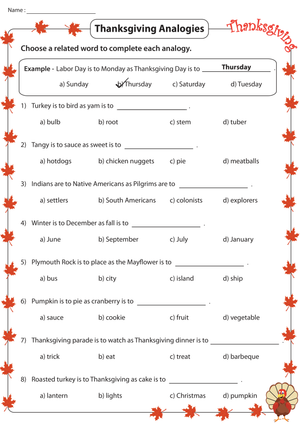
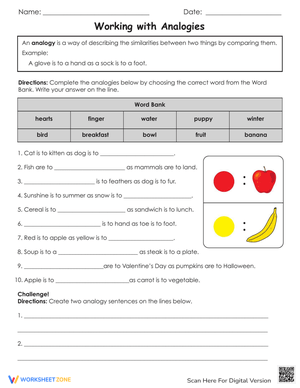
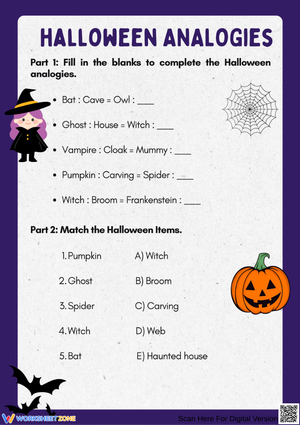
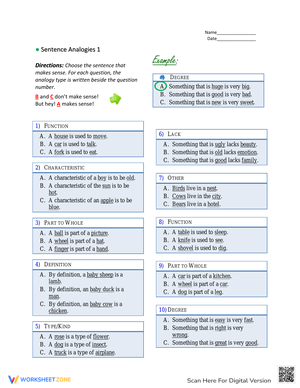
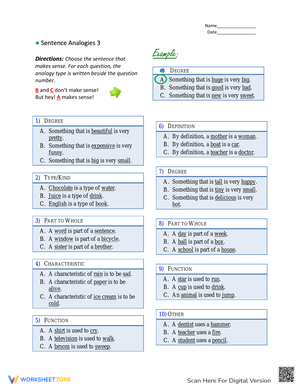
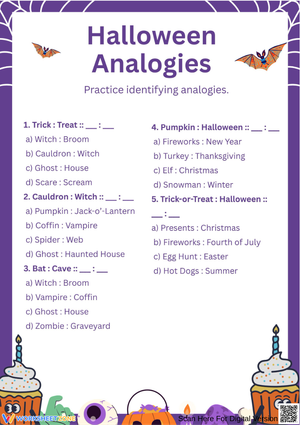
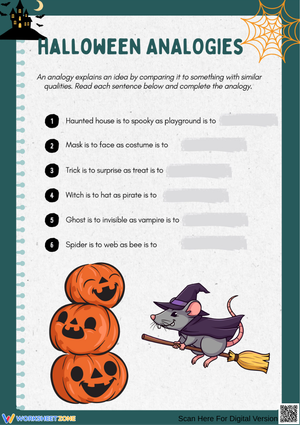
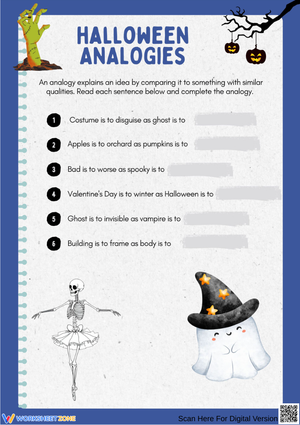
These analogies worksheets for 4th grade give teachers a ready-made system for building the word relationship skills that standardized assessments test — and that reading comprehension actually depends on. Each worksheet targets a specific analogy category, so teachers can assign exactly what students need rather than working through a random mix. The set runs from straightforward synonym and antonym pairs to more demanding part-to-whole and cause-and-effect problems, giving students the category-by-category practice that makes the underlying logic stick.
The Relationship Categories Students Work Through
Rather than mixing all relationship types on a single worksheet, the set separates categories so students build fluency with one pattern before they encounter it alongside unfamiliar ones. That sequencing matters — confusion almost always sets in at the point where two relationship types look superficially similar, not at the point where the vocabulary gets harder.
- Synonym and antonym analogies — Students match word pairs by meaning or by opposition: rapid : slow :: bright : dim. These introduce the formal notation in the least ambiguous context, giving students a clean first experience with the structure before the logic gets more complex.
- Part-to-whole analogies — Students identify a component and the larger thing it belongs to: petal : flower :: spoke : wheel. This category connects well to science content — teachers running a unit on plant or animal structures can pull these worksheets as targeted vocabulary reinforcement without building anything new.
- Object and function analogies — Students connect a tool or object to the action it performs: needle : sew :: chisel : carve. Functional vocabulary is where students often have gaps; they know the noun but have not connected it to the verb that defines its purpose.
- Characteristic and quality analogies — Students match objects to their defining properties: sandpaper : rough :: silk : smooth. The reasoning built here transfers directly to descriptive writing — students who can articulate what makes one texture different from another write more precise sentences.
- Cause-and-effect analogies — rain : flood :: drought : famine. The most demanding category in the set. Unlike the others, cause-and-effect requires students to hold a sequential, directional relationship in mind rather than a static one — a meaningfully different cognitive task at this grade level.
Student Errors Worth Catching Before They Become Habits
The most consistent error in fourth grade is direction reversal. A student who sees finger : hand as the first pair will sometimes write foot : toe instead of toe : foot, because they recognize that both words are relevant and don't stop to verify whether the part-to-whole order matches the original. What makes this tricky is that the same student will get the answer right in a verbal discussion — they understand the relationship — but miss it on paper because the written format doesn't prompt them to check direction. Building a habit of marking the first-pair order before answering is worth teaching explicitly.
A second reliable problem is what might be called the familiarity trap. Students look at chef : kitchen and register "these things go together," then scan the answer options for any word that "goes with" the third word — rather than testing whether the same specific relationship holds. The bridge sentence method addresses this directly: the student writes "A chef works in a kitchen," then reads each answer into that same sentence frame. Students who form a precise, active bridge sentence choose correctly at a high rate; students who rely on loose familiarity guess at close to chance level.
Standard Alignment
These worksheets address CCSS.ELA-LITERACY.L.4.5.C, which requires students to demonstrate understanding of word relationships and nuances in word meanings — including connecting words to their antonyms and to synonyms with meaningfully different shades of meaning. In practical terms, this standard sits in the Language strand and shows up most visibly on state ELA assessments in word relationship and vocabulary items. Teachers who run short analogy warm-ups in the weeks leading up to testing consistently report that students eliminate distractor answer choices faster once they have practice naming the specific type of relationship a pair represents, rather than going by feel.
Fitting These Worksheets Into Your Teaching Week
The analogies worksheets for 4th grade work well as Monday warm-ups after a weekend break, when students need a focused but low-stakes task before a new unit begins. Two or three analogy items — projected on the board or printed — take under eight minutes and settle the room faster than an open-ended journal prompt. Once students know the bridge sentence routine, the warm-up runs without daily modeling, which is a real practical advantage during a packed week.
For literacy center rotations, one worksheet per visit keeps the task contained and the cognitive demand clear. A partner comparison step — students complete the worksheet independently, then compare bridge sentences before the group reconvenes — is where much of the real learning happens. Hearing a classmate produce a more specific bridge sentence than your own creates a standard students remember and reach for on the next attempt.
These worksheets also function as reference models when students move to generating their own analogy pairs. A student who needs to write an object-function pair for a writing center task uses the completed worksheet to recall what that category looks like, then produces something original. That shift — from selecting an answer to constructing a pair — is where students internalize the logic rather than simply recognizing it.
Adjusting the Work for Students at Different Points in the Learning Curve
For students still building basic vocabulary, the synonym and antonym worksheets are the right entry point — but only if every word in the pair set is already in their reading vocabulary. An analogy exercise becomes an unintended vocabulary lesson the moment a student doesn't know one of the four words, and those are two different instructional goals. Pre-teaching three or four key terms before assigning a worksheet keeps the focus where it belongs: on the relationship logic, not on individual word meanings.
Students who move through synonym and antonym pairs quickly are ready for mixed-category worksheets where the relationship type is unlabeled. The challenge there is not vocabulary — it's tolerating ambiguity long enough to test multiple relationship types before committing to an answer. For advanced fourth graders, the analogies worksheets for 4th grade pair well with a reverse-analogy extension: instead of completing a given pair, students receive a relationship category and generate two entirely different word pairs that fit it. One student might write spark : fire while another writes study : knowledge. That open-ended format pushes students to search their full mental vocabulary rather than recognize from a menu — a meaningfully harder task that reveals how deeply the logic has been internalized.
Frequently Asked Questions
How do I explain the colon and double-colon notation to students who haven't seen it before?
Read it aloud with them: the single colon (:) means "is to," and the double colon (::) means "as." So apple : red :: grass : green becomes "apple is to red as grass is to green." Once students hear it spoken a few times, the notation stops feeling like a code and starts reading like a sentence they're completing. This matters for test preparation because many standardized assessments use the formal notation without a built-in explanation, and students who haven't practiced it lose time decoding the format rather than solving the problem.
A student finishes quickly but can't explain any of the answers — what does that tell me?
It tells you they matched on word familiarity rather than relationship logic. Ask the student to say — not write — the bridge sentence for the first pair in any problem they completed. If they can't produce one, they guessed. A short conference where the teacher models two or three bridge sentences aloud is usually enough to shift the approach. The completed worksheet makes that conversation concrete because the work sits in front of both people and the reasoning (or absence of it) is visible.
How many analogy items per session is appropriate for fourth graders?
Five to ten items is the right range for focused practice. Beyond ten, accuracy tends to drop — not because students don't know the vocabulary, but because sustained logical effort becomes genuinely fatiguing. That's a cognitive load issue, not a vocabulary one, and it's worth naming explicitly for students so they understand why accuracy matters more than speed. The analogies worksheets for 4th grade are sized to stay within that range, which makes short, frequent sessions more productive than a longer review packet assigned once a month.
Can analogy practice connect to content areas outside ELA?
Directly. Science maps well onto part-to-whole pairs (nucleus : cell :: engine : car), and social studies vocabulary fits location and function analogies (governor : state :: president : country). Using content-area terms inside analogy practice creates a second retrieval pass on vocabulary students already studied in another subject — and that spaced retrieval across contexts strengthens long-term retention in ways that re-reading notes does not. These worksheets carry any vocabulary set without requiring teachers to build new materials from scratch.












 Interactive Worksheet Maker
 Quiz Maker
 Word Search Maker
 Crossword Puzzle Maker
 Word Scramble Generator
 Sentence Scramble Generator
 Handwriting Worksheet Generator
 Name Tracing Generator
 Fill In The Blank Generator




 BACK TOSCHOOL