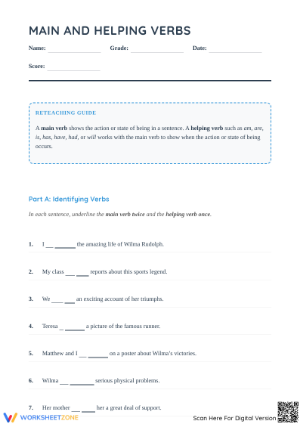
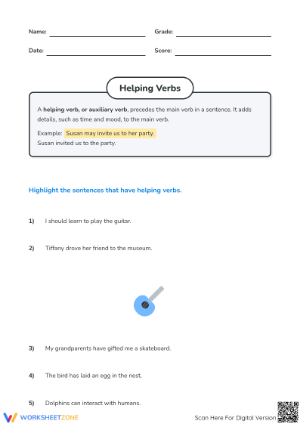
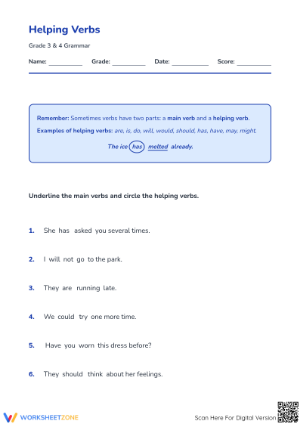
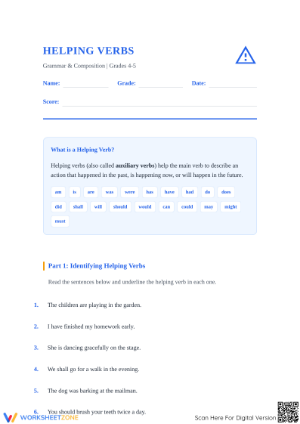
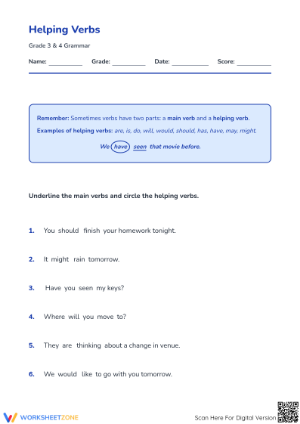
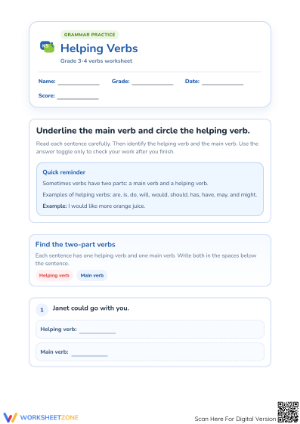
These 4th grade helping verbs worksheets resources give teachers targeted practice on one of the trickier grammar shifts in upper elementary: the point where students stop thinking of verbs as single words and start recognizing verb phrases. Each worksheet isolates a specific skill — identifying helping verbs in context, choosing the right modal auxiliary, or distinguishing auxiliary is from linking is — so instruction stays focused rather than scattered across too many concepts at once.
The Specific Grammar Skills in the Set
The worksheets address helping verbs across several dimensions. Students work with forms of to be (am, is, are, was, were, being, been), to have (have, has, had), and to do (do, does, did) as they appear inside verb phrases. Separate exercises target modal auxiliaries — can, could, will, would, shall, should, may, might, must — with tasks that ask students to sort modals by what they express: ability, possibility, permission, or obligation.
Additional exercises ask students to:
- Underline the complete verb phrase in a sentence and label the helping verb and main verb separately
- Rewrite sentences to shift tense by swapping one helping verb for another ("She is running" → "She was running")
- Select the modal that matches a described condition — a task that forces students to choose between must and should, or between may and can, based on sentence meaning rather than familiarity
- Identify helping verbs in questions, where the helping verb appears before the subject rather than directly beside the main verb
Errors Students Make That These Worksheets Help You Catch
The helping verb / linking verb overlap is the most consistent trouble spot at this level, and the confusion is structurally predictable. Words like am, is, are, was, and were can function either way. A student who correctly marks "is" as a linking verb in "The dog is friendly" will frequently mark "is" the same way in "The dog is chasing the squirrel" — same word, same instinct, wrong call. Without a task that puts both sentence types side by side and asks students to justify their reasoning, that error stays invisible in student work.
Questions surface a second distinct pattern. In "Does she play soccer?", the verb phrase is does play, but the subject ("she") splits the two parts. Students trained to find a main verb next to its helper miss this structure entirely — they circle "play" and move on, never registering "does" as part of the verb at all. These 4th grade helping verbs worksheets exercises address that split structure directly, which is not something every grammar resource at this level handles.
Modal confusion is a third common issue. Many fourth graders treat must and should as interchangeable, not yet sensing the difference between obligation and recommendation. The modal-selection tasks give that distinction repeated, low-stakes practice before it has to show up correctly in a writing assignment.
Standard Alignment
CCSS.ELA-LITERACY.L.4.1.C requires fourth graders to use modal auxiliaries to convey various conditions. That standard appears at fourth grade specifically because students at this level are expected to begin expressing nuance in writing — not just what happens, but how certain, obligatory, or possible the action is. The modal exercises in this set give students the controlled, sentence-level practice that standard requires before they are expected to apply modal choice independently in paragraphs or essays.
The set also supports L.4.1 more broadly, which covers correct use of standard English grammar conventions. Verb phrase identification, tense consistency, and helping verb selection all fall within that umbrella, making these worksheets useful throughout a grammar unit rather than only during a single lesson on modals.
How to Build These Worksheets Into Your Lesson Plans
The most effective placement depends on where you are in the unit. Worksheets focused on identifying helping verbs in simple declarative sentences work well as a 10-minute morning grammar task during the first week of instruction — students need repeated exposure to the concept before they can apply it under any pressure. The modal auxiliary worksheets hold up better as small-group work, because the condition-matching tasks prompt discussion that sharpens student reasoning before anything gets written down.
One consistent classroom move: after students finish any identification task using these 4th grade helping verbs worksheets materials, have two or three students read a sentence aloud and name the helping verb before the class moves on. That two-minute verbal check surfaces the students who marked answers without processing them — a real pattern with fourth graders who have learned to fill in blanks quickly. The worksheets also hold up as sub-day grammar activities because the instructions are direct enough that students do not need teacher facilitation to begin.
Adjusting the Work for a Range of Learners
Students who are still building fluency with basic verb identification benefit from keeping the 23 helping verbs list visible while they work. This is not a shortcut — it reduces retrieval demand so students can put their attention on the structural task at hand: is this word part of a verb phrase? Once they can work without consulting the list, that is when you pull it away. Moving these students through identification exercises before modal-selection tasks also reduces the processing load enough for them to stay in the task rather than shutting down.
Advanced students who move through identification quickly can be pushed into application. Take a sentence from a completed 4th grade helping verbs worksheets exercise and ask them to rewrite it three ways: once with a different modal, once in a different tense, once as a question. That rewriting task reveals whether a student truly understands what the helping verb is doing or has simply learned to locate it. For students who struggle specifically with question-structure tasks, a brief whiteboard mini-lesson — project a question, have students rewrite it as a statement, find the verb phrase together — gives them a concrete entry point before they attempt the written exercise on their own.
Frequently Asked Questions
What is the simplest way to explain the difference between a helping verb and a linking verb to a fourth grader?
Tell students to check whether a second verb follows. Linking verbs stand alone: "She is tired." Helping verbs always lead into a main verb: "She is sleeping." If there is a second verb after the be-form, it is a helper. That test works reliably for the sentence types students encounter at this grade level, and it gives them a self-correction move they can apply during writing.
My students keep mixing up can and may. Will the worksheets address that?
Yes. The modal exercises ask students to match the word to a described condition — ability, permission, possibility, or obligation — rather than fill in any modal that sounds reasonable. That condition-matching task forces the distinction. It does not resolve the confusion in one sitting, but it builds a framework students can return to when making modal choices in their own writing.
How do I use these for students working below grade level in grammar?
Start them with the verb phrase identification exercises and hold off on the modal tasks until they can reliably find a helping verb in a simple sentence. Keep the helping verbs reference list available during the first few exercises. Treat those early worksheets as formative check-ins — the patterns in their errors will tell you whether the gap is in vocabulary (they do not recognize the helping verbs as a category) or in structure (they cannot parse the phrase).
Can I use these worksheets as a formal grammar grade?
The identification and labeling exercises translate cleanly to a formal grade because the answers are unambiguous. Modal-selection tasks are equally gradable. Where to be cautious: early sorting and categorization tasks are better used as formative check-ins than as summative grades. What a student does with those tasks in the moment tells you more about next steps than any score would.












 Interactive Worksheet Maker
 Quiz Maker
 Word Search Maker
 Crossword Puzzle Maker
 Word Scramble Generator
 Sentence Scramble Generator
 Handwriting Worksheet Generator
 Name Tracing Generator
 Fill In The Blank Generator




 BACK TOSCHOOL