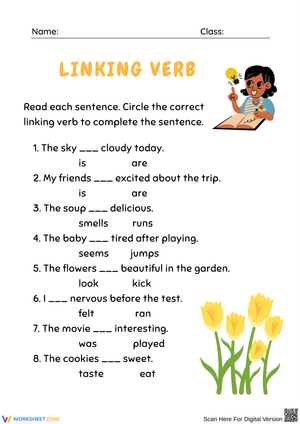
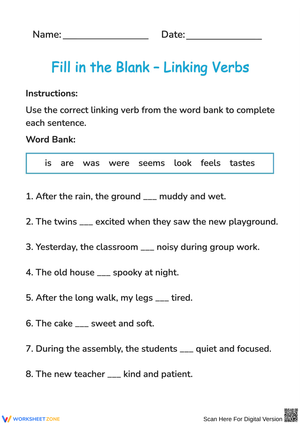
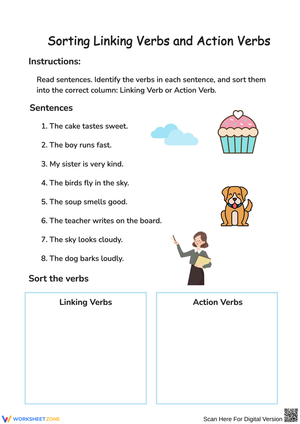
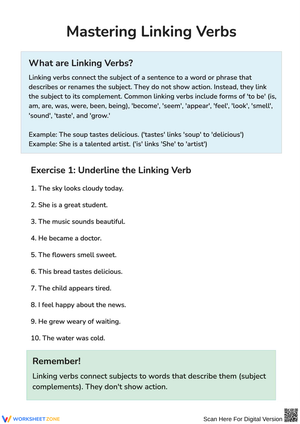
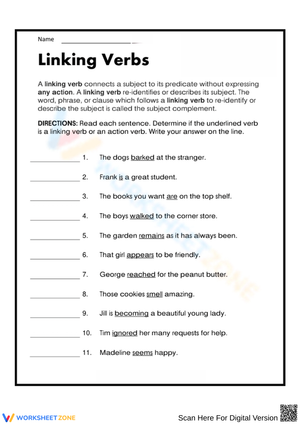
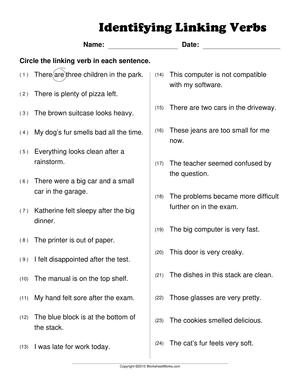
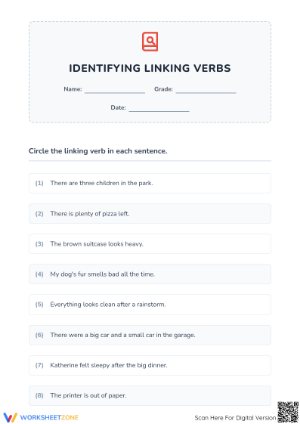
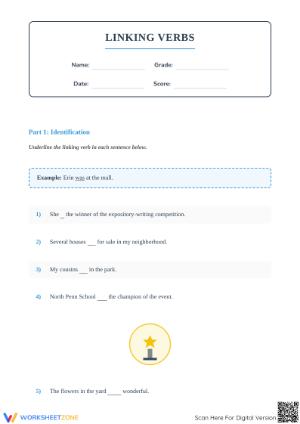
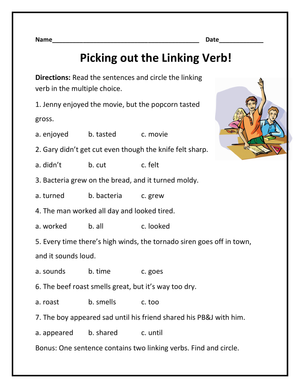
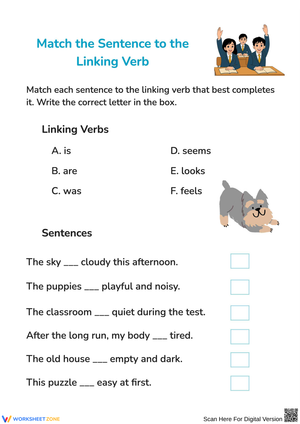
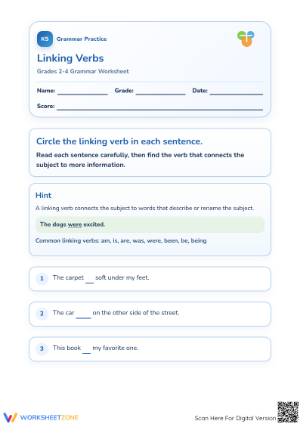
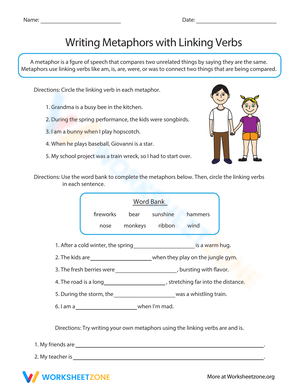
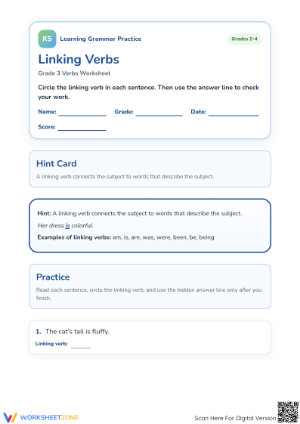
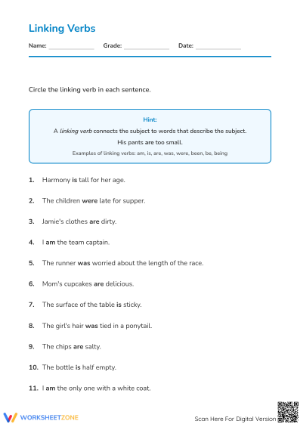
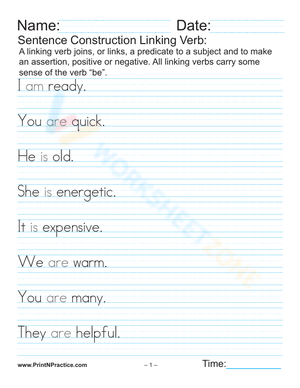
These 4th grade linking verbs printable worksheets give teachers ready-made sentence-level practice for one of upper-elementary grammar's trickier distinctions — the moment students realize that some verbs can work two completely different ways depending on the sentence around them. Each worksheet targets a specific part of that skill, from identifying straightforward be-verb constructions to working through sentences where verbs like look, smell, and taste shift function based on what follows them. The set moves students through the concept in a deliberate sequence without requiring teachers to build every activity from scratch.
The Skills These Worksheets Build
The central task in each worksheet is deciding what a verb is doing in a particular sentence — not what it looks like in isolation, but whether it connects the subject to a description or a new name, or whether it shows an action. Students underline linking verbs, mark the subject complement, and classify verbs in sentences where function is determined entirely by context. The 4th grade linking verbs printable worksheets in this set cover that progression from straightforward identification to nuanced classification, giving teachers a full range of practice formats in one resource.
Across the set, students work through:
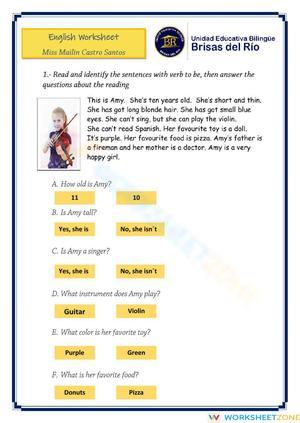
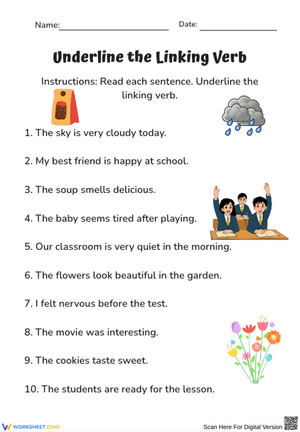
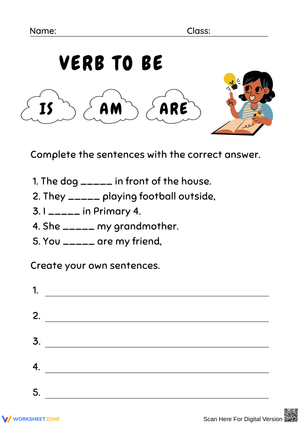
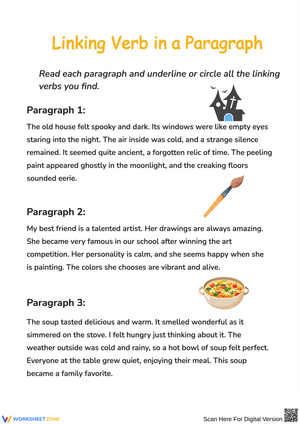
- identifying linking verbs in sentences using common forms of be, seem, become, feel, appear, and sensory verbs
- distinguishing linking from action uses of the same verb in paired sentences
- underlining the subject complement and naming whether it is a noun, pronoun, or adjective
- rewriting sentences to substitute one linking verb for another without changing meaning
- editing practice where students correct errors in verb usage
Rewrite tasks belong in a set like this because they reveal whether students understand the grammar or have only memorized a list. A student who can substitute appears for seems in The dog seems tired has grasped the relationship between verb and complement — not just catalogued a set of words.
Mistakes Students Make That These Worksheets Help You Catch
The predictable split in Grade 4 classrooms goes like this: most students identify is, was, and were correctly on the first try, because those verbs rarely appear in action-verb contexts that could mislead them. The real confusion starts with sensory and perceptual verbs. A student who handles The sky is clear without difficulty will mark looks as an action verb in The coach looks frustrated, reasoning that looking is something you do. That same student will often mark smell as a linking verb in She smells the cookies — because it appears on the class anchor chart right next to feel and taste.
The error isn't random guessing — it's a reasonable misapplication of a partial rule. Students have absorbed that certain verbs "belong" in the linking category, so they apply that label regardless of what the verb is actually doing in the sentence. The fix is redirecting attention away from verb identity and toward sentence structure: what word does this verb point back to, and does that word describe or rename the subject? A student who can ask that question independently will catch these errors themselves, which matters far more than any list they've committed to memory.
Recommended Lesson-Planning Strategies for These Worksheets
The most efficient approach is a gradual-release sequence spread across two or three days. On day one, introduce the concept with a handful of anchor sentences on the board — one action verb, one linking — and assign the first worksheet as guided practice while students are still in whole-group mode. On day two, bring in a worksheet featuring dual-function verbs, the ones that shift between linking and action depending on the sentence, and work through the first few items together before releasing students independently. By day three, a mixed-review worksheet serves as both additional practice and a quick formative check of who needs a small-group follow-up.
Outside a formal grammar unit, these worksheets sit naturally in the last ten minutes before a specials rotation or as the first task in morning work. A short, five- or six-item worksheet surfaces confusion without turning a review moment into a full lesson. Scanning the class set afterward and marking where errors cluster takes about two minutes — and that cluster tells you exactly which mini-lesson to run later in the week. Teachers who work 4th grade linking verbs printable worksheets into a weekly grammar spiral find that student errors on dual-function verbs drop significantly by mid-year, particularly once students have the "what does it point back to?" test internalized.
Differentiating These Worksheets for a Range of Learners
For students who are still getting their footing with the concept, restrict early practice to be-verb sentences. Sentences like The answer is correct and They were ready make the subject-complement relationship visible without introducing the action/linking ambiguity. Once those students show they can identify the verb and the word it connects the subject to, bring in seem, become, and feel — verbs that function as linking verbs in almost every Grade 4 reading context. Reserve dual-function verbs for when that foundation is solid.
Students who are ready for more should move from identification into production. Asking them to write two sentences using the same verb — one linking, one action — forces them to think about sentence structure rather than verb identity. Using look or smell for this task works especially well because both verbs shift function often enough to require genuine reasoning. It's a stronger check of understanding than any fill-in-the-blank item, and it surfaces thinking that multiple-choice formats can't reach.
Practical adjustments that work across a full class range:
- offer a reference list of common linking verbs for students who need it during independent work
- pre-highlight the subject in each sentence for students who lose track of what the verb is supposed to connect to
- use sentence frames ("The verb ___ is linking because it connects ___ to ___") for students who understand the concept but struggle to articulate their reasoning in writing
- pair students for partner checks on mixed-review work so errors surface during practice rather than after
- assign open-response challenge items to students who are ready — write a sentence where taste is linking, then write another where it is not
Standard Alignment
These worksheets align to CCSS.ELA-LITERACY.L.3.1.a, which requires students to explain the function of verbs in general and in particular sentences. That standard is introduced at Grade 3, but Grade 4 instruction extends it into more complex sentence contexts — exactly where linking verbs become harder to separate from action verbs. Many Grade 4 ELA scope-and-sequence documents treat L.3.1.a as review and extension material in the first quarter of the year, before students move into progressive verb tenses and modal auxiliaries under L.4.1. Placing these worksheets in that early review window keeps practice directly connected to what students are accountable for and builds the grammatical reasoning they'll need throughout the rest of the year.
Frequently Asked Questions
Which verbs give Grade 4 students the most trouble?
The sensory verbs — look, smell, taste, feel, and sound — consistently cause the most confusion because each one can function as either a linking verb or an action verb. A student who handles is and seems correctly will often stumble on The soup tastes salty versus She tastes the soup, because the verb looks identical and only the sentence structure reveals the difference. These are the items worth prioritizing in any reteach session.
How do teachers explain linking verbs without relying on lists?
The most transferable explanation is structural: ask students what comes after the verb and whether that word describes or renames the subject. If cold follows feels and cold describes the room, then feels is linking. If the wall follows feels and the wall is what she's touching — not a description of her — then feels is action. That test works on sentences students haven't seen before, which is the actual instructional goal.
Can these worksheets serve as a formative assessment?
A six- to eight-item worksheet with a mix of be-verb sentences and dual-function verb sentences gives enough information to sort students into three clear groups: those who have the concept fully, those who handle only be-verbs correctly, and those who need the whole idea reintroduced. That sorting makes small-group follow-up far more targeted than reteaching to the whole class after a single exit ticket.
Where do these worksheets fit in a grammar unit sequence?
Most Grade 4 grammar units introduce verbs broadly before narrowing to specific types. These worksheets work best after students have a working definition of action verbs, so the linking verb distinction has something concrete to contrast with. Introducing linking verbs before action verbs are solid leads to practice where students guess rather than reason. Once that contrast is in place, 4th grade linking verbs printable worksheets fit naturally as the first independent practice in the unit, then again as spiral review four to six weeks later.












 Interactive Worksheet Maker
 Quiz Maker
 Word Search Maker
 Crossword Puzzle Maker
 Word Scramble Generator
 Sentence Scramble Generator
 Handwriting Worksheet Generator
 Name Tracing Generator
 Fill In The Blank Generator




 BACK TOSCHOOL