These 4th grade descriptive verbs printable worksheets resources give students structured practice replacing overworked verbs with ones that actually carry meaning — the kind of single-word swap that turns "the boy went across the room" into "the boy crept across the room" or "the boy lunged across the room" depending on what the writer actually intends. Teachers get a set of standalone worksheets that move from recognition through revision to original sentence writing, following the full progression of the skill without padding the sequence with busywork.
What Students Practice in Each Worksheet
The worksheets cover five distinct task types, and that range is intentional. Students who only ever circle verbs in a list never learn to choose better ones in their own sentences, so the set pushes toward application early.
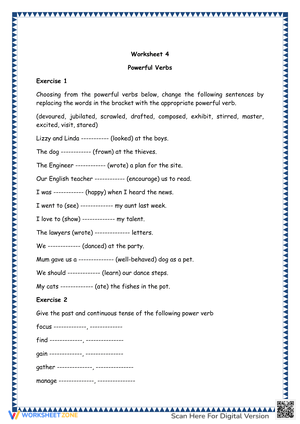
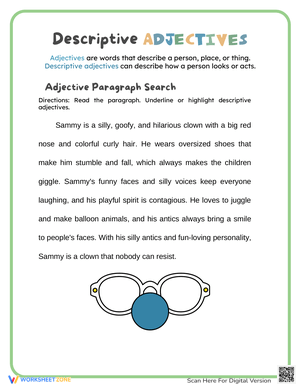
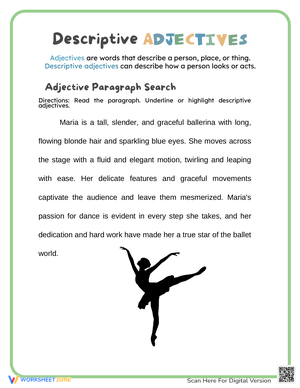
- Identification and sorting: Students underline or categorize verbs in sentences, distinguishing between general choices (go, get, do) and vivid ones (scramble, seize, dart).
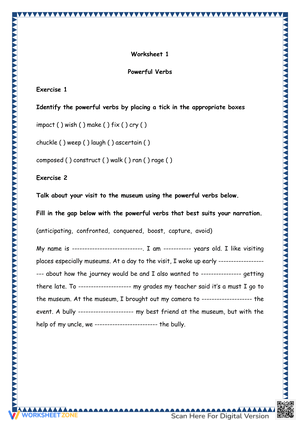
- Word bank replacement: Students swap a weak verb for a stronger choice drawn from a short, curated list, keeping the sentence structure intact.
- Fill-in-the-blank selection: Students choose the most precise verb to complete a sentence, often from two or three close options that demand genuine comparison.
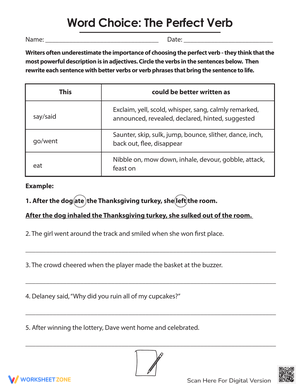
- Sentence revision: Students rewrite a plain sentence by changing only the verb — or by improving the full sentence when a stronger verb opens up more possibilities.
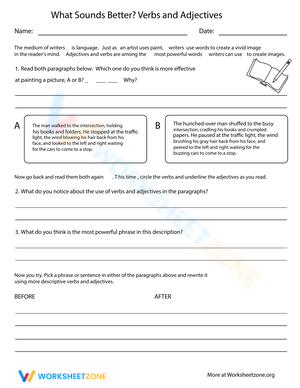
- Short passage editing: Students read a paragraph and replace repeated or vague verbs with more specific choices, which mirrors what real revision looks like.
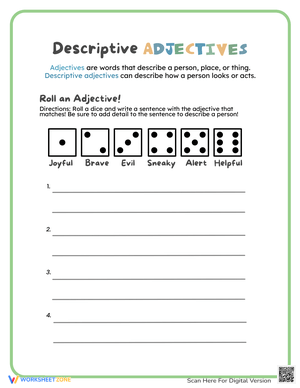
- Original sentence writing: Students compose their own sentences using a set of target verbs, the step that transfers worksheet practice into actual writing behavior.
Familiar topics — animals moving, characters in action, weather changes — keep the content simple so students can focus on the verb rather than on decoding what a sentence is about.
Frequent Student Errors Worth Watching For and Addressing
The most consistent error is what teachers sometimes call "said-blindness." Students who eagerly swap "walked" for "sprinted" will still leave "said" untouched across six lines of dialogue — it feels invisible to them. When a revision worksheet includes dialogue, most students change every movement verb and miss every speech verb entirely. Flagging this before students start the worksheet prevents frustration and turns it into a productive teaching moment rather than a surprise during review.
A second pattern shows up during word bank tasks: students pick the most visually impressive verb rather than the one that fits the sentence. "Catapulted" beats out "trotted" because it looks more exciting, even when the sentence describes a cat moving across a sunny porch. Modeling by meaning — reading the sentence aloud, picturing the action, then testing the verb — helps students use the bank as a thinking tool instead of a guessing game.
Third, and subtler: students who successfully revise an isolated sentence often revert to flat verbs the moment they return to their own drafts. The gap between "I can improve a sentence someone gave me" and "I notice my own weak verbs" is real. Building in a brief transfer step — asking students to mark three verbs in their current draft right after finishing the worksheet — closes that gap faster than additional isolated practice alone.
How to Build These Worksheets Into Your Lesson Plans
A reliable entry point is the Monday morning warm-up block: put one plain sentence on the board, crowd-source five stronger verb replacements, then hand out the worksheet. Students arrive already in verb-comparison mode, and the transition to independent work takes under a minute. The 4th grade descriptive verbs printable worksheets set works particularly well here because each worksheet targets a single task type, so there is no confusion about what students are supposed to be doing.
Literacy centers are another strong fit. Two students completing the same revision worksheet can compare their verb choices aloud and debate which option sounds strongest in context — that conversation is more instructive than silent individual work because it forces students to articulate why one verb works better than another. For homework, reach for the fill-in-the-blank or word bank replacement worksheet rather than the open-ended revision, since those tasks give families a clear frame without requiring materials or explanation beyond the worksheet itself.
Before a narrative writing assignment, run the short passage editing worksheet as a whole-class warm-up. Read the paragraph aloud with the weak verbs in place, then ask students to revise — the contrast between the original and the improved version sets up a direct conversation about how verb choice shapes the reader's experience. That five-minute exchange does more to motivate verb revision in student drafts than multiple rounds of isolated drilling.
Adjusting the Worksheets for Students at Different Levels
For students who need more support, keep a visible category chart nearby — movement verbs in one column, speech verbs in another, emotion verbs in a third. Words like stomped, tiptoed, rushed, and wandered in one group; muttered, announced, snapped, and pleaded in another. Students still do their own thinking, but the chart removes the vocabulary barrier that otherwise stalls them before they can practice the actual skill.
Grade-level students work through the worksheets in the standard sequence — identification, replacement, revision, original writing — with teacher check-ins after the replacement and revision steps. The 4th grade descriptive verbs printable worksheets set covers enough variety that teachers can pull any single worksheet for a focused 15-minute block without the broader sequence falling apart.
Students who move quickly benefit from an added constraint: ask them to use a target verb in a sentence where it is the only precise word that works — not just a word that fits, but the word. This pushes them from fluency into intentionality. A student who can argue why "crept" is better than "shuffled" in a specific sentence understands verb choice at a level that carries directly into their narrative writing.
Standard Alignment
The strongest standards match is CCSS.ELA-LITERACY.L.4.3.A — "Choose words and phrases to convey ideas precisely." That standard sits in the Language strand and explicitly targets intentional word selection, which is exactly what descriptive verb practice trains. Teachers following district pacing guides typically address L.4.3.A during the narrative writing unit, where it intersects with CCSS.ELA-LITERACY.W.4.3.D, which asks students to use concrete words and sensory details to convey experiences precisely. Running verb choice worksheets during that instructional window gives students practice at the word level that transfers directly into their writing assignments — the language standard and the writing standard reinforce each other when they land in the same week of instruction.
Frequently Asked Questions
Are these worksheets suitable for sub plans or homework?
The fill-in-the-blank and word bank replacement worksheets work best in both settings. Both give students a self-contained task that does not require a teacher introduction or a follow-up discussion to make sense. Answer keys keep review fast, and for open-ended revision items, accepting any strong verb that genuinely fits the sentence keeps grading flexible without being vague.
How many worksheets should I work through before expecting students to transfer the skill into their own writing?
Most students need three to five exposures across different task types before the revision habit starts appearing in drafts. Identification and replacement tasks build recognition; revision and original writing tasks build application. Teachers who skip straight to original writing often find students reverting to flat verbs because they have not yet internalized what the comparison feels like. Moving through the sequence matters, even if you spend only one class session at each step.
How do I grade the open-ended revision items when multiple answers are acceptable?
Grade by criteria rather than exact match. A revised sentence earns credit when the replacement verb is more specific than the original, fits the meaning of the sentence, and sounds natural in context. Establishing that expectation with students before the first revision task — "I'm looking for a verb that does more work, not just a different verb" — gives them a usable frame and makes your grading consistent. The 4th grade descriptive verbs printable worksheets format makes this manageable because the tasks are narrow enough that students rarely land on something completely off-base.












 Interactive Worksheet Maker
 Quiz Maker
 Word Search Maker
 Crossword Puzzle Maker
 Word Scramble Generator
 Sentence Scramble Generator
 Handwriting Worksheet Generator
 Name Tracing Generator
 Fill In The Blank Generator




 BACK TOSCHOOL