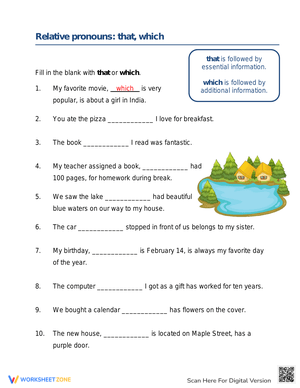
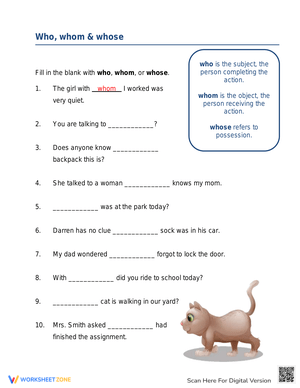
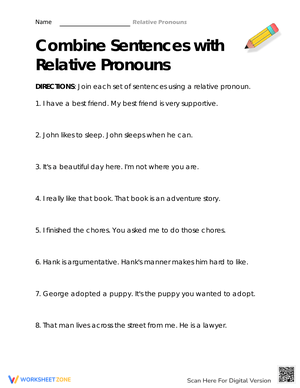
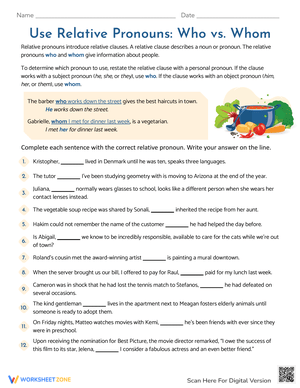
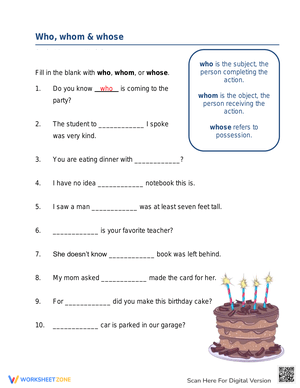
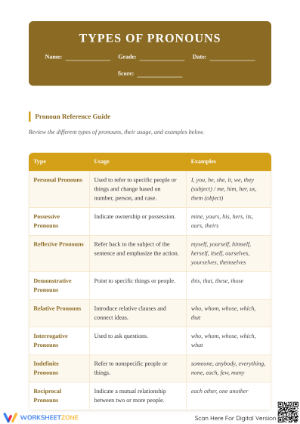
These 4th grade relative pronouns pdf worksheets give teachers a no-prep grammar set that moves students from simple recognition to active sentence construction — the full arc this skill actually requires. The five relative pronouns — who, whom, whose, which, and that — behave differently depending on whether they refer to a person, an object, or possession, and fourth graders need repeated sentence-level exposure before those distinctions feel automatic. Each worksheet keeps the focus on complete sentences rather than vocabulary lists, which is where the learning actually takes root at this grade.
What's Inside the Set
Five distinct task types appear across the worksheets, each targeting a different layer of how this skill works:
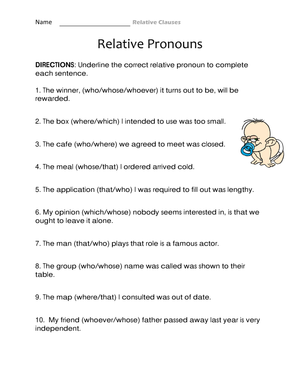
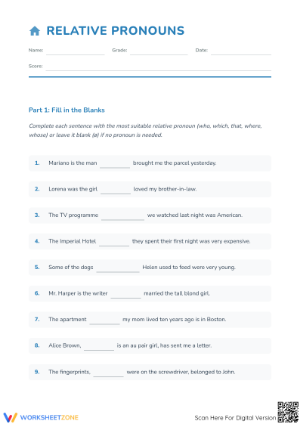
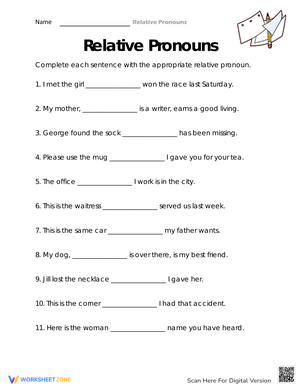
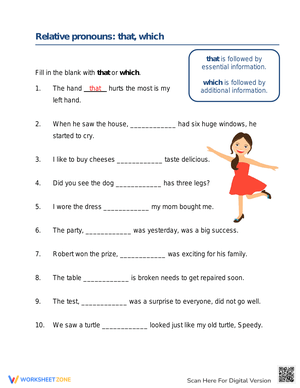
- Sentence completion: Students choose among who, which, whose, and that to finish a sentence correctly.
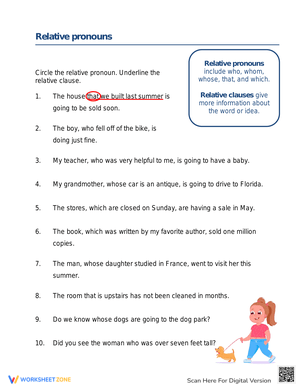
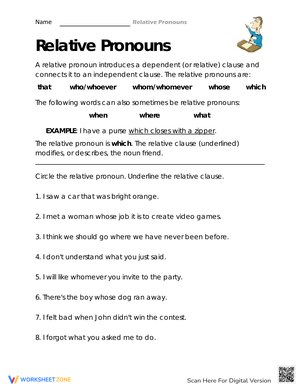
- Antecedent identification: Students circle the relative pronoun and draw an arrow back to the noun it refers to — the step most other worksheet formats skip.
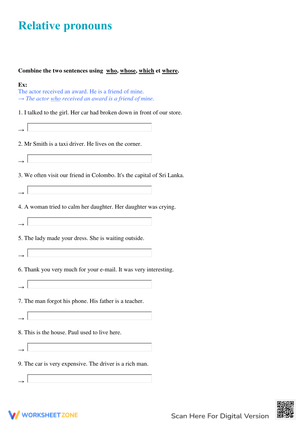
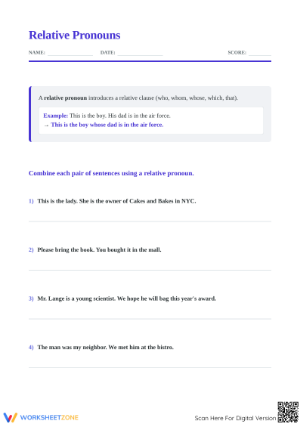
- Sentence combining: Students merge two short sentences into one using the appropriate relative pronoun.
- Editing: Students fix a sentence with an incorrect or missing pronoun choice.
- Original writing: Students write their own sentence using a given relative pronoun, with no word bank provided.
That last task is the meaningful test. A student who can circle who in a sentence is not yet demonstrating the same understanding as a student who writes The librarian who orders the graphic novels stayed late without any prompt structure to lean on.
Frequent Errors Worth Catching Early
The most common mistake fourth graders make is using which for a person instead of who. Students write The boy which won the trophy smiled and read it back without noticing the problem. They have heard which in conversation, and the sentence still sounds complete to them. A second persistent error is attaching the relative pronoun to the wrong noun, particularly in sentences with more than one noun before the clause. In The principal visited the teacher who earned the award, many students correctly underline teacher as the antecedent — but when they write their own version, they accidentally tie the clause to the subject of the sentence instead. The antecedent-identification task in each worksheet applies direct pressure to exactly that relationship.
There is also a production gap that sentence completion alone does not expose. Students who choose correctly from a word bank will sometimes stall completely on an open writing prompt. That gap — between selecting and generating — tells teachers something important about where a student's understanding actually stops. The editing and original writing tasks surface this in ways that fill-in-the-blank items cannot.
How to Build These Worksheets Into Your Lesson Plans
A reliable structure is to spread the skill across three or four short sessions rather than one long grammar block. On the first day, model two or three examples with a think-aloud — name the noun, then show how the relative pronoun points back to it. On the second day, assign the sentence completion worksheet as follow-up practice while students are still in guided mode. By the third day, move to sentence combining and then editing. That pacing fits the fifteen to twenty minutes most fourth-grade classrooms can carve out for grammar before transitioning into writing workshop.
One technique that consistently improves accuracy on the combining tasks: ask students to say both short sentences aloud, then say the combined version out loud before writing it. The girl is my neighbor. She bakes bread every Saturday. Spoken first, students hear that who bakes bread every Saturday connects naturally to girl — and they almost always land on who instead of which. The oral step reduces the cognitive load of managing two sentence structures simultaneously while also sorting out pronoun choice. It works especially well on combining tasks where students would otherwise guess.
These 4th grade relative pronouns pdf worksheets also fit well distributed across literacy centers. One center handles sentence completion, another handles combining, and a third handles editing. Because each task is short and self-contained, students cycle through without the sense that they are repeating themselves — and the teacher gets three separate windows into the same skill.
Standard Alignment
These worksheets address CCSS.ELA-LITERACY.L.4.1.a, which specifically requires students to "use relative pronouns (who, whose, whom, which, that) and relative adverbs (where, when, why)." This is one of the few places in the K–5 language standards where relative pronouns appear as a named, discrete skill. Grade 3 does not address them explicitly, and Grade 5 shifts the pronoun focus elsewhere — which makes fourth grade the designated window for introducing, practicing, and consolidating the skill before students encounter more complex sentence structures in upper-elementary reading and writing. Teachers who use each worksheet as a formative tool after a mini-lesson will find the results map directly onto the L.4.1.a expectation.
Differentiating the Set Across Ability Levels
For students still building basic sentence awareness, narrow the practice to who and that only. Those two pronouns cover the most common classroom patterns and carry simpler rules than whose or whom. Use sentences with short, clearly separated nouns so the antecedent is never ambiguous. Covering two pronouns well is more useful than rushing through five.
Students who have already internalized the basic rules benefit from added complexity. Assign the combining tasks with longer base sentences, or give the writing task as an open challenge: write a short paragraph that includes at least two relative clauses. For English language learners, the oral step described above is particularly useful — saying the sentence before writing it mirrors how strong bilingual language processing works and builds confidence before written accuracy is required. Using 4th grade relative pronouns pdf worksheets at multiple entry points across one classroom is entirely workable given how the task types are structured.
Frequently Asked Questions
What is the clearest way to explain who versus which to a fourth grader?
The most direct classroom explanation: who refers to people, and which refers to things or animals. That is flexible and works with people, animals, or things in most elementary grammar examples. Teaching students to ask one question — "Does this pronoun point back to a person or a thing?" — catches the majority of who/which errors before they become ingrained habits. That single habit also transfers into their own writing more reliably than memorizing a list of rules.
Where do relative pronouns fit in a fourth-grade scope and sequence?
Most teachers introduce the skill in the fall or early winter, after pronoun basics from third grade are reviewed, and before students are expected to revise their writing for sentence variety in the spring. The grammar-to-writing connection is worth naming explicitly: relative pronouns are not test-prep vocabulary — they are the specific tools students reach for whenever they need to combine two ideas into one stronger sentence. Establishing that connection early gives the skill a purpose beyond the worksheet.
Can a single worksheet from this set work as a quick formative check?
Yes. One worksheet from the set gives enough information to identify which students can apply the skill independently and which ones need a reteach. The completion task shows recognition. The combining or writing task shows production. If most students finish the completion items correctly but stall on the combining tasks, the next small-group lesson should focus on sentence structure rather than pronoun vocabulary. These 4th grade relative pronouns pdf worksheets are short enough to use as a quick formative check without consuming a full class period, and the results point directly toward whatever instructional move comes next.












 Interactive Worksheet Maker
 Quiz Maker
 Word Search Maker
 Crossword Puzzle Maker
 Word Scramble Generator
 Sentence Scramble Generator
 Handwriting Worksheet Generator
 Name Tracing Generator
 Fill In The Blank Generator




 BACK TOSCHOOL