




























Views
Downloads

Relative Pronouns Printable Worksheet | Grade 4 ELA

Paste this activity's link or code into your existing LMS (Google Classroom, Canvas, Teams, Schoology, Moodle, etc.).
Students can open and work on the activity right away, with no student login required.
You'll still be able to track student progress and results from your teacher account.
This comprehensive relative pronouns worksheet helps fourth-grade students master the use of who, whom, whose, which, and that. By completing targeted grammar exercises, learners will improve their sentence structure and writing clarity, ensuring they can connect clauses smoothly and accurately in their everyday communication.
At a Glance
- Grade: 4 · Subject: ELA
- Standard:
CCSS.ELA-LITERACY.L.4.1.A— Use relative pronouns and relative adverbs.- Skill Focus: Relative Pronouns
- Format: 3 pages · 27 problems · Answer key included · PDF
- Best For: Independent practice and grammar review
- Time: 20–30 minutes
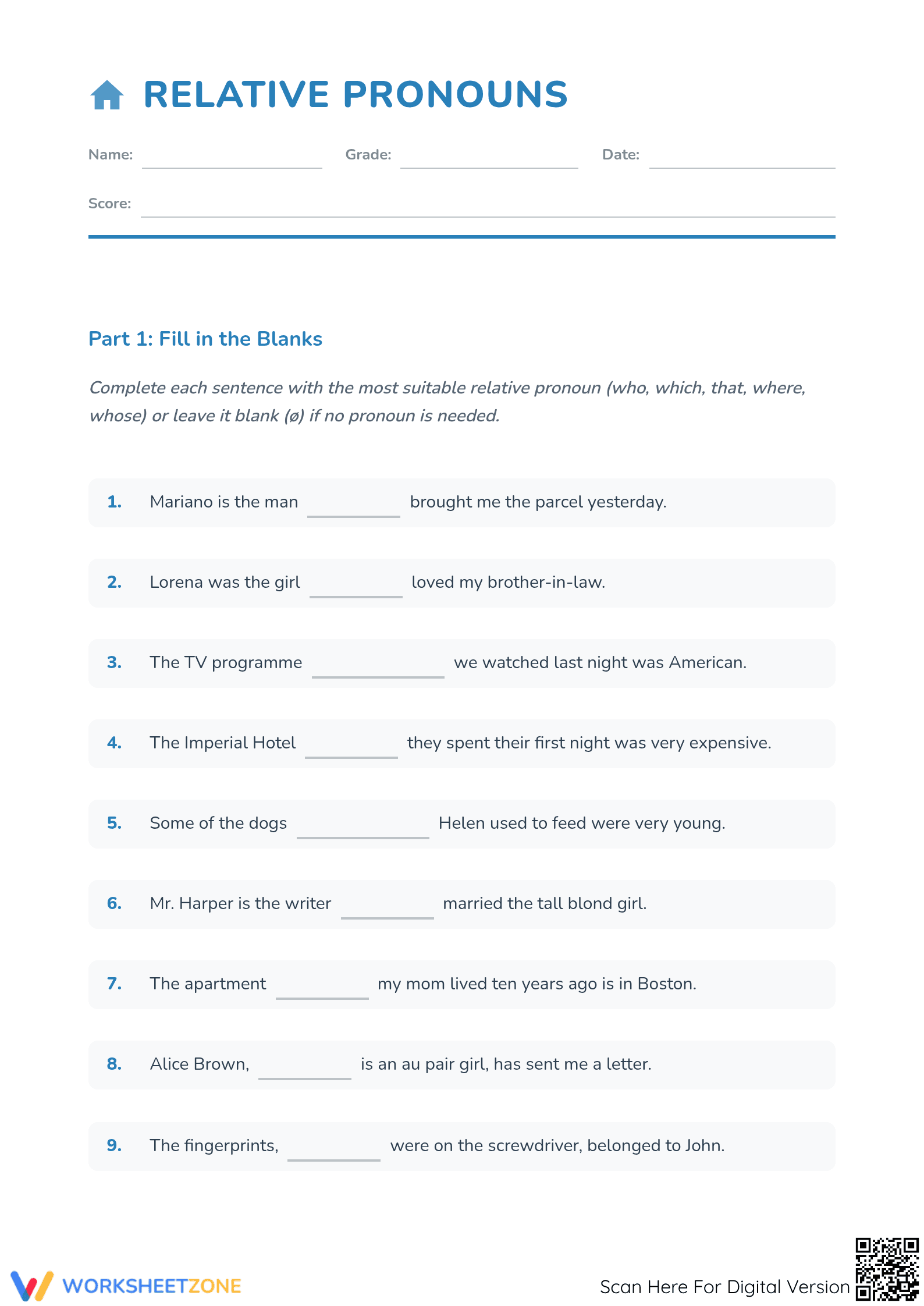
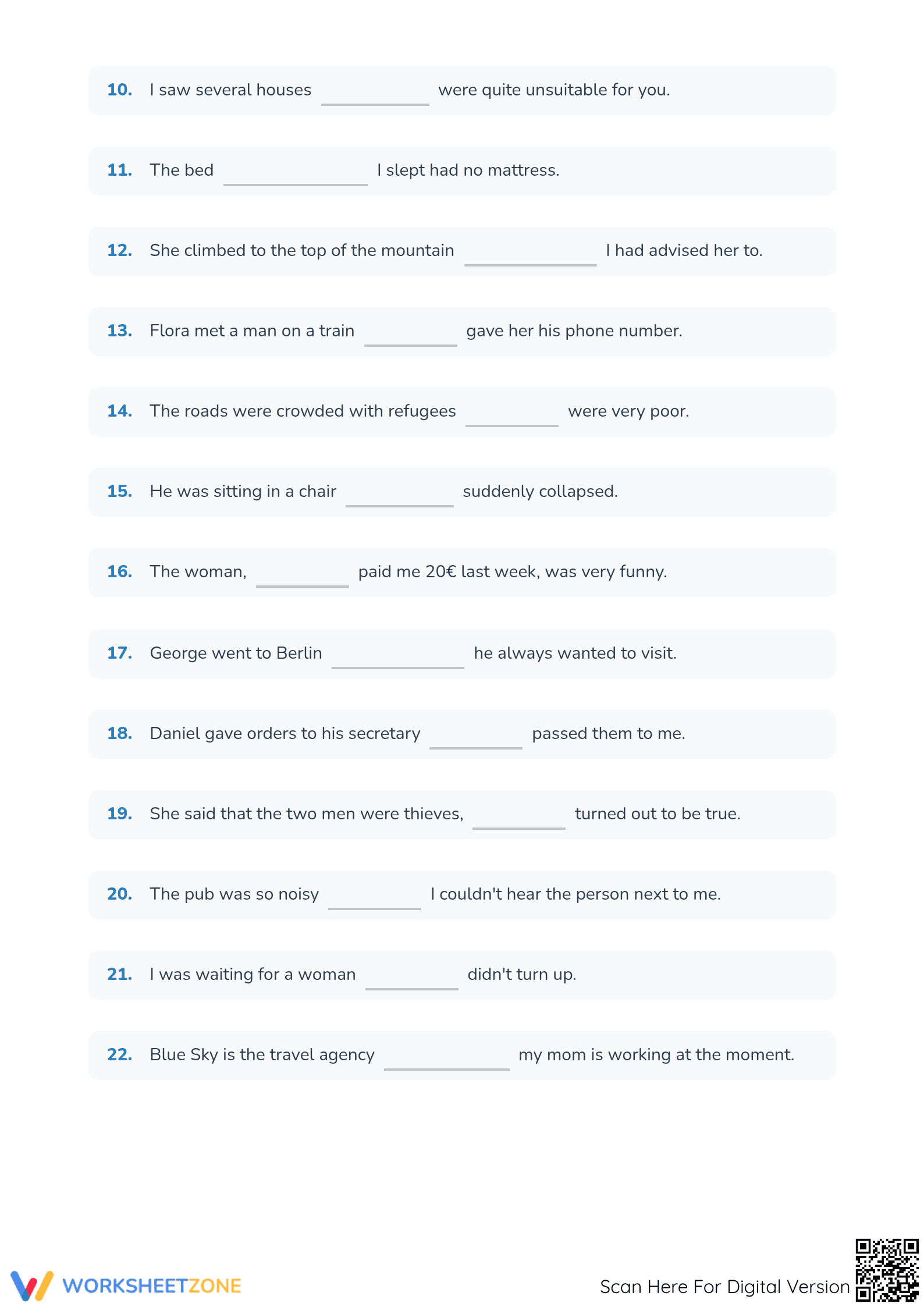
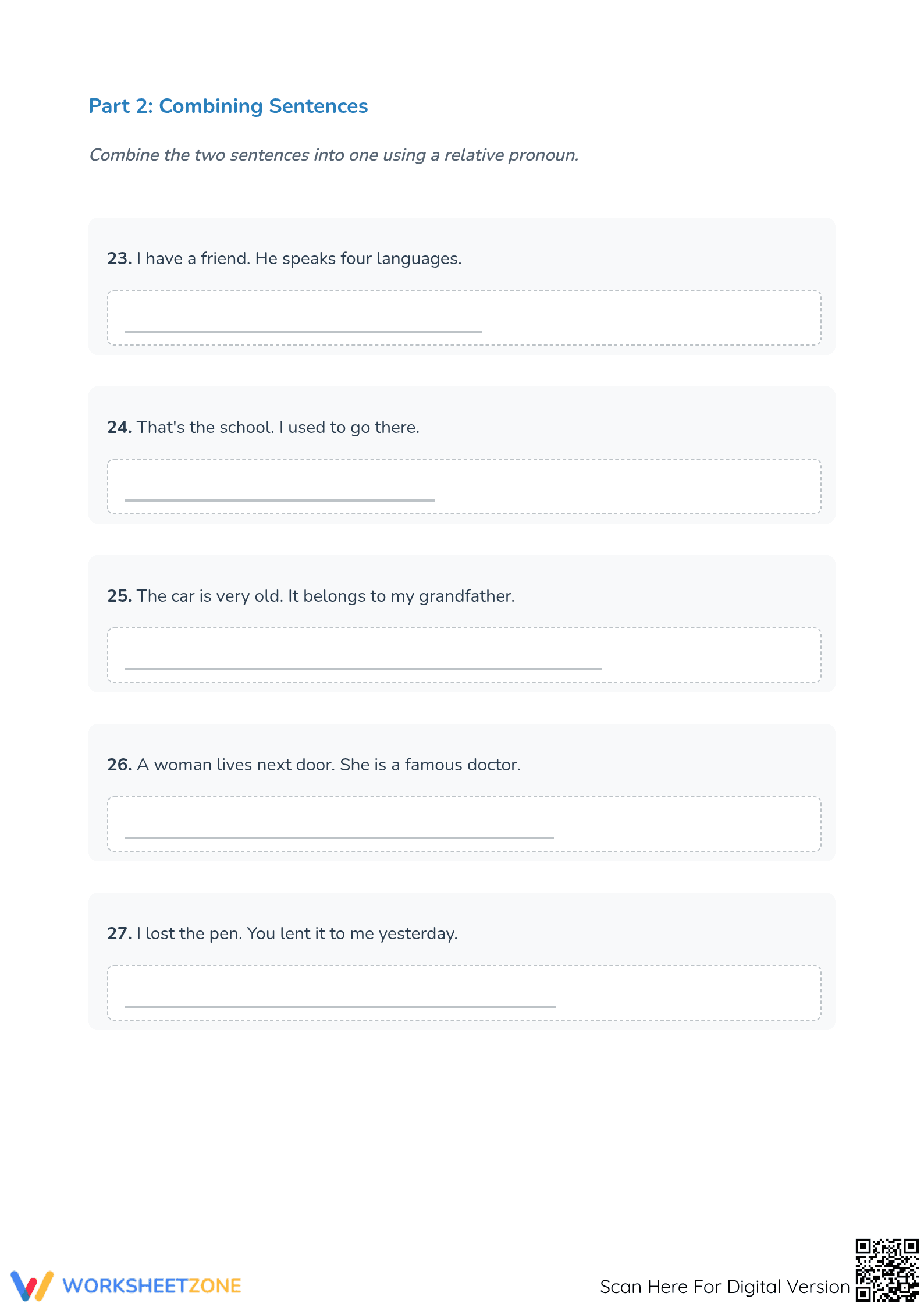
Inside this three-page grammar resource, educators will find two distinct sections designed to build student confidence. Part one features 22 fill-in-the-blank sentences where students must select the most suitable relative pronoun. Part two challenges students with five sentence-combining tasks, requiring them to merge two independent clauses using the correct relative pronoun. A complete answer key is provided for quick and accurate grading.
Skill Progression
- Guided practice: The initial fill-in-the-blank questions offer straightforward context clues, allowing students to easily identify whether a person, place, or thing is being referenced.
- Supported practice: As students move through the 22 sentence-completion tasks, the vocabulary and sentence structures become slightly more complex, reinforcing their understanding of pronoun-antecedent agreement.
- Independent practice: The final five questions require students to synthesize their knowledge by combining two separate sentences into one cohesive thought using a relative pronoun. This gradual-release approach ensures students confidently transition from recognition to application.
Standards Alignment
This resource is directly aligned to CCSS.ELA-LITERACY.L.4.1.A, which requires students to use relative pronouns (who, whose, whom, which, that) and relative adverbs (where, when, why). By practicing these specific grammatical structures, students build the foundational skills necessary for writing complex sentences. Both standard codes can be copied directly into lesson plans, IEP goals, or district curriculum mapping tools.
How to Use It
This worksheet is highly versatile and fits perfectly into a standard literacy block. Use it as independent practice immediately following direct instruction on relative pronouns, or assign it as a focused homework task. As a formative assessment tip, review students' answers on the sentence-combining section to quickly gauge if they understand how relative pronouns function as conjunctions. Most students will complete the entire three-page packet in 20 to 30 minutes.
Who It's For
This resource is primarily designed for fourth-grade students, though it serves as an excellent review tool for fifth and sixth graders who need extra support with complex sentence structures. For students requiring differentiation, teachers can cross out the sentence-combining section and focus solely on the fill-in-the-blank exercises. This worksheet pairs perfectly with a classroom anchor chart detailing the specific rules for using who versus whom.
Mastering grammar mechanics like those found in CCSS.ELA-LITERACY.L.4.1.A is essential for developing strong, independent writers. When students learn to use relative pronouns and relative adverbs effectively, they transition from writing simple, choppy sentences to crafting fluid, complex thoughts. According to Fisher & Frey (2014), explicit grammar instruction combined with immediate, targeted practice significantly improves students' overall writing fluency and reading comprehension. By providing 27 distinct opportunities to apply these rules in context, this worksheet ensures learners move beyond rote memorization and begin internalizing the syntactic patterns required for advanced literacy. Consistent practice with sentence combining, in particular, has been shown to enhance students' ability to manipulate language, ultimately leading to higher achievement across all academic subjects that require written expression.


