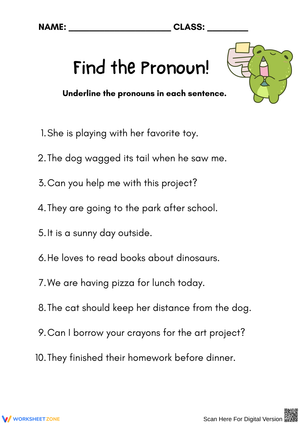
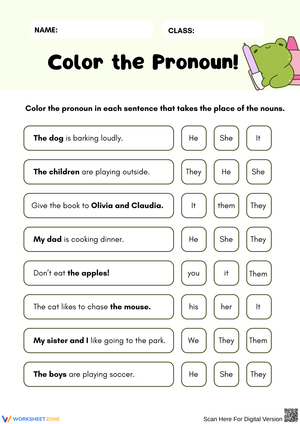
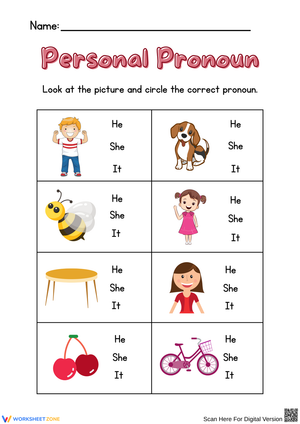
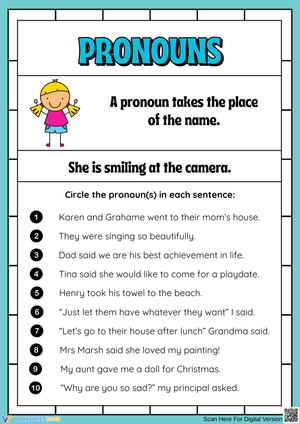
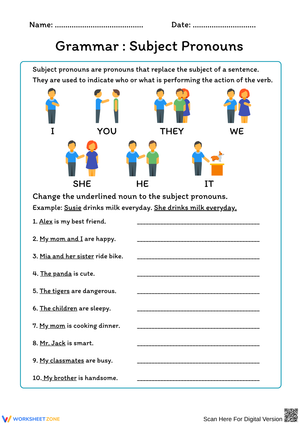
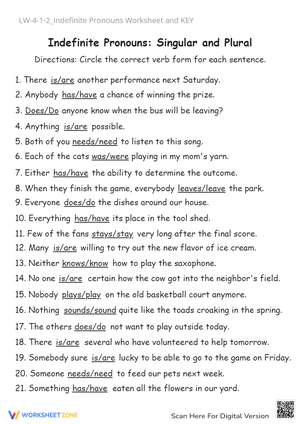
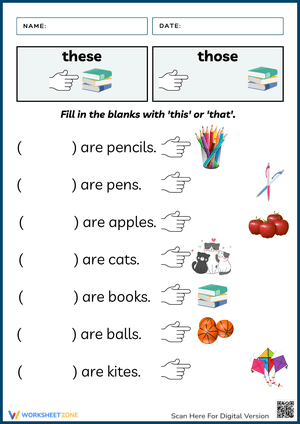
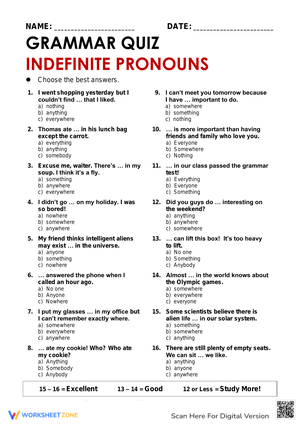
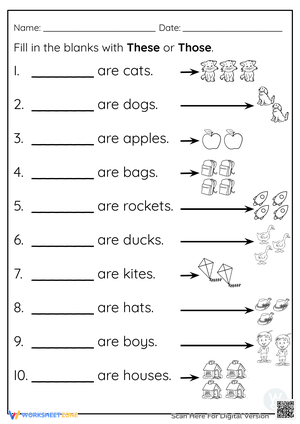
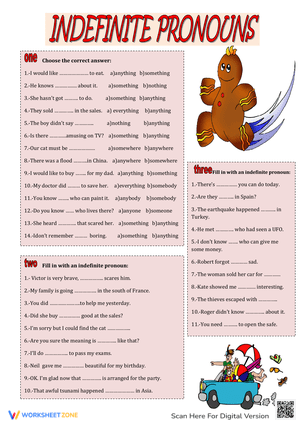
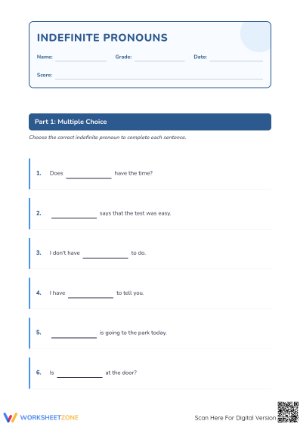
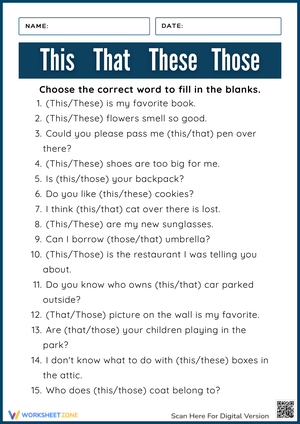
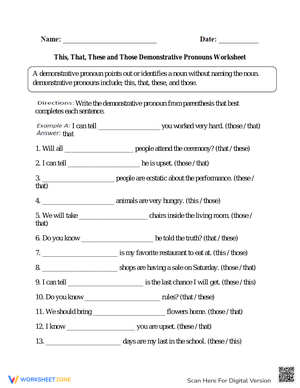
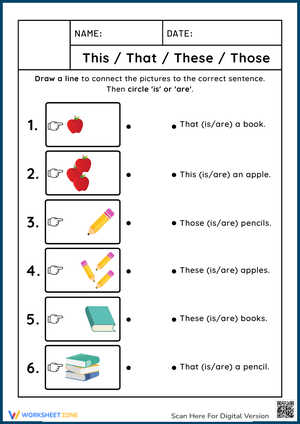
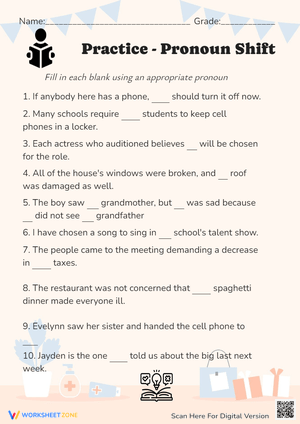
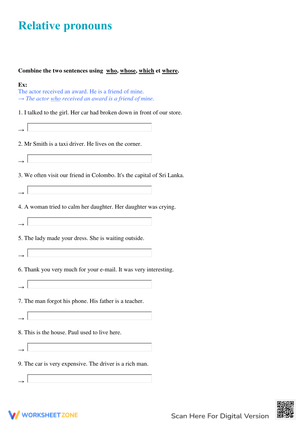
These pronouns pdf worksheets for 4th grade land at a precise moment in the curriculum — when student writing shifts from simple sentences to complex ones, and when vague pronoun reference starts showing up on every page of every writing notebook. The set targets four categories: relative, possessive, reflexive, and pronoun-antecedent agreement, which is the category where fourth-grade essays most visibly fall apart.
What the Set Covers
Each worksheet targets one pronoun category with enough practice items that students internalize the pattern rather than guess through it.
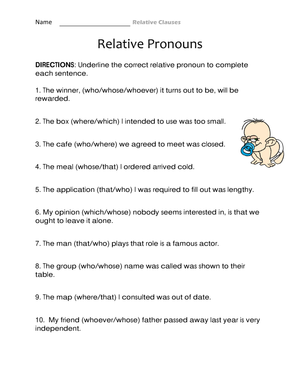
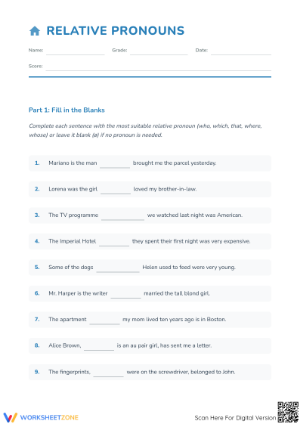
- Relative pronouns — who, whom, whose, which, and that. Students combine two short sentences into one using a relative pronoun, which directly practices the sentence complexity fourth graders need for longer narratives and informational writing. The hard part isn't remembering that "who" refers to people; it's holding that rule while simultaneously managing where the relative clause sits in the new sentence.
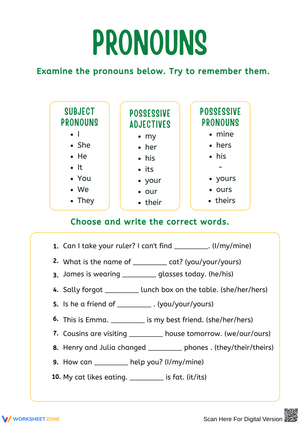
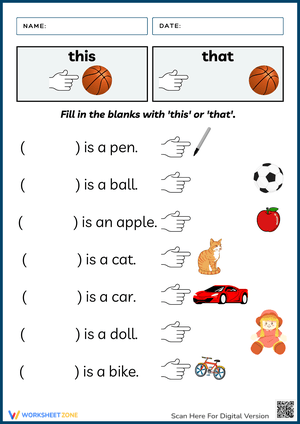
- Possessive pronouns — specifically the distinction between possessive adjectives (her backpack) and independent possessive forms (that backpack is hers). Fourth graders have seen possessives in print for years, but the independent form is often unfamiliar enough to cause hesitation during editing tasks.
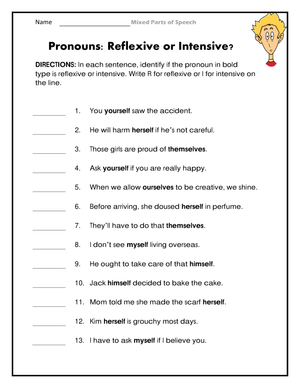
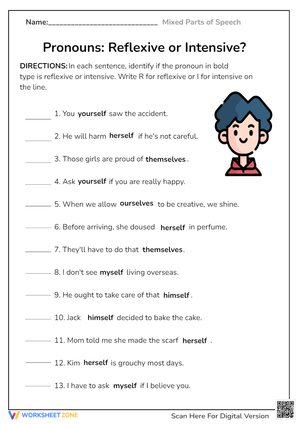
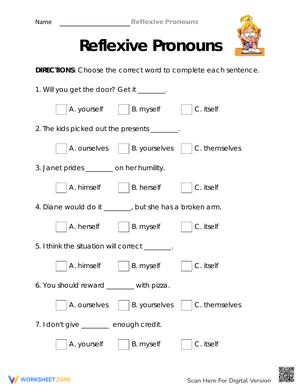
- Reflexive pronouns — myself, yourself, himself, herself, itself, ourselves, yourselves, themselves. Each worksheet asks students to determine whether the subject and object in a sentence refer to the same person before choosing a reflexive form over a personal pronoun.
- Pronoun-antecedent agreement — singular and plural matching, plus gender reference. Students identify errors in given sentences, name the antecedent that creates the problem, and rewrite. This is also the category that surfaces most reliably during one-on-one writing conferences.
Error Patterns Fourth Graders Bring to the Page
The reflexive pronoun errors are the most patterned. Students who have learned "myself" frequently overextend it as a substitute for "me" in compound objects — writing "she handed it to Marcus and myself" instead of "she handed it to Marcus and me." The worksheet format helps because it presents the reflexive form alongside other choices and forces a decision about subject-object identity before the student can select an answer. Interestingly, students who write this exact error in their own compositions almost always catch it when it appears in someone else's printed sentence — which is exactly why editing-focused practice builds awareness faster than isolated grammar drills do.
Agreement errors with collective and indefinite noun antecedents are harder to dislodge. A sentence like "The team celebrated their victory" looks grammatically natural to most nine-year-olds because the word "team" carries a plural feeling. The worksheets address this directly by pairing the collective noun with an unambiguous singular article — "a panel announced their findings" — so students can practice the decision-making step without interference from ambiguous context clues.
Standard Alignment
These pronouns pdf worksheets for 4th grade address CCSS ELA-Literacy.L.4.1, which requires students to demonstrate command of standard English grammar conventions, including the correct use of relative pronouns. The standard specifically names who, whose, whom, which, and that — and the set distributes practice across all five rather than drilling only the two or three that appear in most basal grammar programs. The pronoun-antecedent agreement exercises also support the broader L.4.1 expectation that student writing maintain consistent internal logic at the sentence level, which is increasingly important as fourth-grade compositions grow in length and complexity.
Working These Worksheets Into Your Instructional Week
The most consistent use pattern is the first five minutes of the language arts block. Each worksheet is short enough to finish before a read-aloud or writing lesson begins, and the format — find the error, rewrite the sentence — directly mirrors the revision thinking students need during workshop time. Whole-class review takes about three minutes: put the corrected version on the board, ask two or three students to explain their reasoning aloud, move on. That verbal explanation step matters more than most teachers initially expect; students who can name why a pronoun is wrong make fewer of those errors in their own drafts.
The relative pronoun worksheets sequence most effectively after a lesson on subordinate clauses. Students who have already heard "who" and "which" used as clause connectors in a discussion are noticeably more accurate on sentence-combining items than students encountering both concepts simultaneously. The possessive pronoun worksheets can work in reverse — assigning them before a mini-lesson on independent possessives creates productive confusion that the lesson then resolves, which tends to make the his/hers, their/theirs distinction stick more durably than instruction followed immediately by practice.
Using the Worksheets Across a Range of Student Readiness Levels
For students still building confidence with basic personal pronouns, start with the agreement worksheets rather than the relative pronoun exercises. Agreement work is procedural — match the number of the antecedent to the number of the pronoun — and students can practice it successfully before they are ready to analyze clause structure. Sending those students to the sentence-combining worksheets too early produces random answers, not learning.
Students working above grade level get more from the relative pronoun exercises when the task shifts from selection to generation. Ask them to write two original sentence pairs and combine them using a relative pronoun of their own choosing. That's a meaningfully different cognitive demand than selecting among printed options. A few pronouns pdf worksheets for 4th grade in this set include open-ended extension prompts — those are the items to direct advanced writers toward while on-level students complete the core practice.
Frequently Asked Questions
Which pronoun type is hardest for most fourth graders?
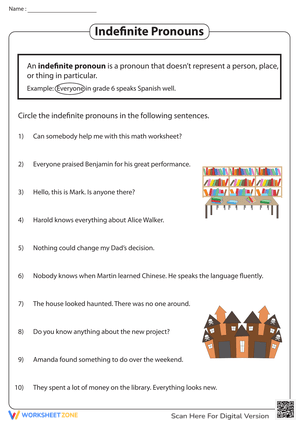
Pronoun-antecedent agreement, particularly with collective nouns and indefinite pronoun antecedents like "everyone" or "each." Students have strong number intuitions that sometimes conflict with grammatical convention — "everyone forgot their homework" sounds right even though "everyone" is grammatically singular. Repeated exposure to marked examples in the worksheets helps, because students begin to recognize the trigger words and pause before choosing a pronoun rather than going with what sounds natural.
How do I explain who versus whom to a nine-year-old without derailing the whole lesson?
The substitution trick works quickly: swap in "he" or "him" and see which sounds right. "Who called?" becomes "He called?" — that holds, so use "who." "Whom did you invite?" becomes "Did you invite him?" — that holds, so use "whom." Four or five examples at the board, two minutes at most, and most students can apply the rule reliably in a controlled exercise. Consistent use in their own writing takes longer, but the decision process sticks fast.
Do the worksheets include answer keys?
The pronouns pdf worksheets for 4th grade in this set come with answer keys for every exercise. Immediate self-checking matters — feedback that arrives a day after a student makes a decision is far less useful for retention than feedback the student accesses right after completing each worksheet. The keys also make whole-class review faster; rather than re-deriving each answer at the board, a teacher can display the key and spend that time on student explanations instead.
Can these be projected for guided practice before students work independently?
Yes. The PDF format preserves the layout exactly as it prints, so projecting each worksheet displays cleanly without text reflow or scaling issues. A common approach is to project the worksheet, complete two or three items together as a class to establish the pattern, then have students finish the remaining items on their own. This works especially well for the relative pronoun sentence-combining exercises, where a few modeled examples at the start give students a clear decision process to replicate rather than a blank exercise to figure out alone.












 Interactive Worksheet Maker
 Quiz Maker
 Word Search Maker
 Crossword Puzzle Maker
 Word Scramble Generator
 Sentence Scramble Generator
 Handwriting Worksheet Generator
 Name Tracing Generator
 Fill In The Blank Generator