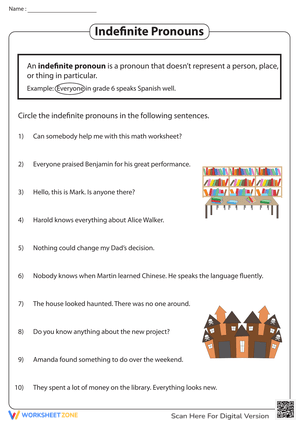
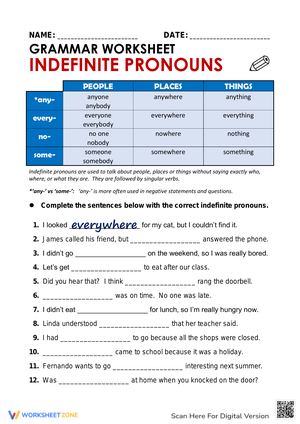
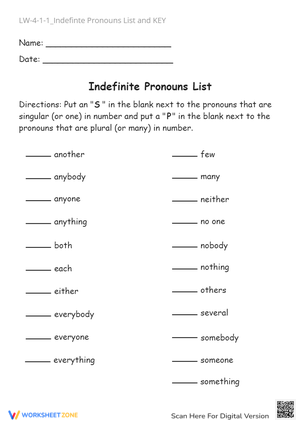
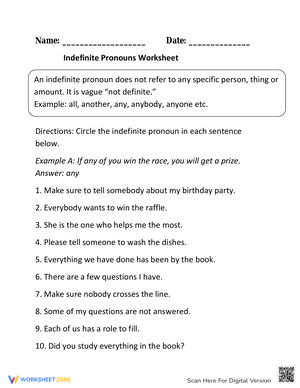
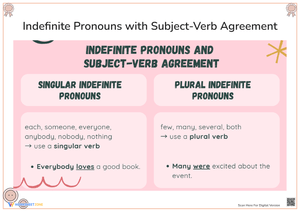
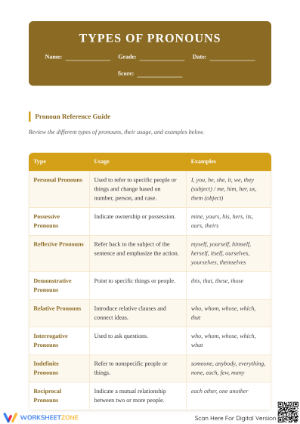
These indefinite pronouns pdf worksheets for 4th grade give teachers a focused set of grammar resources built around one of the most reliably difficult pronoun categories in upper elementary ELA. The set addresses identification, singular/plural/variable classification, subject-verb agreement, error correction, and original sentence writing — moving students from passive recognition to accurate, independent usage.
The Specific Skills Targeted
Each worksheet zeroes in on a discrete skill, so teachers can assign them in sequence or pull individual ones to address specific gaps. The core skills across the set include:
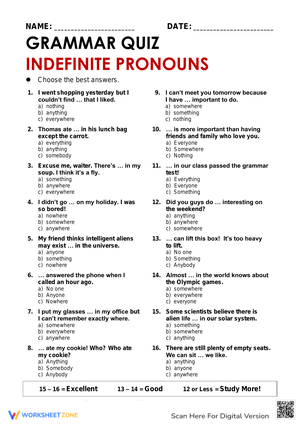
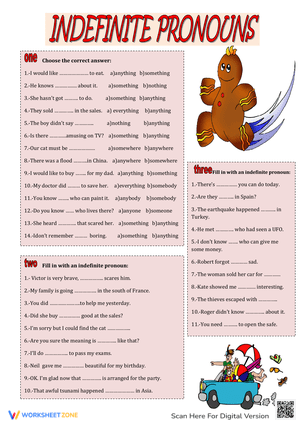
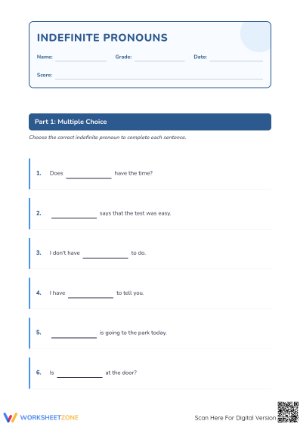
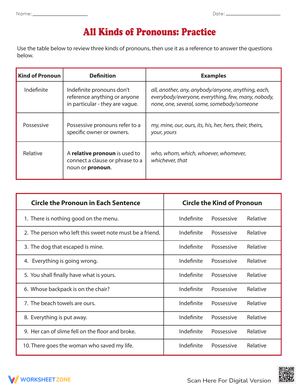
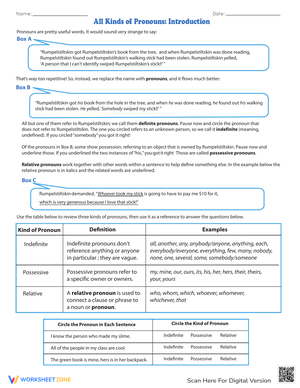
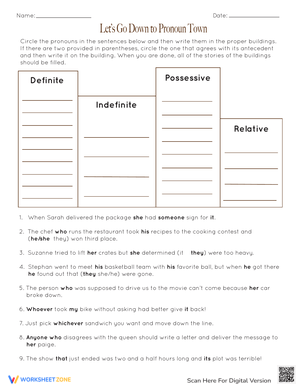
- Identifying indefinite pronouns within sentences and short paragraphs
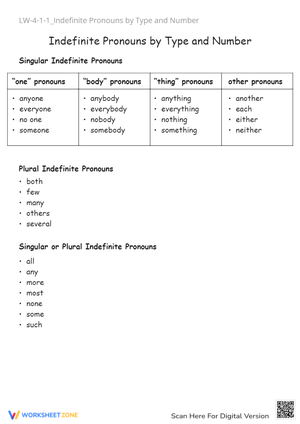
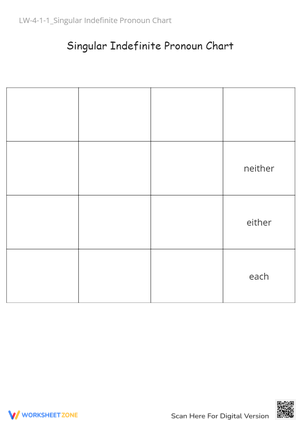
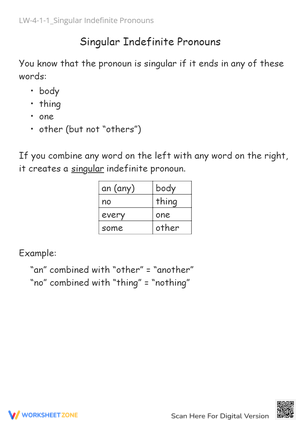
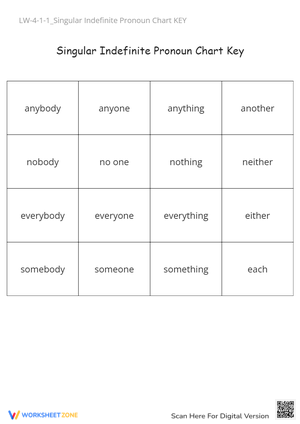
- Sorting words like everyone, few, and none into singular, plural, and variable categories
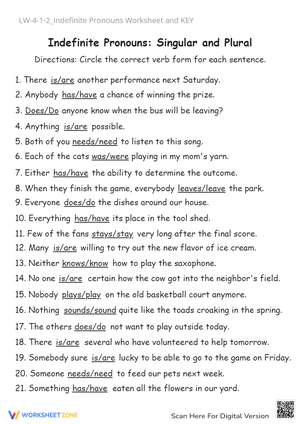
- Selecting the correct verb form in fill-in-the-blank exercises where the indefinite pronoun serves as the subject
- Spotting and correcting subject-verb agreement errors in written sentences
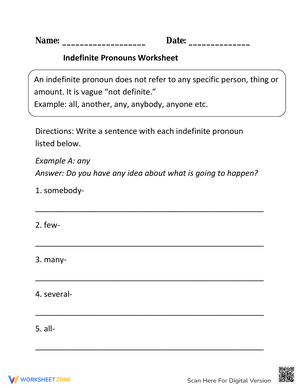
- Writing original sentences that use assigned indefinite pronouns accurately
The variable group — all, some, none, most, and any — gets explicit attention because these pronouns shift between singular and plural depending on the noun that follows. That context-dependency is genuinely hard for fourth graders, and several worksheets in the set isolate it with side-by-side sentence pairs before mixing it into broader review exercises.
Common Student Mistakes Teachers Should Anticipate and Address
The dominant error pattern is predictable: students treat singular indefinite pronouns as plural because they feel collective. Everyone is here sounds wrong to a nine-year-old who is picturing an entire group of people, so they write everyone are here instead. The same reasoning produces everybody were excited and nobody have their pencils. By fourth grade, this is already a habit in spoken language, which makes written correction harder than it might look on paper.
The variable pronouns create a different problem. When students see some of the cake is gone right next to some of the students are gone, many decide the rule is arbitrary rather than principled. Showing them that the verb tracks the noun after of — singular cake takes is, plural students takes are — gives them an actual decision-making strategy instead of a coin flip. Each worksheet covering variable pronouns builds this contrast in explicitly so the logic is visible.
How to Work These Worksheets Into Your Lesson Plans
A five-day sequence works well as a focused mini-unit. Day one opens with a sorting task: students place pronouns into a three-column chart (singular, plural, variable) that stays in their writing folders for the rest of the unit. Day two builds recognition before production — students underline indefinite pronouns in a short passage without yet being asked to apply agreement rules. Days three and four shift to fill-in-the-blank and sentence writing, the two highest-demand tasks. Day five pulls everything together through a correction-and-writing combination that serves as a low-stakes formative check.
Outside a formal unit, these indefinite pronouns pdf worksheets for 4th grade fit naturally into the warm-up slot before writing workshop — especially on Mondays, when a brief grammar return helps rebuild the previous week's attention before drafting begins. One practical addition worth keeping near the writing center: a laminated two-sided reference card listing singular and plural pronouns. Students grab it during independent writing when they second-guess themselves, and over several weeks the self-checking habit builds toward internalized knowledge as the card becomes unnecessary.
Standard Alignment
These worksheets address Common Core State Standards Language Standard L.4.1, which requires fourth graders to demonstrate command of standard English grammar and usage when writing and speaking. Correct pronoun use — including subject-verb agreement with indefinite pronouns — is a named component of that standard. In classroom terms, L.4.1 shows up during grammar instruction, writing workshop editing conferences, and on district benchmark assessments that include grammar correction items. Teachers using these worksheets are building toward the specific usage expectations tested at the end of Grade 4, not supplementing them from the side.
Differentiating These Worksheets Across Ability Levels
Students still building foundational pronoun knowledge benefit from a word bank of indefinite pronouns printed at the top of the worksheet alongside a quick-reference strip showing which are singular and which are plural. Removing that memory demand lets them concentrate on the agreement logic itself rather than stalling on vocabulary recall. On-level students work through standard identification and fill-in-the-blank exercises without those supports, applying the rule independently from a cold start.
For students who need a challenge, ask them to rewrite three sentences with agreement errors and then write one sentence explaining why each original was wrong — not just correct it, but name the reasoning. That step surfaces whether a student is applying a rule or pattern-matching by ear. These indefinite pronouns pdf worksheets for 4th grade include answer keys so teachers can scan student work during a short check-in window rather than dedicating a full grading block to grammar alone.
Frequently Asked Questions
What indefinite pronouns should fourth graders know?
Grade 4 students should be fluent with the always-singular group (everyone, everybody, someone, somebody, anyone, anybody, no one, nobody, everything, something, anything, nothing, each, either, neither), the always-plural group (few, many, several, both, others), and the variable group (all, some, none, most, any). The variable group is the one students most often underlearn because it requires reading context rather than memorizing a fixed list.
How do you explain indefinite pronouns to a fourth grader?
A classroom-tested explanation: Instead of naming a specific person, we use a stand-in word — not 'Maria lined up quietly' but 'everyone lined up quietly.' Using examples drawn directly from classroom routines makes the concept land faster than invented sentences. Nobody forgot their folder and Somebody left a jacket in the hall are immediately recognizable, which lowers the cognitive load on first exposure.
What does Common Core L.4.1 require around pronoun use?
L.4.1 covers grammar and usage conventions for Grade 4, and correct pronoun use — including agreement between an indefinite pronoun subject and its verb — falls within its expectations. Each worksheet targets a specific part of that standard, so teachers can point to direct instructional alignment rather than claiming incidental coverage through writing feedback alone.
Can these resources be used with students above or below fourth grade?
Yes. The differentiation adjustments described above handle both directions within the grade level. Beyond that, the indefinite pronouns pdf worksheets for 4th grade are also a practical fit for fifth-grade review when grammar gaps show up in writing assessments, and for advanced third graders who are ready to move ahead of their grade-level grammar sequence.
What other activities reinforce this skill alongside the worksheets?
Oral call-and-response drills — teacher names an indefinite pronoun, students respond with the correct verb form — take under three minutes and activate the same rule-based thinking the written practice requires. Error-correction tasks projected during the first five minutes of ELA class and partner editing in writing workshop where students specifically hunt for agreement errors in each other's drafts both strengthen the same skill through different channels.












 Interactive Worksheet Maker
 Quiz Maker
 Word Search Maker
 Crossword Puzzle Maker
 Word Scramble Generator
 Sentence Scramble Generator
 Handwriting Worksheet Generator
 Name Tracing Generator
 Fill In The Blank Generator




 BACK TOSCHOOL