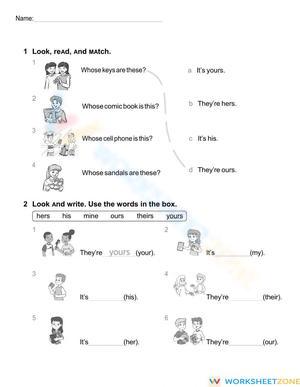
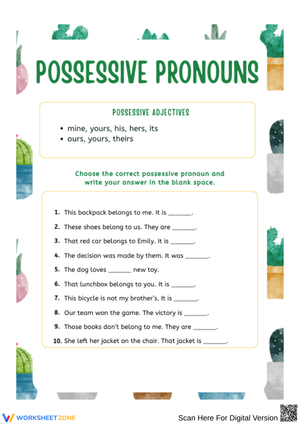
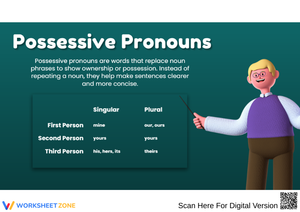
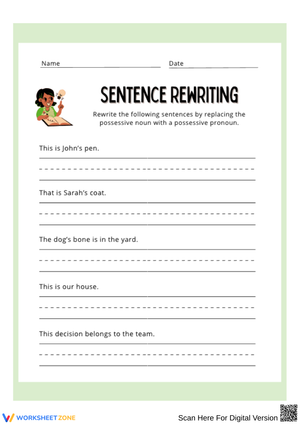
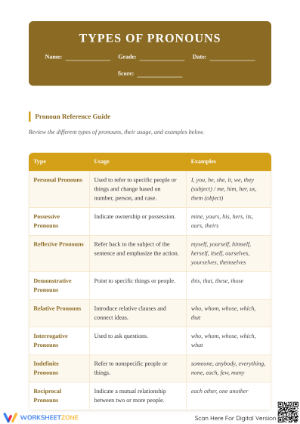
These possessive pronouns pdf worksheets for 4th grade give teachers a focused set of materials for one of the trickier grammar milestones in the intermediate grades — the standalone ownership word. The seven core forms (mine, yours, his, hers, its, ours, theirs) look manageable on an anchor chart but sit at the intersection of several persistent errors fourth graders are actively producing in their paragraph writing. This set addresses those errors directly, building enough structured repetition to interrupt the habits before they become automatic.
The Specific Skills Targeted
Each worksheet isolates one or two skills rather than trying to cover all aspects of possessive pronouns at once. The tasks students work through include:
- Identifying possessive pronouns in context: Students underline, circle, or sort standalone pronouns within sentences — a recognition step that must come before accurate production in writing.
- Rewriting possessive noun phrases: A sentence like "The red jacket belongs to Marcus" becomes "The red jacket is his." Students have to produce the standalone form rather than just spot it.
- Distinguishing standalone pronouns from possessive adjectives: Students mark the difference between "That book is hers" and "her book" — a distinction that confuses fourth graders routinely, and one that single-lesson instruction rarely fixes.
- Pronoun-antecedent agreement: Students match the pronoun to the antecedent in number and gender, building the habit of checking the noun before choosing the pronoun form.
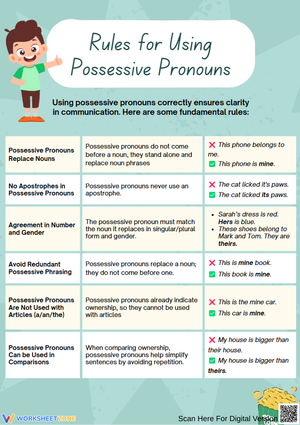
- The no-apostrophe rule: Multiple exercises return to its, theirs, yours, and ours — the four forms where apostrophe errors appear most frequently in actual student work.
Mistakes Students Make That These Worksheets Help You Catch
The apostrophe issue is the central problem, and it makes sense when you trace it back to what students already know. Fourth graders have spent two years drilling the rule that apostrophes mark possession — "the teacher's desk," "the dog's leash." When they shift to expressing ownership through a pronoun, they reach for the apostrophe on instinct. "Their's," "our's," and "your's" turn up regularly in fourth-grade writing notebooks, and the students who write them are not being careless — they are applying a rule they know. What they have not yet internalized is that pronouns are the exception to it.
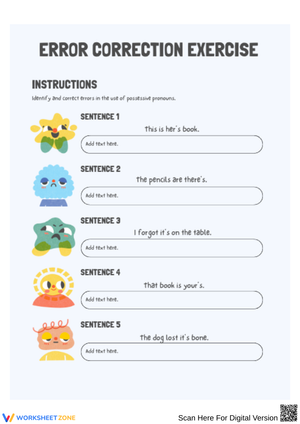
The its/it's split is where this gets particularly stubborn. A student who writes neat, well-punctuated sentences will still write "The dog wagged it's tail" without hesitation, because the contraction logic feels exactly right to them: it's = it is. The substitution test — replace "its" with "it is" and check whether the sentence still holds — is the most reliable fix, but students need to practice it on paper before it becomes a mental habit. Several exercises in the set ask students to apply the test and mark their reasoning rather than simply circle the correct answer from two choices, which builds a more durable understanding than recognition alone.
A second pattern worth watching: students who correctly identify "mine" and "yours" on a worksheet will revert to possessive adjectives in their independent writing — "The notebook is my" instead of "The notebook is mine" — because the standalone pronoun feels grammatically incomplete without a noun following it. The rewriting exercises address this directly by giving students a full noun phrase to replace, which forces production of the standalone form rather than just recognition of it.
How to Build These Worksheets Into Your Lesson Plans
The morning warm-up is the most reliable placement for this kind of focused grammar practice. Handing one worksheet to students as they arrive uses 8–10 minutes efficiently and gives the whole class a shared reference point for a brief correction conversation before the main lesson. Because the exercises are short and targeted, students can complete them without a full re-teach of the concept — the warm-up stays a warm-up rather than expanding into another whole-group lesson.
Literacy centers are another strong fit. Printing and laminating worksheets inside dry-erase sleeves extends the set considerably — students mark answers with a marker, erase, and rotate to the next station. The rewriting exercises work especially well here because two students completing the same task will sometimes produce different pronouns and then have to work out which one fits. That kind of practical disagreement does more for retention than silent individual work, and the conversation it generates is genuinely useful grammar instruction.
These possessive pronouns pdf worksheets for 4th grade also work well in small-group instruction. For students who are still conflating possessive pronouns with contractions, guided practice in a group of four or five lets teachers catch substitution errors in real time — before students carry those errors into paragraph drafts. The pronoun-antecedent agreement exercises double effectively as exit tickets: four items, under five minutes, and the results show clearly whether the class is ready to apply agreement rules in original writing or needs another session of targeted practice first.
Standard Alignment
The most direct standard connection is CCSS.ELA-Literacy.L.4.1g, which requires students to correctly use frequently confused words — and the standard specifically names its/it's, their/they're, and your/you're, all of which recur across this set. That is a narrow, clearly stated expectation, and the exercises asking students to apply the substitution test and record their reasoning build directly toward it.
Pronoun-antecedent agreement falls under the broader CCSS.ELA-Literacy.L.4.1 expectation that students demonstrate command of standard English grammar and usage in writing and speaking. In practice, teachers address this standard during writing conferences and revision lessons — it is not a standalone grammar event but a skill that surfaces whenever students move from simple sentences into multi-sentence paragraphs. The exercises in this set bridge grammar practice and writing application by requiring students to produce corrected sentences, not just identify errors from a list.
Adjusting the Set for a Range of Learners
Used as written, the possessive pronouns pdf worksheets for 4th grade reward students who can independently recall pronoun forms — but a few adjustments open them to a wider range of readiness levels. Students who need more support do well with a reference card alongside each worksheet: a two-column chart listing standalone pronouns next to their possessive adjective counterparts (mine/my, ours/our, theirs/their). With that reference available, identification and fill-in exercises stay productive rather than turning into guesswork. The rewriting tasks are better held for these students until they have demonstrated accuracy on the recognition exercises first.
Students who move quickly can extend the rewriting exercises by producing two versions of each sentence — one using a singular pronoun, one using a plural — and writing a brief explanation of why the antecedent requires each form. This shifts the work from mechanical substitution to active reasoning about agreement, which is much closer to what students must do in original writing.
The its/it's exercises run well as peer-check activities in mixed groups. One student completes the exercise independently, a partner verifies each answer using the substitution test, and both must discuss any disagreement before moving on. The back-and-forth tends to clarify the rule more effectively than silent individual work — and it gives the faster student a chance to articulate the reasoning rather than just apply it.
Frequently Asked Questions
What is the difference between a possessive pronoun and a possessive adjective?
A possessive pronoun stands alone and replaces a full noun phrase: "That coat is mine." A possessive adjective sits directly before a noun and modifies it: "That is my coat." Both express ownership, but they operate differently in a sentence. Students confuse them in writing regularly — producing sentences like "The answer is our" instead of "The answer is ours" — because the adjective form feels more complete to them. The side-by-side identification exercises in these possessive pronouns pdf worksheets for 4th grade make the structural difference visible through repeated contextualized practice rather than a single rule statement.
Why do fourth graders specifically struggle with the no-apostrophe rule for pronouns?
The struggle is a direct consequence of a rule they learned correctly. Apostrophes mark possession in nouns — "the principal's office," "a student's notebook" — and that rule is solid by the end of third grade. Pronouns are the exception, and exceptions introduced in passing do not hold the way extended practice does. The no-apostrophe rule needs its own dedicated practice time, separate from instruction on noun possessives, which is why several exercises in this set return to it across different contexts rather than treating it as a one-lesson fix.
Can these worksheets serve as formative assessments?
Yes — the pronoun-antecedent agreement exercises are the most useful for that purpose. Four or five items completed as an exit ticket give a clear picture of which students are matching pronouns to antecedents accurately and which are still making number or gender errors. The rewriting exercises function as a slightly heavier assessment: asking students to revise two or three sentences and explain their pronoun choices in writing reveals whether understanding is surface-level or transferable to new contexts they have not seen before.












 Interactive Worksheet Maker
 Quiz Maker
 Word Search Maker
 Crossword Puzzle Maker
 Word Scramble Generator
 Sentence Scramble Generator
 Handwriting Worksheet Generator
 Name Tracing Generator
 Fill In The Blank Generator




 BACK TOSCHOOL