


























Views
Downloads


Types of Pronouns Worksheet | Grade 6 Printable
Paste this activity's link or code into your existing LMS (Google Classroom, Canvas, Teams, Schoology, Moodle, etc.).
Students can open and work on the activity right away, with no student login required.
You'll still be able to track student progress and results from your teacher account.
This comprehensive worksheet helps students master identifying and using various types of pronouns in context. By providing a clear reference guide alongside targeted practice, learners will confidently distinguish between personal, reflexive, relative, and indefinite pronouns to improve their overall sentence construction and grammar skills.
At a Glance
- Grade: 6 · Subject: ELA
- Standard:
CCSS.ELA-LITERACY.L.6.1— Demonstrate command of standard English grammar conventions.- Skill Focus: Identifying and using pronoun types
- Format: 4 pages · 15 problems · Answer key included · PDF
- Best For: Independent practice and sub plans
- Time: 25–35 minutes
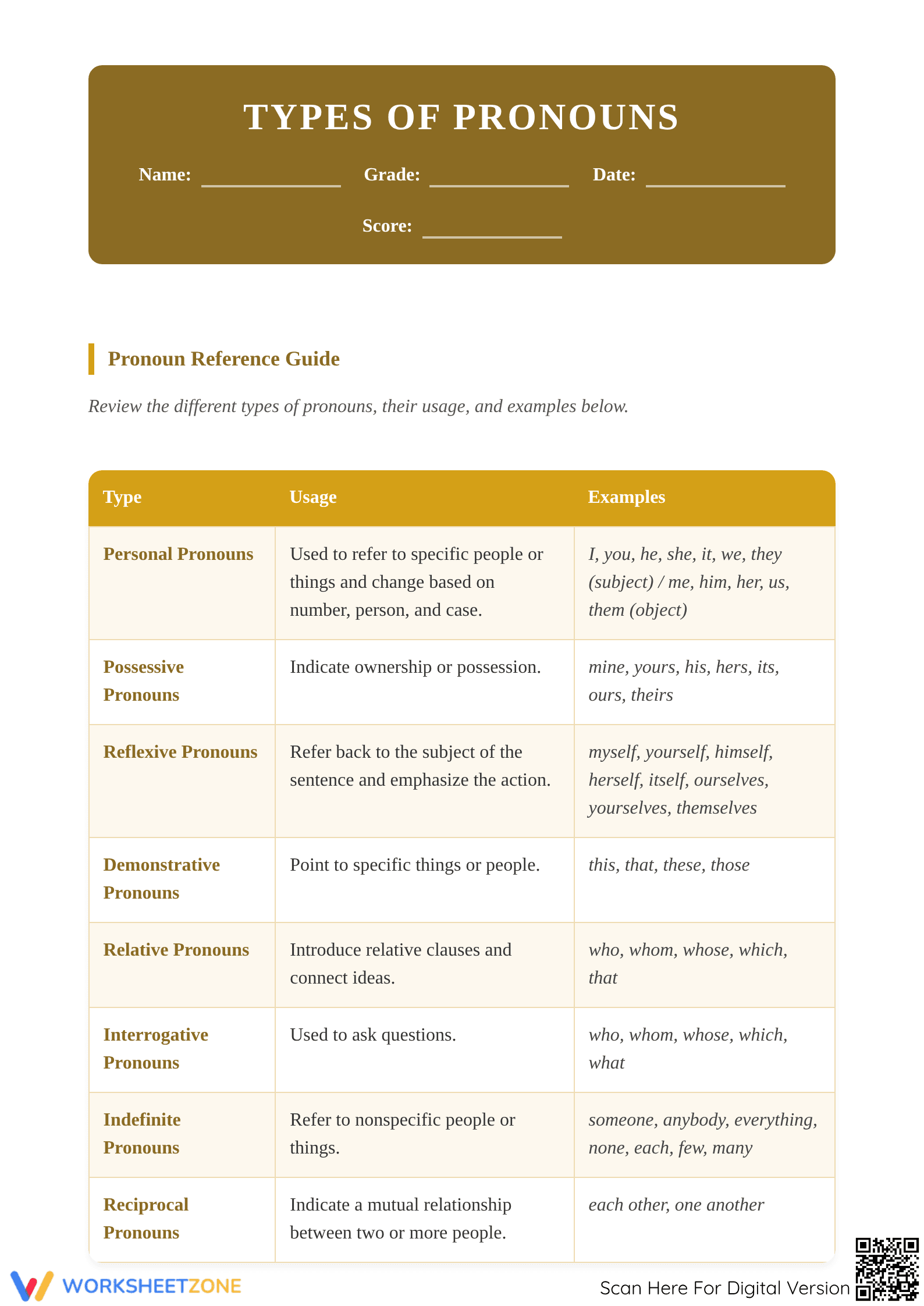
This resource features a detailed one-page reference guide outlining eight different pronoun types with definitions and examples. Following the guide, students complete 15 structured tasks divided into three sections: identifying underlined pronouns, filling in the blanks with specific pronoun types, and constructing original sentences. A complete answer key is provided for quick grading.
This resource is designed for immediate classroom implementation with a zero-prep workflow:
- Print (1 minute): Simply print the four-page PDF packet. The built-in reference chart means no additional anchor charts are required.
- Distribute (1 minute): Hand out the packets to students for independent work or partner review.
- Review (3 minutes): Use the included answer key to quickly check student responses or facilitate a whole-class review session.
Total teacher prep time is under two minutes, making this an ideal, self-explanatory activity for emergency sub plans.
This worksheet is directly aligned to CCSS.ELA-LITERACY.L.6.1, requiring students to demonstrate command of the conventions of standard English grammar and usage when writing or speaking. It also supports foundational reading and writing skills by reinforcing how pronouns function within complex sentences. Both standard codes can be copied directly into lesson plans, IEP goals, or district curriculum mapping tools.
Teachers can utilize this worksheet during the independent practice phase of a grammar lesson, right after direct instruction on parts of speech. Alternatively, it serves as an excellent review packet before a unit assessment. As a formative assessment tip, observe how students handle Part 3 (Sentence Construction); struggling to generate original sentences with reciprocal or interrogative pronouns often indicates a need for targeted reteaching. Expect students to complete the entire packet in 25 to 35 minutes.
This resource is primarily designed for 6th-grade ELA students, though it serves as an excellent review for 7th graders or an extension activity for advanced 4th and 5th graders. The included reference guide provides built-in differentiation for students who need visual scaffolds or memory aids. Pair this worksheet with a mentor text analysis activity where students highlight different pronoun types in published writing.
Mastering grammar conventions, specifically through resources aligned to CCSS.ELA-LITERACY.L.6.1, is essential for developing strong written and oral communication skills. When students can accurately demonstrate command of standard English grammar conventions, they are better equipped to construct clear, coherent sentences. According to a 2024 report by EdReports, instructional materials that pair explicit grammar reference guides with immediate, structured application significantly improve student retention of complex language rules. This worksheet bridges that gap by providing a comprehensive pronoun cheat sheet followed by targeted exercises, ensuring learners do not just memorize definitions but actively apply them. By integrating identification tasks with original sentence construction, educators can effectively measure true grammatical proficiency. This evidence-based approach supports long-term writing development and aligns with best practices for middle-grade language arts instruction.


