


























Views
Downloads
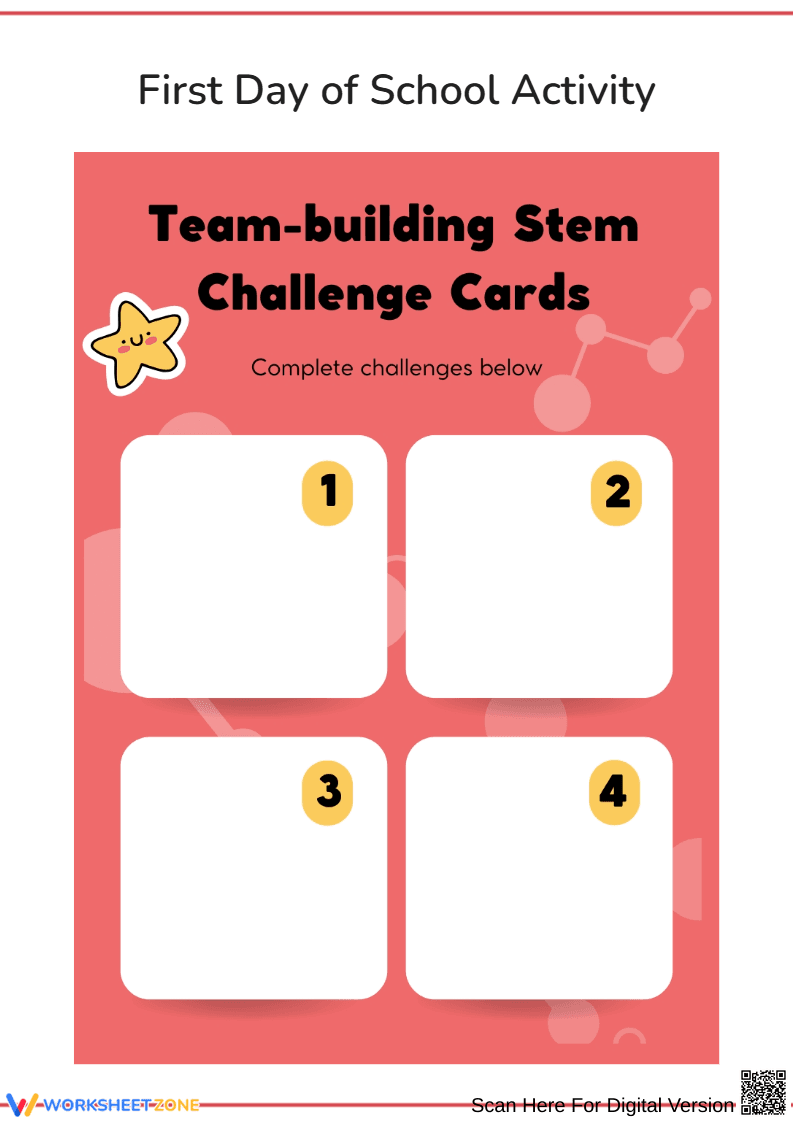

Printable STEM Challenge Cards | Grade 3-4 Teamwork
Paste this activity's link or code into your existing LMS (Google Classroom, Canvas, Teams, Schoology, Moodle, etc.).
Students can open and work on the activity right away, with no student login required.
You'll still be able to track student progress and results from your teacher account.
This Grade 3 and Grade 4 team-building worksheet gives students a structured format to collaborate on STEM challenges. By working through four problem-solving tasks, learners develop essential communication skills. It serves as an excellent first-day-of-school activity to establish classroom community.
At a Glance
- Grade: 3-4 · Subject: Social Skills
- Standard:
3-5-ETS1-2— Generate and compare multiple solutions to a problem- Skill Focus: Team-building and collaboration
- Format: 1 page · 4 problems · No answer key · PDF
- Best For: First day of school activities
- Time: 30–45 minutes
This single-page resource features four numbered challenge boxes designed to guide small groups through collaborative STEM tasks. The open-ended layout allows teachers to assign specific engineering challenges while providing students space to sketch or record solutions. Because the tasks focus on the collaborative process, no answer key is required.
Zero-Prep Workflow
This resource is designed for immediate classroom implementation:
- Print (1 minute): Print the single-page PDF for each group.
- Distribute (1 minute): Hand out the cards along with basic STEM materials.
- Review (3 minutes): Explain the four challenges and set expectations for shared decision-making.
With a total teacher prep time of under two minutes, this worksheet is an ideal addition to back-to-school plans or sub folders.
Standards Alignment
This activity aligns with 3-5-ETS1-2, requiring students to generate and compare multiple possible solutions to a problem. By working in teams, students practice core social-emotional competencies related to effective communication. Both standard codes can be copied directly into lesson plans, IEP goals, or district curriculum mapping tools.
How to Use It
This worksheet is highly effective as a back-to-school icebreaker. Assign students to small groups and provide simple building materials. Have them use the four boxes to plan designs for mini-challenges. Alternatively, use it during a social skills block to teach active listening. As a formative assessment tip, observe how students negotiate disagreements and provide positive feedback for equitable participation. Expect completion in 30 to 45 minutes.
Who It's For
Designed for third and fourth-grade students, this resource develops cooperative learning skills. Differentiate by adjusting the complexity of the physical STEM materials provided, ensuring accessibility for all needs. It pairs naturally with introductory lessons on group work expectations or active listening anchor charts.
Integrating collaborative problem-solving tasks early in the academic year establishes a critical foundation for sustained academic engagement and positive classroom dynamics. This resource directly targets 3-5-ETS1-2, helping students generate and compare multiple solutions to a problem within a highly structured group setting. According to a comprehensive EdReports 2024 analysis, instructional materials that intentionally embed social-emotional learning into core academic tasks—such as hands-on engineering and design challenges—significantly improve both peer relationships and long-term content retention. By requiring students to navigate four distinct planning phases together, this worksheet moves beyond superficial icebreakers to foster genuine cognitive collaboration. The open-ended format ensures that learners must rely on active communication, mutual respect, and compromise to succeed, directly supporting both NGSS engineering practices and essential behavioral competencies. Educators can confidently utilize this evidence-based approach to build a supportive, inclusive classroom culture while simultaneously introducing foundational STEM concepts.


