


























Views
Downloads

Printable Find Area with Distributive Property Worksheet
Paste this activity's link or code into your existing LMS (Google Classroom, Canvas, Teams, Schoology, Moodle, etc.).
Students can open and work on the activity right away, with no student login required.
You'll still be able to track student progress and results from your teacher account.
This math worksheet helps students bridge the gap between concrete area models and abstract multiplication using the distributive property. By decomposing large rectangles into smaller units, learners develop a conceptual understanding of multiplication. Students will progress from visual shading to solving real-world word problems with confidence.
At a Glance
- Grade: 3–4 · Subject: Math
- Standard:
CCSS.MATH.CONTENT.3.MD.C.7.C— Use area models to represent the distributive property in mathematical reasoning- Skill Focus: Distributive property and area models
- Format: 3 pages · 11 problems · Answer key included · PDF
- Best For: Small group or independent practice
- Time: 25–35 minutes
What's Inside
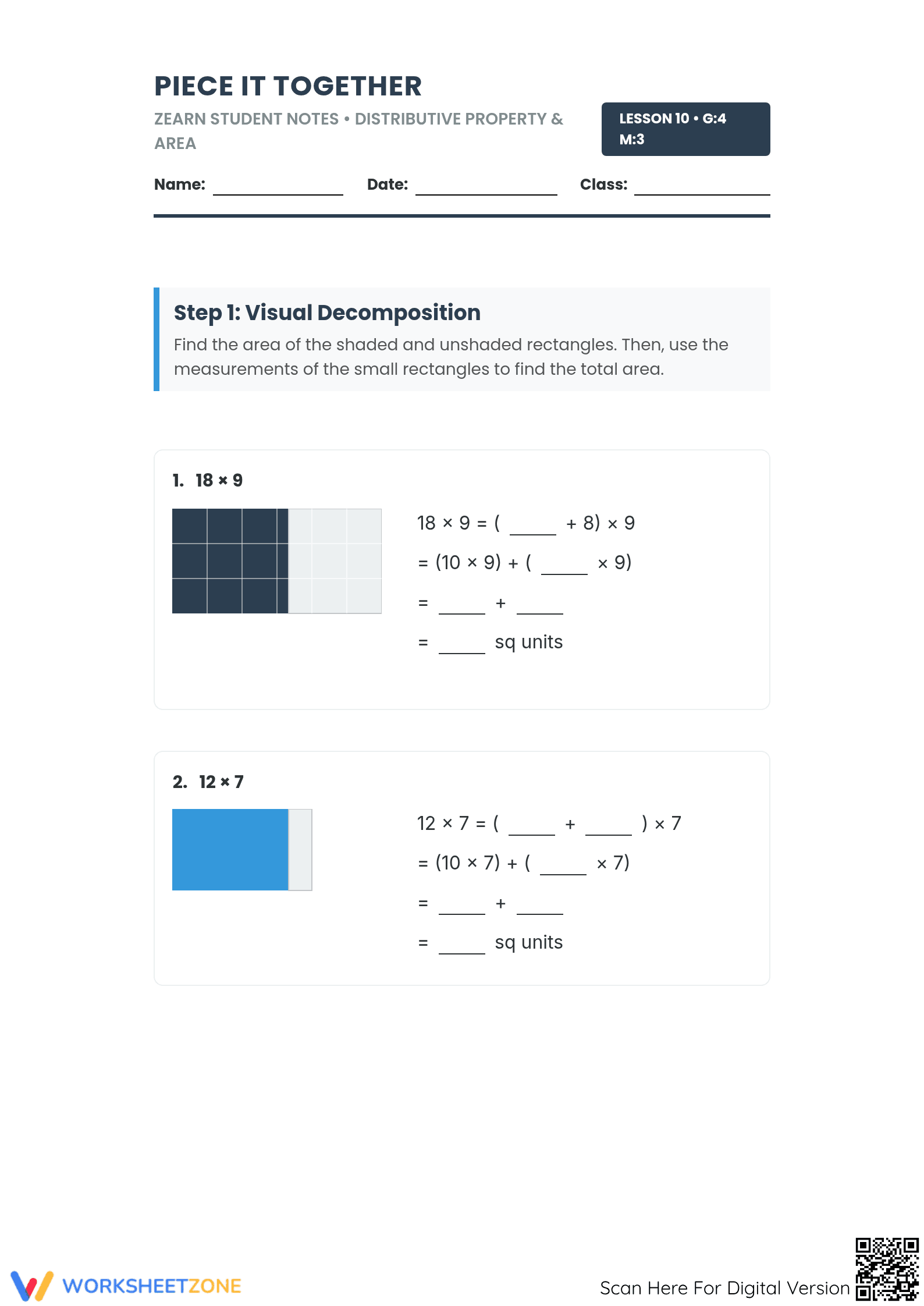
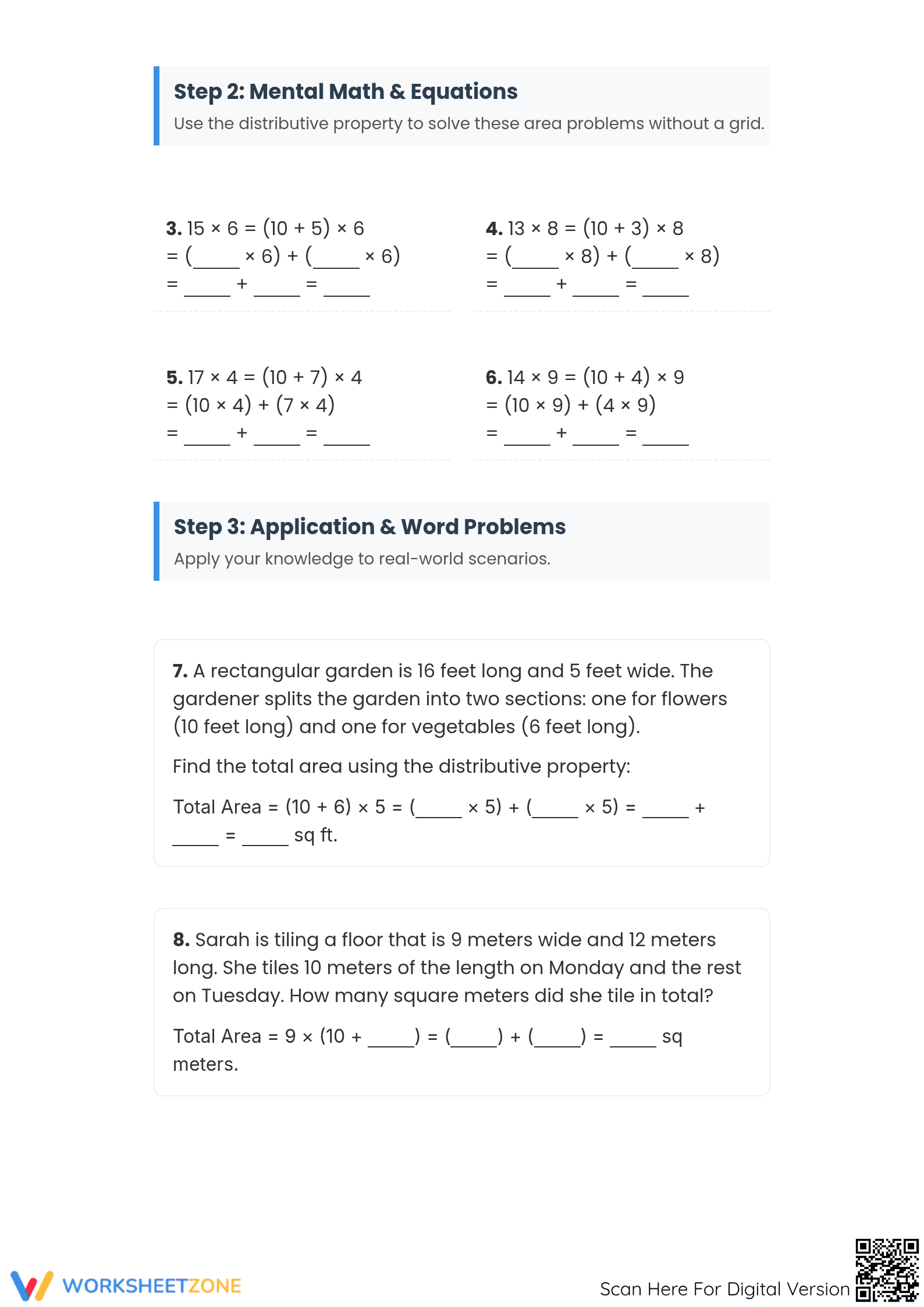
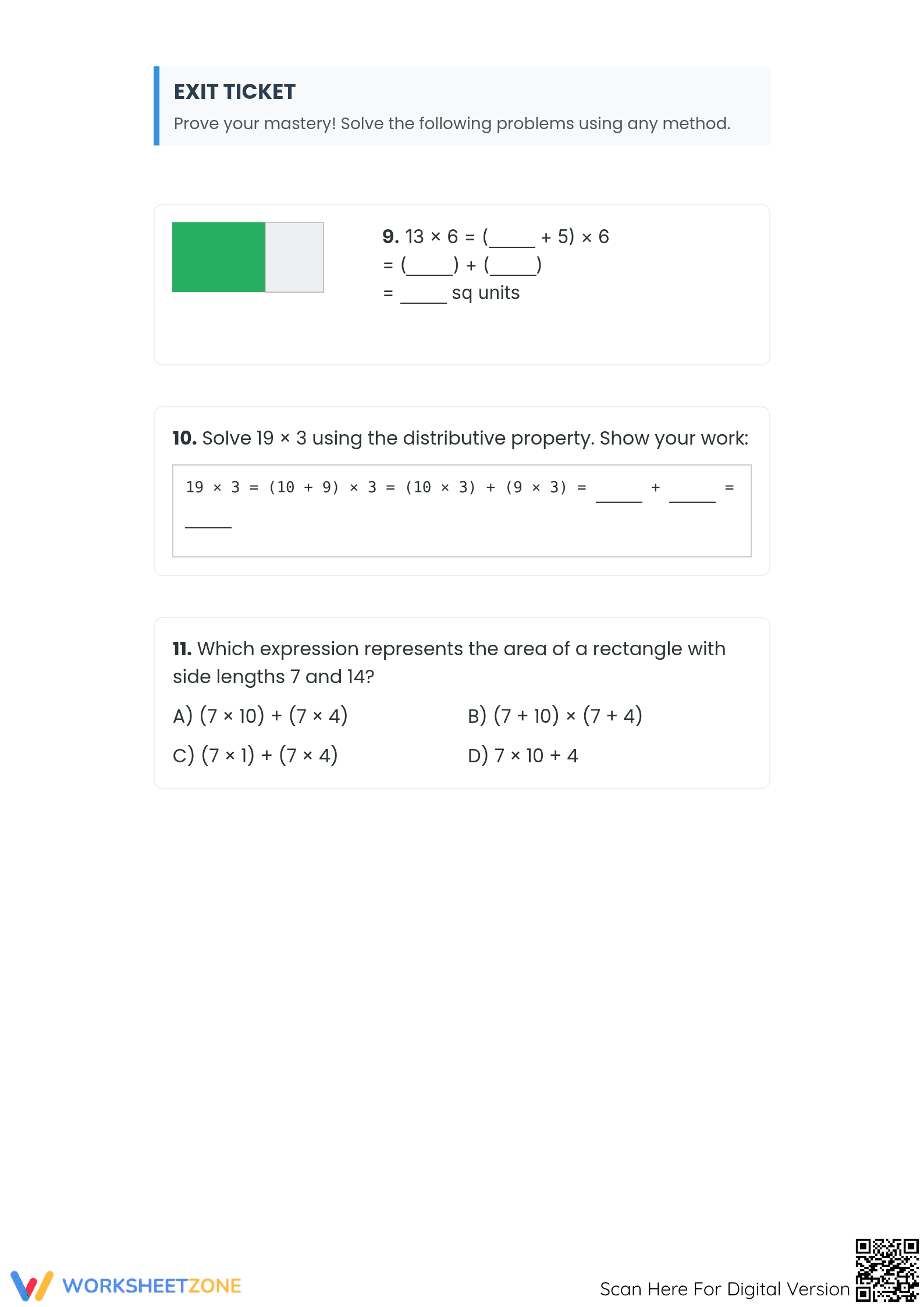
This 3-page instructional resource contains 11 scaffolded problems designed for gradual release. Page 1 focuses on visual decomposition with shaded grids. Page 2 transitions to mental math equations and two complex word problems involving garden measurements and floor tiling. Page 3 concludes with an "Exit Ticket" assessment to verify mastery of the distributive property.
Skill Progression
- Guided Practice: Students engage with visual decomposition problems where rectangles are pre-shaded to show the (10 + n) breakdown.
- Supported Practice: The mental math phase removes the grid while providing equation frames to help students organize their partial products.
- Independent Practice: Learners apply their skills to real-world word problems and a multiple-choice exit ticket to demonstrate complete independence.
This structured sequence ensures a successful gradual release of responsibility from visual modeling to abstract calculation.
Standards Alignment
This resource is explicitly aligned to CCSS.MATH.CONTENT.3.MD.C.7.C: "Use area models to represent the distributive property in mathematical reasoning." It also supports 4.NBT.B.5 through rectangular arrays. Both standard codes can be copied directly into lesson plans, IEP goals, or district curriculum mapping tools.
How to Use It
Deploy this worksheet during the "We Do" or "You Do" portion of a lesson on multi-digit multiplication. It serves as an excellent formative assessment; observe students during the visual decomposition phase to see if they correctly identify the "10" as a friendly number. Expect completion in 25–35 minutes. Use the Exit Ticket on page 3 as a quick check for understanding before moving to the next module.
Who It's For
Ideal for Grade 3 students learning area or Grade 4 students needing a refresher on multiplication strategies. The included sentence frames and visual models provide essential differentiation for English Language Learners and students with IEPs. Pair this worksheet with a physical manipulative like base-ten blocks for a multi-sensory learning experience.
Research from the RAND AIRS 2024 report emphasizes that visual representations, such as area models, are critical for students transitioning from additive to multiplicative thinking. This worksheet utilizes the distributive property—a fundamental algebraic concept—to simplify complex multiplication tasks into manageable partial products. By grounding abstract numbers in spatial geometry, the resource aligns with the Fisher & Frey (2014) framework for scaffolded instruction, moving students from dependent learners to independent problem solvers. The inclusion of an "Exit Ticket" provides the necessary data for responsive teaching, a practice shown by EdReports 2024 to significantly improve student outcomes in Title I settings. Using standard CCSS.MATH.CONTENT.3.MD.C.7.C, this tool ensures that students do not just memorize procedures but actually visualize the mathematical relationships inherent in area calculation and decomposition.


