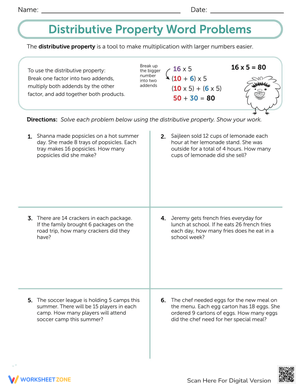
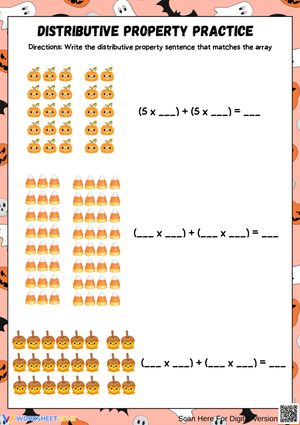
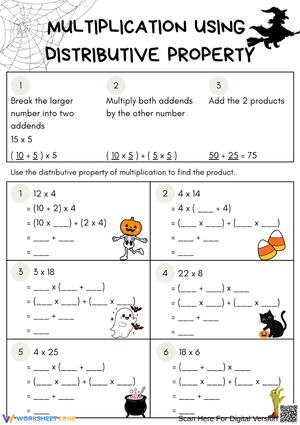
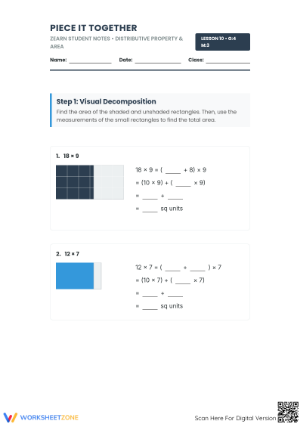
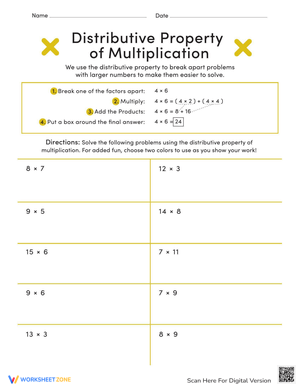
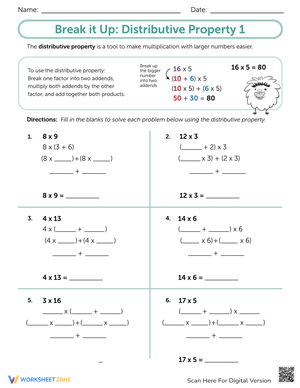
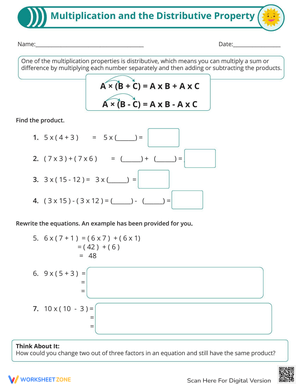
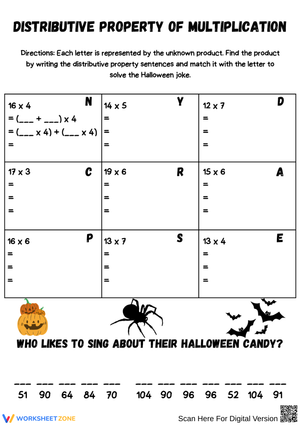
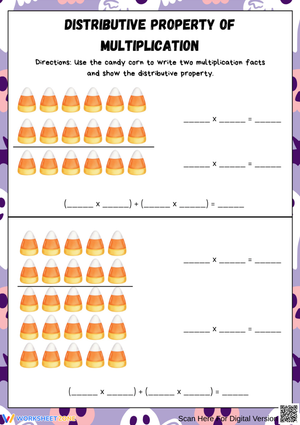
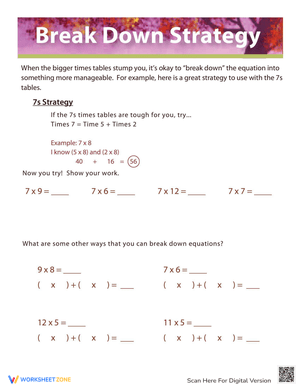
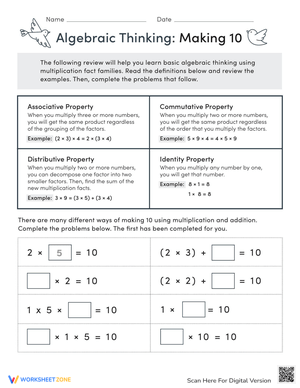
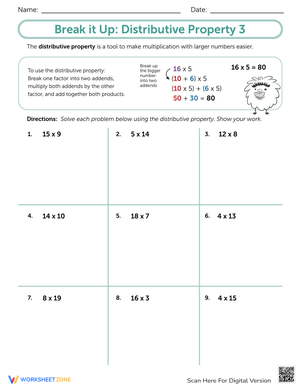
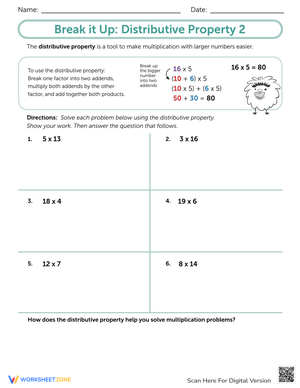
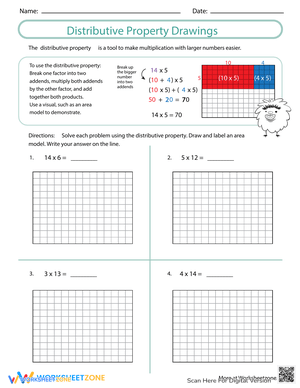
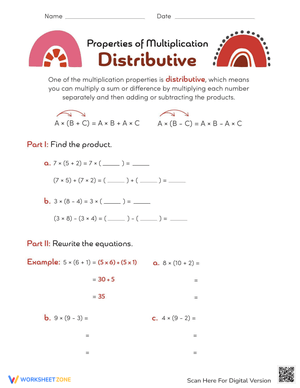
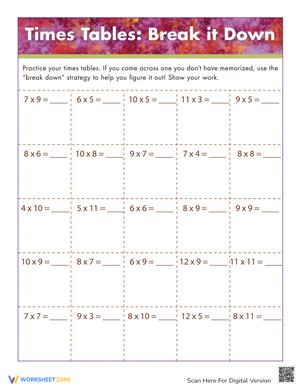
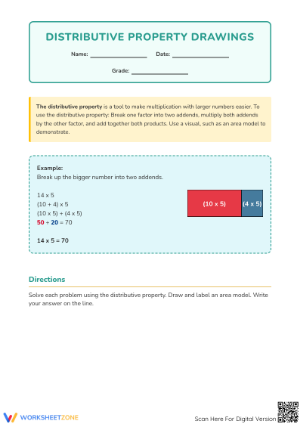
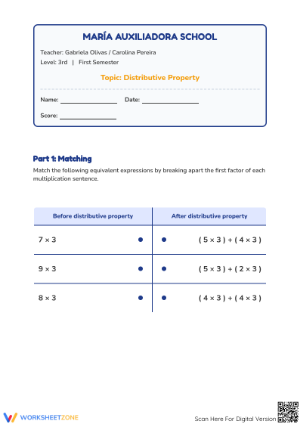
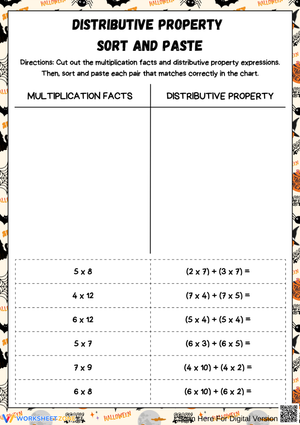
These distributive multiplication pdf worksheets for 3rd grade give teachers a print-ready set built around one specific strategy: breaking apart a factor to convert a difficult multiplication fact into two easier ones students can handle using what they already know. Each worksheet moves students from working with labeled split arrays toward writing full equations independently, building that progression across the set without skipping any of the steps that make the difference between "I memorized this" and "I can figure this out."
The Specific Skills Targeted
The central skill is factor decomposition — choosing one factor, splitting it into two addends, multiplying both by the fixed factor, and adding the partial products. Each worksheet isolates a specific stage of this procedure so students practice the whole sequence rather than just the beginning or the end. The skills across the set include:
- Partitioning one factor into two addends (for example, splitting 8 into 5 + 3 to produce two familiar facts)
- Reading a pre-split array and labeling the two sub-arrays with their dimensions
- Writing two partial multiplication equations from a single split diagram
- Adding the two partial products to reach the final answer
- Choosing a useful decomposition independently — not just any split, but one that lands on facts already in memory
- Applying the full procedure without any array support, working from a bare equation alone
That last step is where the distributive multiplication pdf worksheets for 3rd grade do some of their heaviest lifting. Students who can read a split array but freeze when the diagram disappears haven't fully internalized the procedure — they've learned to decode a picture. The set handles this by gradually removing visual support across later worksheets, giving students repeated exposure to the same procedure at increasing levels of abstraction.
The Errors That Show Up in Student Work on This Strategy
The most consistent mistake is splitting both factors instead of one. A student working through 4 × 7 writes (2 × 3) + (2 × 4), which is neither the distributive property nor a correct answer. It reveals that the student understood "break apart" but not which number does the breaking. The fill-in-the-blank format on most worksheets in this set stops the error structurally — the fixed factor is shaded, and only the decomposed factor has open blanks to fill.
A subtler problem appears at the final step. A student correctly splits 6 × 8 into (6 × 5) + (6 × 3), finds 30 and 18, and then multiplies them together — arriving at 540. Every part of the process was right except the last operation. This isn't carelessness; third graders have been heavily rewarded for multiplying in math class, and that procedural habit hijacks the finish line. These worksheets bold the addition sign in the final step of each equation template, which reduces the error during early practice, though you'll still want to name it aloud the first time you introduce the format.
There's a developmental dimension worth naming here. Third graders are simultaneously building the understanding that multiplication is repeated addition, and the distributive property asks them to end in addition. That final step can feel to a student like they made an error and slipped backward into easier math. The confusion clears quickly once a teacher says it plainly: "The last step is addition, and that is correct — that's the whole point."
Working These Worksheets Into Your Weekly Lesson Plans
Before students ever pick up a worksheet in this set, give them scissors and a printed grid. A 6 × 8 or 8 × 7 rectangle on dot paper takes about three minutes to cut along a self-drawn line into two smaller pieces. Students who physically separate an 8 × 5 section from an 8 × 2 section carry that tactile memory forward — when they encounter a split array on a worksheet later in the week, they mentally recall the action of cutting, which makes the abstract diagram far less confusing. That five-minute pre-activity pays back the time during independent practice.
For the regular weekly routine, the warm-up block — the first 8 to 10 minutes before new instruction begins — is the most natural home for these resources. One array-reading worksheet asks students to label two sub-arrays, write two multiplication sentences, and add the products. Most third graders finish in about six minutes, which is enough to activate prior knowledge without compressing teaching time.
For small-group instruction, pull out the worksheets that show the split array but leave the equation blanks empty. Students who can read a diagram but struggle to record the corresponding equation need that middle stage — completing the procedure rather than executing it cold. Once they're writing equations reliably from diagrams, move them to the worksheets with split arrays but no pre-labeled dimensions, which requires them to determine the partial products themselves.
How to Adjust These Worksheets for Your Full Range of Students
For students still shaky on facts below 5 × 5, limit practice to factors of 6, 7, and 8 broken against 5 and a small remainder. Keeping partial products below 40 means students can verify their work mentally without a chart. These students should stay with worksheets where the split is already marked on the array and one partial product is pre-filled — they're completing the procedure with targeted support, not executing it from scratch.
Students who have the decomposition procedure down can work with a productive extension: solve the same fact two different ways. For 7 × 8, break the 8 into 5 + 3 and also into 4 + 4, write out both full sets of equations, and compare the results. This surfaces the actual conceptual point — the property holds regardless of how the factor is split — and it distinguishes students who have memorized a sequence of steps from students who understand why the procedure works. That distinction matters when multiplication gets more demanding in fourth grade.
For the fastest students, reverse the problem entirely: show one partial product and the final answer, then ask them to determine what the original fact and the decomposition must have been. The distributive multiplication pdf worksheets for 3rd grade in the extension tier include problems in exactly this format, and they provide reliable productive struggle for students who move through the standard practice without breaking stride.
Standard Alignment
The standard these worksheets address is CCSS.Math.Content.3.OA.B.5, which requires students to apply properties of operations as strategies to multiply and divide. In classroom terms, this standard becomes active when students move past count-by and repeated-addition approaches and need a reliable method for facts they haven't memorized yet. The distributive property receives the most instructional attention within this standard at the third-grade level. The worksheets address it across a range of abstraction — from diagram-supported decomposition to bare equations — which reflects how the standard tends to be assessed: students are expected to apply the property, not merely identify it by name.
Frequently Asked Questions
What multiplication facts do these worksheets cover?
The set focuses on factors from 2 through 10, with concentrated practice on the facts students tend to find hardest: the 6s, 7s, 8s, and 9s. Earlier worksheets use smaller factors to establish the procedure before the numbers become demanding. That ordering matters — if a student meets 8 × 7 as a first practice problem, the difficulty of the fact makes it nearly impossible to tell whether they understand the strategy or are simply confused by the numbers.
Do students need their multiplication facts memorized before starting?
No — the strategy is most useful before all facts are memorized. Students do need solid recall of their 2s, 3s, 4s, and 5s, because those appear as partial products in most decompositions. The property then becomes a tool for deriving the harder facts from the ones already in memory. Teachers who introduce the distributive property before students have fully memorized the 6s through 9s tend to see higher engagement, because students experience the strategy as genuinely useful rather than redundant.
Which worksheets in the set work best for homework?
The array-supported worksheets — the ones with split diagrams and labeled dimensions — hold up better for homework than the bare-equation worksheets. Without a teacher available to redirect, students working at home tend to abandon the procedure and guess when there's no visual anchor. Keeping the fully abstract worksheets for class and sending home the diagram-supported ones produces more accurate work and fewer frustrated conversations at the kitchen table.
How do these worksheets support day-to-day formative assessment?
The fill-in-the-blank structure makes errors locatable. A student who writes correct partial products but places a multiplication sign between them tells you something specific and fixable. A student whose partial products are wrong tells you something different — the underlying fact recall needs attention before the strategy can take hold. Collecting these after independent work gives you a quick diagnostic read that a timed drill or multiple-choice check won't provide. The distributive multiplication pdf worksheets for 3rd grade, used this way, function as both practice and evidence — no separate assessment instrument needed.













 Interactive Worksheet Maker
 Quiz Maker
 Word Search Maker
 Crossword Puzzle Maker
 Word Scramble Generator
 Sentence Scramble Generator
 Handwriting Worksheet Generator
 Name Tracing Generator
 Fill In The Blank Generator