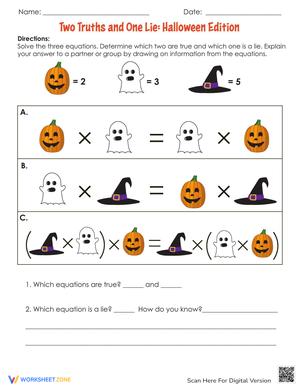
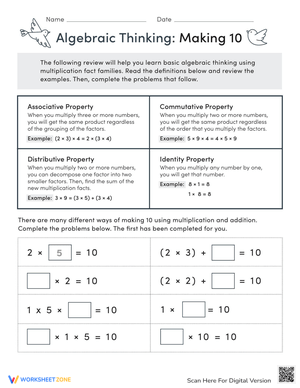
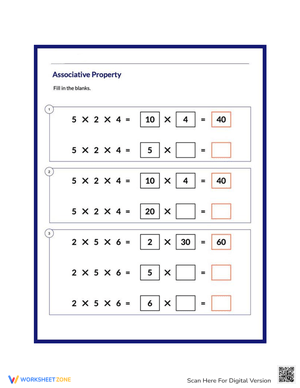
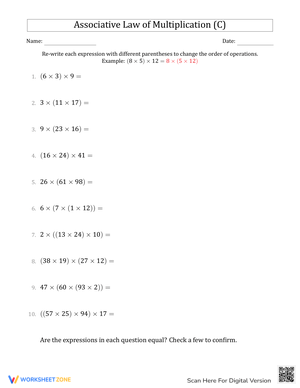
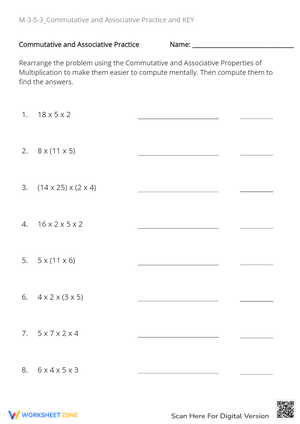
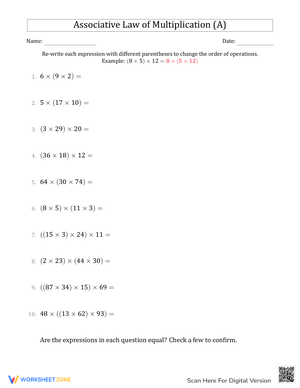
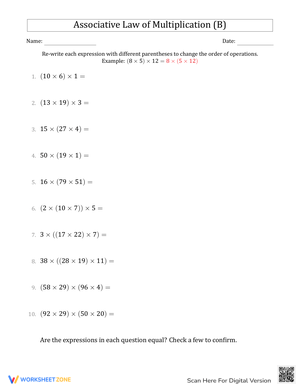
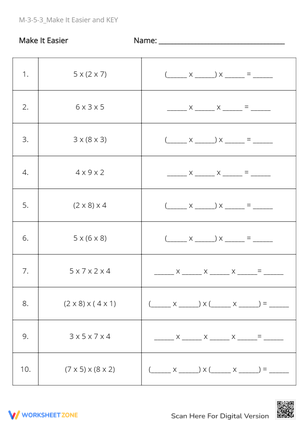
These associative multiplication pdf worksheets for 3rd grade put a specific tool in teachers' hands: structured practice with parentheses placement and factor regrouping across multiple equation formats, without the filler that comes with a full unit packet. The set moves from fill-in-the-blank groupings through equivalent expression comparisons to multi-step word problems, so students encounter the same property in enough different contexts to internalize it. Each worksheet stands alone, which means you can drop one into a warm-up block, pull another for a small-group reteach, and use a third as a formative check—all within the same week.
The Specific Skills These Worksheets Target
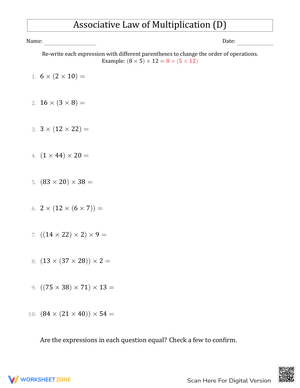
The core task on every worksheet is recognizing that (a × b) × c and a × (b × c) produce the same product, then using that insight deliberately. Students read and place parentheses correctly, rewrite given equations with different groupings, and solve both versions to confirm equivalence. The problem formats across the set include:
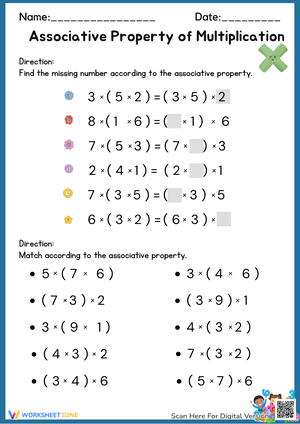
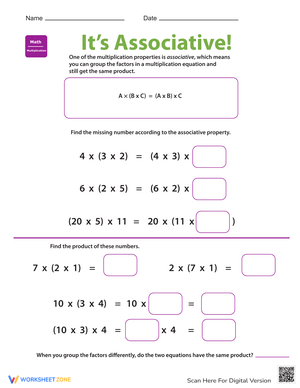
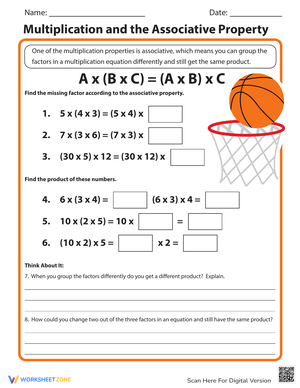
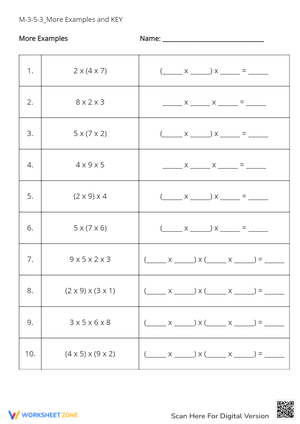
- Fill-in-the-blank equations: Students supply the missing factor inside a regrouped expression—for example, (2 × 5) × 3 = 2 × ( __ × 3). This tests recognition of the property without requiring a full calculation.
- Equivalent expression matching: Students connect equations that share the same factor sets in different groupings, building visual recognition before numerical fluency.
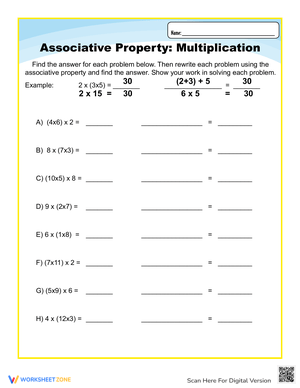
- Solve-and-compare problems: Students solve the same three-factor expression two ways, record both products, and note they match—reinforcing that the grouping changed, not the answer.
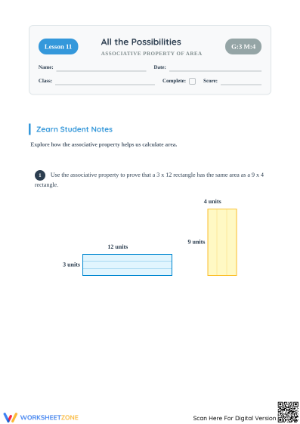
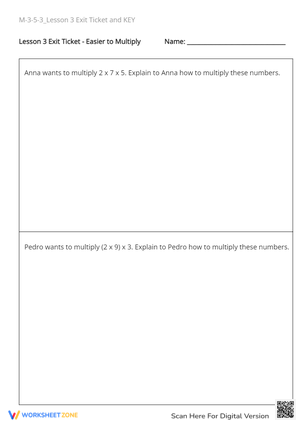
- Word problems requiring factor regrouping: Students read a context involving equal groups arranged in layers or arrays, choose the most efficient grouping, and briefly explain their reasoning.
One problem type worth noting: several worksheets ask students to identify whether two expressions are equal without calculating the final product—purely through parentheses analysis. That pushes well past computation into actual property reasoning, and it's harder for third graders than it looks.
Why Regrouping Factors Matters for Mental Math
The associative property isn't just a vocabulary term to survive a unit test—it's a real calculation strategy. When a student encounters 3 × 7 × 2, regrouping as (3 × 2) × 7 = 6 × 7 = 42 is faster than working through (3 × 7) × 2 = 21 × 2, especially for students whose 21 times table is shaky. Teaching students to scan a three-factor problem and look for a friendly pair—two factors whose product they know solidly—is where this property starts doing real instructional work. Cognitive load research supports this directly: reducing the working-memory demand of one calculation step frees students to focus attention on the next.
Third grade is the right moment for this instruction. Students at this stage have enough single-digit multiplication knowledge to notice friendly pairs like 2 × 5 or 4 × 5, but they haven't yet moved into multi-digit multiplication where strategic regrouping should feel automatic. The window for turning this into a deliberate habit is relatively narrow, and these worksheets sit squarely inside it.
Fitting These Worksheets Into Your Weekly Lesson Plans
The highest-yield placement is the five to eight minutes immediately after direct instruction, while the model is still on the board. Students work independently, you circulate and listen for misconceptions, and the worksheet gives you a concrete record of where the class is before the lesson closes. A second strong use is Monday morning warm-up during the week after initial instruction—spaced retrieval matters here, and one worksheet surfaces quickly whether students retained the concept over the weekend or whether a brief reteach is needed before moving on.
These associative multiplication pdf worksheets for 3rd grade also work well in small-group settings when some students finish earlier computation tasks and need something mathematically substantive. The word-problem worksheets particularly reward a short discussion: ask students to explain why they chose the grouping they did before writing the calculation. That verbal articulation step often catches the commutative/associative confusion before it shows up in written work.
Errors Worth Watching For and Addressing
The most consistent error: students change the order of factors when they mean to change the grouping. Given (3 × 4) × 2, a student will rewrite it as 2 × (3 × 4) and call that the associative property. The product is the same, but they have demonstrated the commutative property. These two properties are easy to conflate in third grade because both allow students to rearrange a multiplication expression without changing the answer—many students carry a single fuzzy rule rather than two distinct ones.
A second error pattern appears specifically on fill-in-the-blank problems: students write the final product in the blank instead of the missing factor. Given (2 × 3) × 4 = 2 × ( __ × 4), a student who multiplies everything out writes 24 in the blank rather than 3. They have answered what is the product instead of which factor belongs in this grouping. This error signals the student doesn't yet understand what the parentheses are asking them to show—it is worth a whole-class discussion before moving on, not just a mark on a returned paper.
Standard Alignment
These associative multiplication pdf worksheets for 3rd grade address CCSS.Math.Content.3.OA.B.5, which requires students to apply properties of operations as active strategies for multiplication and division—not just recite their definitions. In classroom terms, the distinction matters: a student who can name the associative property but cannot use it to simplify 5 × 6 × 2 into (5 × 2) × 6 has not fully met the standard. The worksheets address this by placing students in situations that require flexible grouping—rewriting equations with different parentheses placements, solving multi-factor problems where one grouping is demonstrably more efficient—rather than testing recognition alone.
Modifying the Set for Below-Level and Advanced Learners
Students who need more support benefit from working alongside a printed multiplication chart. Allow them to calculate both groupings before deciding which is friendlier—this preserves the strategic reasoning goal even when fact retrieval is slow. A loop of string or a pipe cleaner on the desk, used to circle the grouped pair of factors, gives students with weaker abstract symbol processing a concrete referent while they work through each equation without losing track of the structure.
For students who move through the computation problems quickly, the most demanding extension is requiring written justification: "I grouped these two factors first because..." followed by a mathematical explanation. That task sounds simple but isn't—articulating the reasoning behind a calculation choice at third-grade level is genuine intellectual work. A small group given this extension stays productively engaged while the rest of the class completes the associative multiplication pdf worksheets for 3rd grade at the standard pace.
Frequently Asked Questions
What is the associative property of multiplication in Grade 3 math?
When multiplying three or more numbers, the way factors are grouped with parentheses does not change the final product. (2 × 3) × 4 and 2 × (3 × 4) both equal 24. The parentheses move; the factors and the answer stay the same.
How is the associative property different from the commutative property?
The commutative property changes the order of factors: 4 × 5 equals 5 × 4. The associative property changes how factors are grouped using parentheses, without reordering them: (2 × 3) × 4 becomes 2 × (3 × 4). Third graders regularly confuse the two because both produce the same product, so side-by-side comparisons with color-coded parentheses help make the distinction visible on the board.
When in the third-grade year should I introduce these worksheets?
After students have solid recall of single-digit multiplication facts through at least the fives. The associative property asks students to evaluate two different calculation paths and pick the friendlier one—that strategic thinking is not accessible if basic fact retrieval is still consuming most of their working memory. Most teachers introduce the property in the second half of the multiplication unit, once fact fluency has stabilized.
What standard do these worksheets address?
CCSS.Math.Content.3.OA.B.5, which requires students to apply properties of operations as strategies to multiply and divide. These worksheets focus specifically on the associative property, asking students to rewrite and solve equations using different factor groupings rather than simply identifying the property by name.













 Interactive Worksheet Maker
 Quiz Maker
 Word Search Maker
 Crossword Puzzle Maker
 Word Scramble Generator
 Sentence Scramble Generator
 Handwriting Worksheet Generator
 Name Tracing Generator
 Fill In The Blank Generator