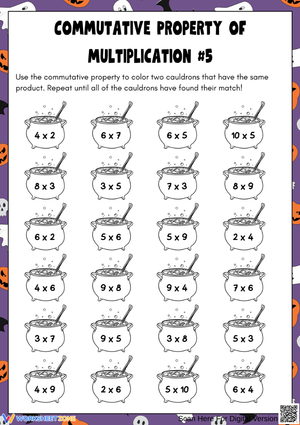
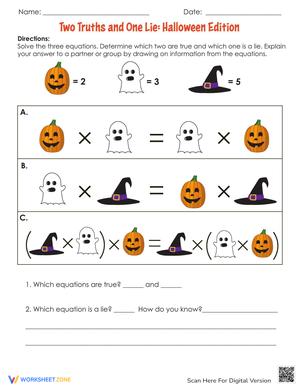
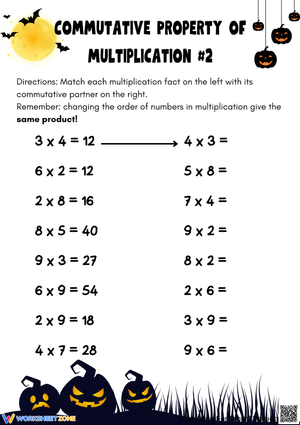
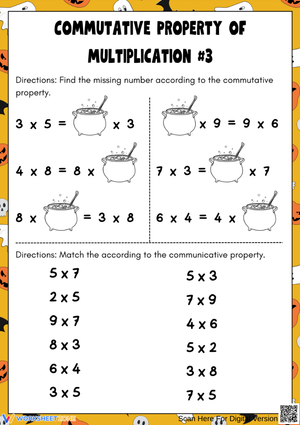
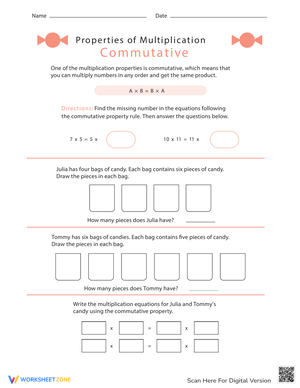
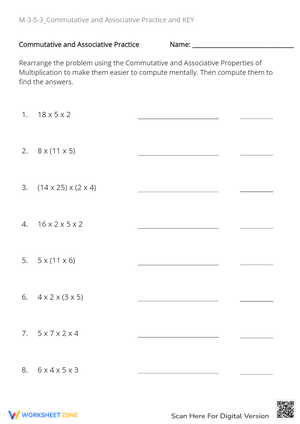
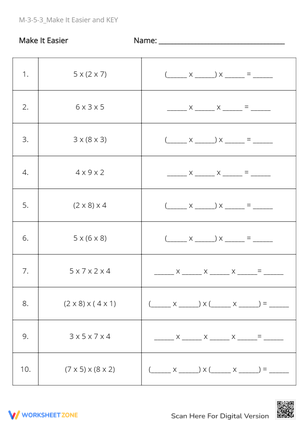
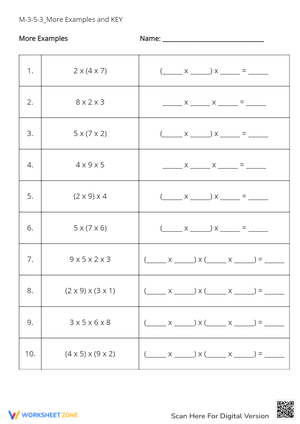
These commutative multiplication worksheets for 3rd grade target one of the most practical realizations in the multiplication unit: the moment a student understands that knowing 6 × 7 automatically gives them 7 × 6 as well. Each worksheet in the set builds that recognition through array drawing, matched-fact pairs, and equation-completion exercises, moving students from vague "turn-around" intuition toward a fluency they can apply on assessments.
The Specific Skills Each Worksheet Builds
The work in this set centers on three connected skills:
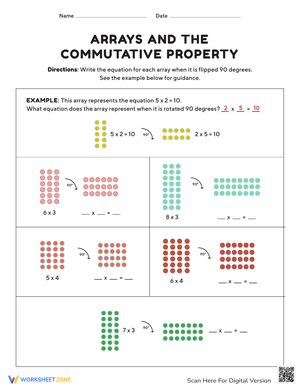
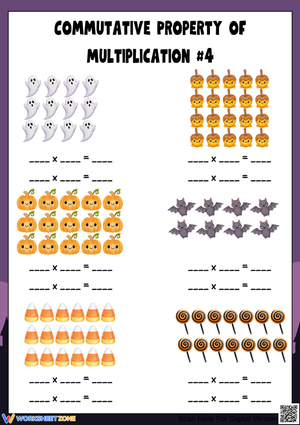
- Array drawing and rotation. Students draw a rectangular array for a given equation — say, 3 × 6 — then draw the rotated version, 6 × 3, and confirm the product stays the same. Drawing both orientations by hand is what makes the equivalence concrete rather than merely declared.
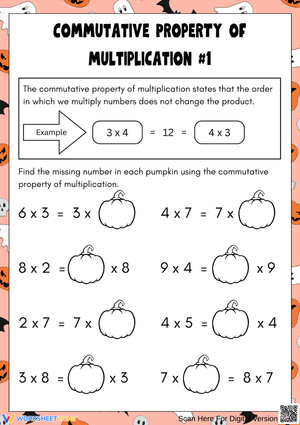
- Relational equation completion. Problems like "4 × 9 = 9 × ___" require students to think about the relationship rather than calculate. A student who reaches for a multiplication chart to answer this hasn't yet internalized the property.
- Matched-fact sorting. Several worksheets ask students to group a mixed list of facts into commutative pairs, which quickly reveals whether each fact is being treated as isolated or as part of a connected system.
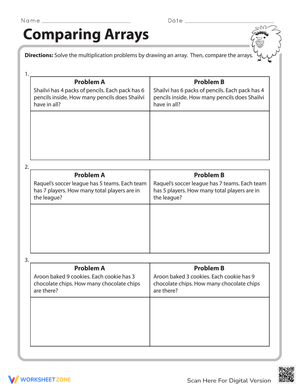
Later worksheets in the set extend the skill to short word problems. A student reads about 5 rows of 8 chairs and rewrites the arrangement as 8 rows of 5, identifying both equations — a step that connects the abstract rule to the spatial reasoning the third-grade curriculum returns to throughout the year.
Arrays and the Logic Behind the Rule
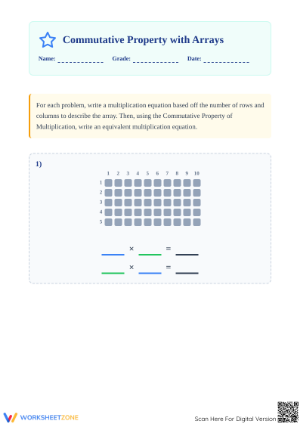
Third grade is where multiplication moves from skip-counting strategies toward genuine multiplicative thinking, and arrays are the right tool for that shift. When a student draws a 2-by-7 array and then rotates it 90 degrees to get a 7-by-2, the product doesn't change — and they see exactly why without needing to memorize a definition. That visual proof matters because third graders are still building trust in abstract number relationships. They need to see before they believe.
Several worksheets pair each array task with a written equation beneath it, so students record both "2 × 7 = 14" and "7 × 2 = 14" in the same workspace. This ties the drawing directly to symbolic notation, which is exactly the connection 3.OA.B.5 expects students to make. One technique worth adding during practice: have students sketch the original array in pencil, then draw the rotated version in a second color next to it. The act of redrawing — rather than just rotating — forces attention to which dimension is now a row and which is a column, a distinction that trips students up more than teachers expect.
Student Mistakes Worth Watching For Before They Become Habits
The most common error isn't a computation mistake — it's a conceptual overreach. Many students who learn the commutative property for multiplication immediately apply it to subtraction on a different problem. A student who correctly writes "8 × 3 = 3 × 8" will sometimes, in the same sitting, claim that "9 − 4 = 4 − 9." The generalization feels obvious once they've accepted it for multiplication. It's worth spending a few minutes explicitly naming which operations the property applies to and which it doesn't, rather than waiting for the confusion to surface on an assessment.
A second pattern: students who fill in the missing factor correctly but still calculate both sides of the equation from scratch. When a worksheet shows "7 × 6 = ___ × 7," some students will work out 7 × 6 = 42, then verify ___ × 7 = 42 before concluding the answer is 6. They're arriving at the right answer through the wrong reasoning — they haven't yet internalized that the relationship itself resolves the question. Watching how a student works these problems, not just what they write, tells you far more than the answer does.
Building These Worksheets Into Your Math Block
The most natural entry point is after a hands-on lesson where students have built and rotated physical arrays with tiles or counters. Move to paper-based work once students have that physical experience behind them — the worksheet then asks them to recreate mentally what they've already done with their hands. Commutative multiplication worksheets for 3rd grade fit well as the independent practice component of a gradual-release lesson, after the teacher has modeled array rotation with the whole group and walked through one or two examples together.
For teachers running math centers, one station with an array-drawing worksheet and a small bin of square tiles lets students check their paper work against a physical build. During small-group instruction, the fill-in-the-blank equation format provides immediate formative data: a student who writes "2" in "9 × 2 = ___ × 9" without calculating has internalized the property; a student who reaches for a multiplication chart first has not. That distinction shapes the next day's instruction more usefully than any end-of-week quiz.
Standard Alignment
These worksheets address 3.OA.B.5 — Apply properties of operations as strategies to multiply and divide. In classroom terms, this standard asks students to use what they know about number relationships to simplify calculation, rather than treating every multiplication fact as a brand-new problem. The commutative property is the first entry point into that kind of strategic thinking, and teachers typically introduce it mid-unit — after students are comfortable representing multiplication with arrays but before moving to the associative and distributive properties. Positioning these worksheets there, not at the opening of the unit and not as a late review, gives students a conceptual anchor right when fact fluency is being built. The standard also connects forward: students who understand why 7 × 8 = 8 × 7 are better prepared to understand why (2 × 3) × 4 = 2 × (3 × 4) when that property arrives later in the year.
Adjusting the Set for Different Student Levels
For students who are still shaky on basic multiplication facts, keep the factor range at 1 through 5. The commutative property doesn't get harder with larger numbers, but fact-recall errors cloud the picture when a student is simultaneously trying to grasp a new relationship. Smaller factors keep the concept visible. Once the conceptual understanding is firm, the same worksheet format with factors from 6 through 9 becomes a review of harder facts rather than a new concept lesson — a useful distinction when planning a two-week sequence.
Students who grasp the property quickly benefit from word-problem extension tasks, where the "turn-around" isn't stated explicitly and they have to recognize on their own that two different arrangements describe the same multiplication. For students who need more structured support, printing the array-drawing worksheets at a larger scale — or providing dot paper so students can build arrays before writing the equations — removes the spatial-organization barrier without reducing the mathematical demand. Commutative multiplication worksheets for 3rd grade can serve a range of ability levels within the same lesson when teachers select tasks by factor range and problem format rather than assigning one worksheet uniformly across the class.
Frequently Asked Questions
When in the multiplication unit should these worksheets come in?
After students have used physical arrays to model multiplication — typically two to three lessons into the unit — but before you move to the associative or distributive properties. The commutative property makes the most sense once students have a concrete image of an array in their minds. Introducing it too early, before arrays feel familiar, turns it into an abstract rule students memorize without understanding why it works.
Can I use these as a formative check, or are they only useful for practice?
Both purposes are valid, but the formative value comes from watching the process rather than reading the answers. A completed set of commutative multiplication worksheets for 3rd grade with all correct answers doesn't distinguish between a student who understood the property and one who calculated each side independently. Pair the worksheet with a brief verbal question — "how did you know what to write there?" — and you get a much clearer picture of where students actually are.
My students keep mixing up the commutative property with the associative property. What helps?
This confusion is common in the second half of the properties unit. The commutative property changes the order of two factors; the associative property changes the grouping of three. A side-by-side comparison chart — written by students themselves during a brief class discussion, not handed out pre-made — tends to make the distinction stick more reliably than repeated explanation. Once students have built the chart, referring back to it during worksheet practice keeps both properties active in working memory without requiring a full re-teaching lesson.













 Interactive Worksheet Maker
 Quiz Maker
 Word Search Maker
 Crossword Puzzle Maker
 Word Scramble Generator
 Sentence Scramble Generator
 Handwriting Worksheet Generator
 Name Tracing Generator
 Fill In The Blank Generator