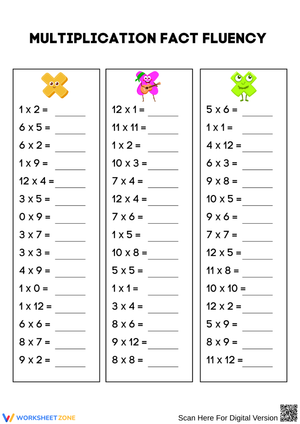
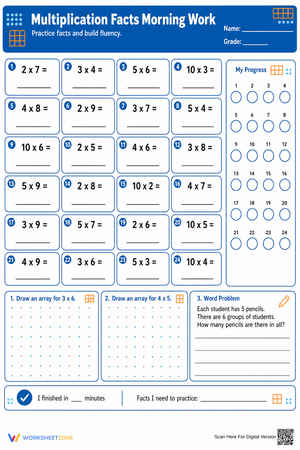
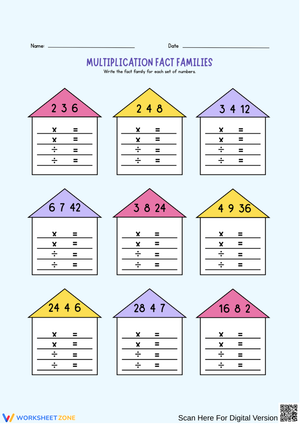
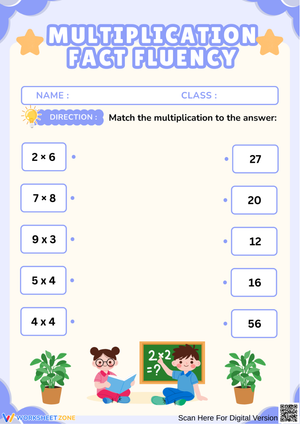
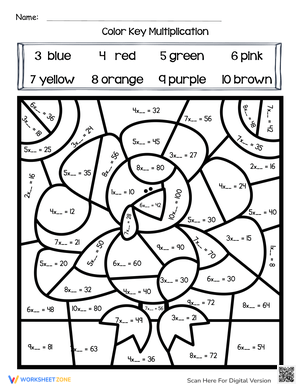
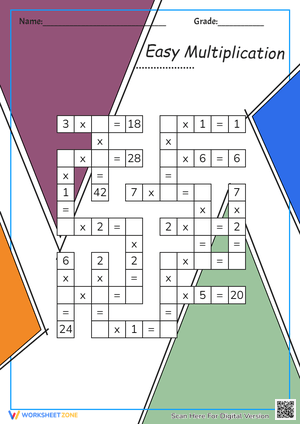
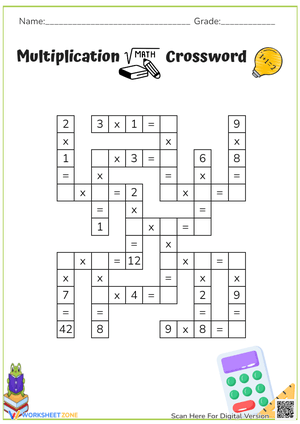
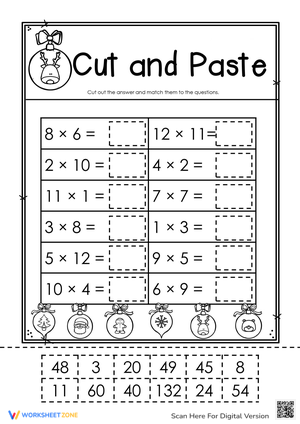
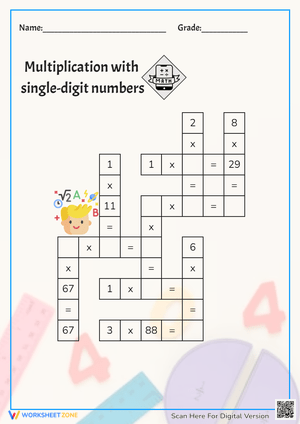
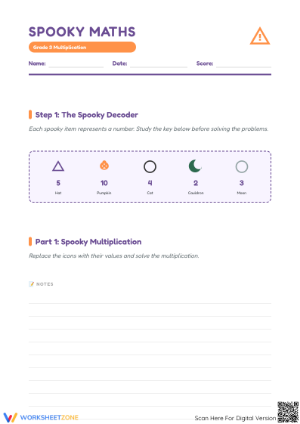
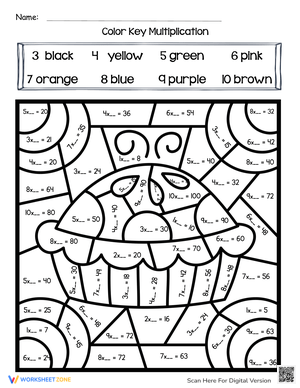
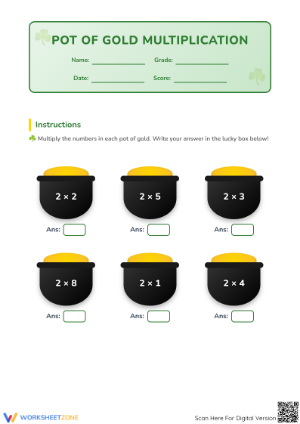
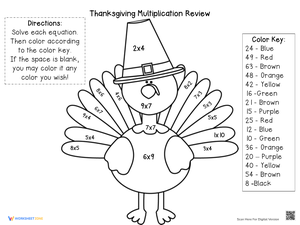
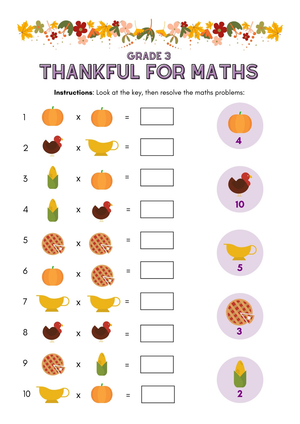
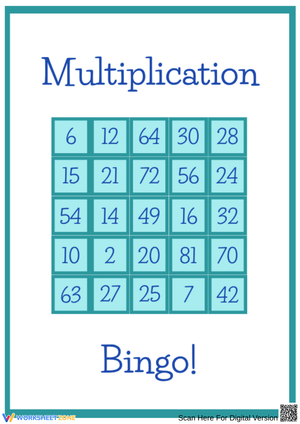
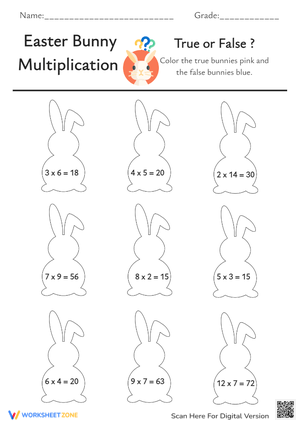
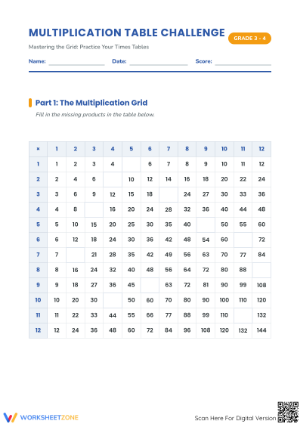
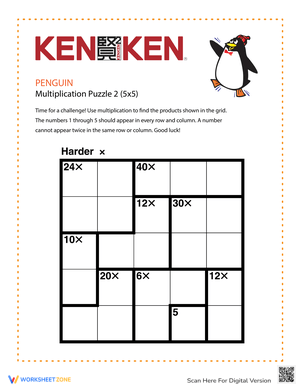
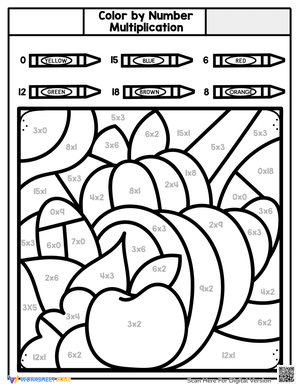
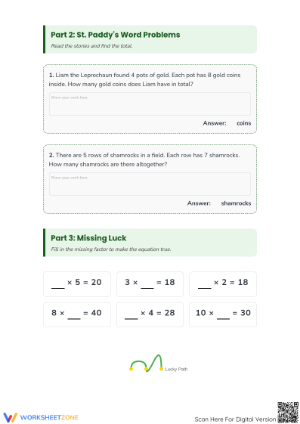
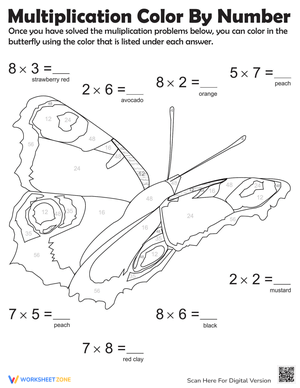
These 3rd grade multiplication fact fluency printable worksheets resources give teachers a flexible, repeatable way to move students from skip-counting to reliable fact recall — without turning every math block into a prolonged drill session. The set covers individual fact families, missing-factor equations, array-based visual models, and cumulative mixed review, so teachers can match each worksheet to an actual lesson goal rather than reaching for whatever's closest.
The Specific Skills These Worksheets Build
Each worksheet targets a narrow slice of multiplication work, giving students concentrated practice on one skill at a time. The range across the set includes:
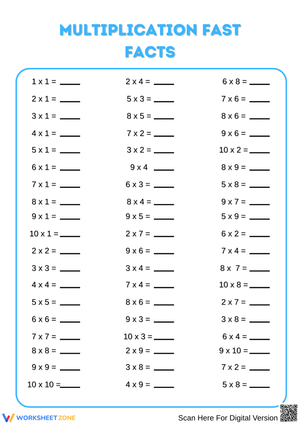
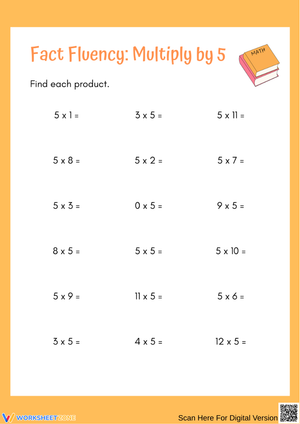
- Single fact family practice — one factor stays fixed while students work through all related products, making patterns visible before recall is expected
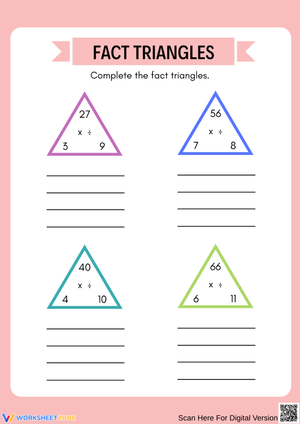
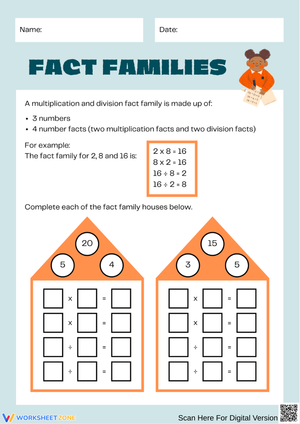
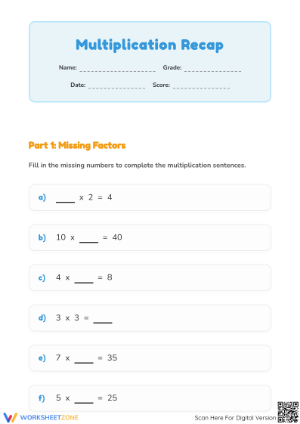
- Missing factor problems — students fill in the unknown in equations like 6 × __ = 42, building the inverse relationship between multiplication and division without formally introducing division as a separate topic
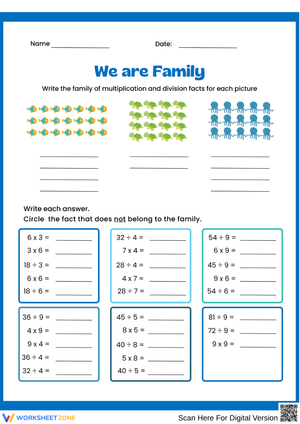
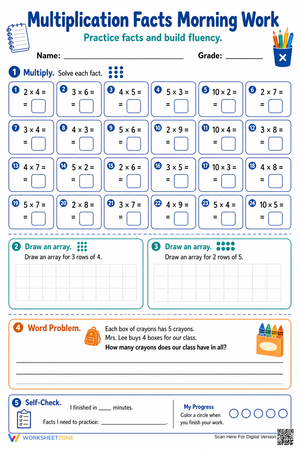
- Array interpretation — students write the multiplication equation described by a given array, or draw one from an equation, anchoring the abstract symbol to a concrete picture
- Equal groups models — visual representations where students count groups to verify answers, useful when a fact hasn't clicked at a numerical level
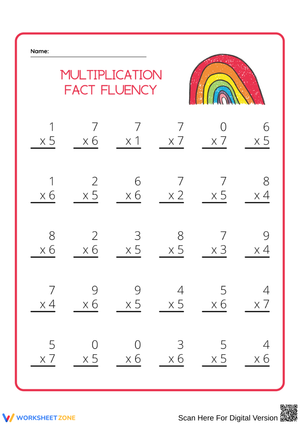
- Cumulative mixed review — these worksheets pull from multiple fact families so recall can't lean on within-column pattern cues
- Short word problems — one or two per worksheet, requiring students to apply a known fact rather than always filling in isolated blanks
The 3rd grade multiplication fact fluency printable worksheets set sequences fact families so teachers can start with the most accessible entry points — 0s, 1s, 2s, 5s, and 10s — before moving into the families students typically find harder: 3s, 4s, 6s, 7s, 8s, and 9s. That sequence isn't arbitrary. Students who already have a strong ×2 foundation can use doubling as a bridge when they encounter ×4, which meaningfully cuts the memorization load.
Mistakes Students Make That These Worksheets Help You Catch
The most persistent error in 3rd grade multiplication is what you might call directional fragility: a student learns that 6 × 7 = 42 and retrieves it instantly — but when the same fact appears as 7 × 6, they treat it like something brand new. They stare, recount, or guess. The commutative property has been introduced, but it hasn't become automatic. Missing-factor worksheets surface this quickly because they force students to approach a fact from multiple angles rather than always reading left to right.
A second pattern appears with the ×0 and ×1 families, which teachers often deprioritize because the rules seem straightforward. In practice, a meaningful portion of students who state the rule correctly in isolation will write the non-zero factor as the product when the problem is embedded in a mixed-fact worksheet — 5 × 0 becomes 5, and 1 × 8 becomes 18 (students add instead of multiply). These slips appear most often when there are many problems to complete at once, which is evidence about cognitive load, not just carelessness.
Missing-factor format also reliably exposes a specific confusion: students read 4 × __ = 24 and try to divide mentally, which is the right move — but without an anchor for ×6, they guess rather than use the ×4 pattern they do know. A wrong answer on a standard fact problem might signal a recall gap; the same wrong answer on a missing-factor problem often signals a reasoning gap. That distinction changes how you respond.
How to Work These Worksheets Into Your Weekly Lesson Plans
The most effective use pattern is short and frequent. Five to eight problems at the start of math block, three or four days a week, produces noticeably better retention than a single long fluency worksheet on Friday. The warm-up slot works well because it activates prior knowledge before direct instruction begins, and it stays under five minutes — which matters on days when morning meeting runs long or transitions eat into the block.
Math centers are another strong placement. One worksheet in a dry-erase sleeve can be reused across two or three rotations in the same week. Students write answers with a dry-erase marker, check against an answer key at the center, erase, and pass the sleeve to the next group. The physical routine — mark, check, erase — gives the activity enough structure that repetition doesn't feel tedious. For 3rd grade multiplication fact fluency printable worksheets, this reuse approach is one of the most practical ways to get multiple exposures per printing without additional prep.
For small-group intervention, choose one fact family or format and work through it together, with students annotating directly on the worksheet — circling equal groups, writing the turn-around fact beside each equation, or marking which facts they can answer without counting. That kind of active marking slows students down in a useful way and gives the teacher visible information about where reasoning breaks down, not just which answers are wrong.
One scheduling note worth keeping in mind: Monday is typically the weakest day for pure recall after a weekend gap. Using Monday for a concept-anchored worksheet — arrays or equal groups — and saving cumulative mixed review for Wednesday or Thursday gives students time to re-engage before they're asked to retrieve facts without support.
Standard Alignment
These worksheets address 3.OA.C.7, which requires that students fluently multiply and divide within 100 by the end of Grade 3, using strategies and understanding the relationship between the two operations. The array, equal-groups, and missing-factor worksheets directly address the strategy component of that standard. The cumulative mixed-fact worksheets address the fluency component. Using both types across the year — rather than switching entirely to mixed review by spring — keeps conceptual grounding intact as recall sharpens.
Several worksheets in the set also connect to 3.OA.A.1 and 3.OA.A.3 through equal-groups models and context problems. That overlap is worth noting during unit planning: a fact fluency worksheet that includes a brief word problem is doing double instructional work without requiring a separate lesson.
Differentiating the Set Across a Range of Learners
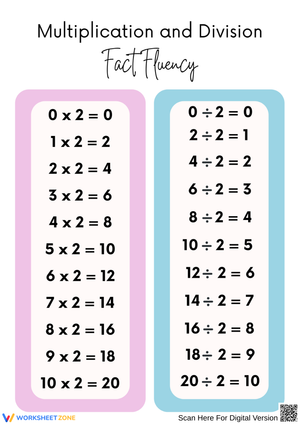
For students still working through the conceptual foundation of multiplication, the array and equal-groups worksheets are the starting point — not a remediation detour. These students benefit from spending more time on visual-model formats before moving to purely numerical practice. Giving them a reference chart during those sessions removes recall pressure so they can concentrate on what the multiplication represents, which is the actual instructional goal at that stage.
Students who have accurate but slow recall benefit from single-family worksheets used on a brief daily cycle. Returning to the same fact family for three or four days in a row — rather than introducing a new one each week — moves a student from "I can figure it out" to "I just know it." Spaced retrieval also matters here: coming back to a fact family after a few days away is more efficient than massed repetition in one sitting, and the set makes that rotation easy to manage because worksheets are organized by fact family and format.
Students who are already fluent within grade-level scope can work with missing-factor problems involving larger products and word problems that require two-step thinking. Teachers can also ask these students to write their own word problems for three facts from a mixed-review worksheet — a task that demands understanding well beyond simple recall.
Frequently Asked Questions
Which fact families should I introduce first?
Start with 0s, 1s, 2s, 5s, and 10s. Students come into 3rd grade with skip-counting knowledge that maps directly onto these families, so the entry point is lower and confidence builds faster. After those are solid, most teachers move to 3s and 4s, then fill in 6s, 7s, 8s, and 9s — adjusting the pace based on where the class lands on quick formative checks.
Should I use timed worksheets, and when do they make sense?
Timed formats make sense as a personal tracking tool once students have had adequate practice on a fact family in an untimed setting — not as an introduction to that family. Framing a timed check as "how many can you answer accurately today compared to last week" keeps the focus on individual growth rather than comparison. A student who freezes under time pressure is telling you the fact isn't automatic yet. More timed repetition won't fix that; more targeted practice on that specific family does.
What if some of my students are still counting on their fingers?
The 3rd grade multiplication fact fluency printable worksheets resources include array and equal-groups formats that give those students visual support for building understanding before they move to purely numeric practice. The sequence from model to equation is the instructional path, not an accommodation. These students may take longer to reach fluency, and using the visual-model worksheets while building toward numerical recall keeps them progressing without rushing past the meaning of what they're multiplying.
How many problems should a daily practice worksheet have?
For warm-up and exit-slip use, six to ten problems is enough. Students who work more slowly need to feel that completion is within reach — a worksheet with 30 problems can shift the experience from practice to something that feels like an evaluation. Longer worksheets, in the 20 to 30 problem range, fit better in center time or independent practice blocks where pacing is less constrained.













 Interactive Worksheet Maker
 Quiz Maker
 Word Search Maker
 Crossword Puzzle Maker
 Word Scramble Generator
 Sentence Scramble Generator
 Handwriting Worksheet Generator
 Name Tracing Generator
 Fill In The Blank Generator