


























Views
Downloads
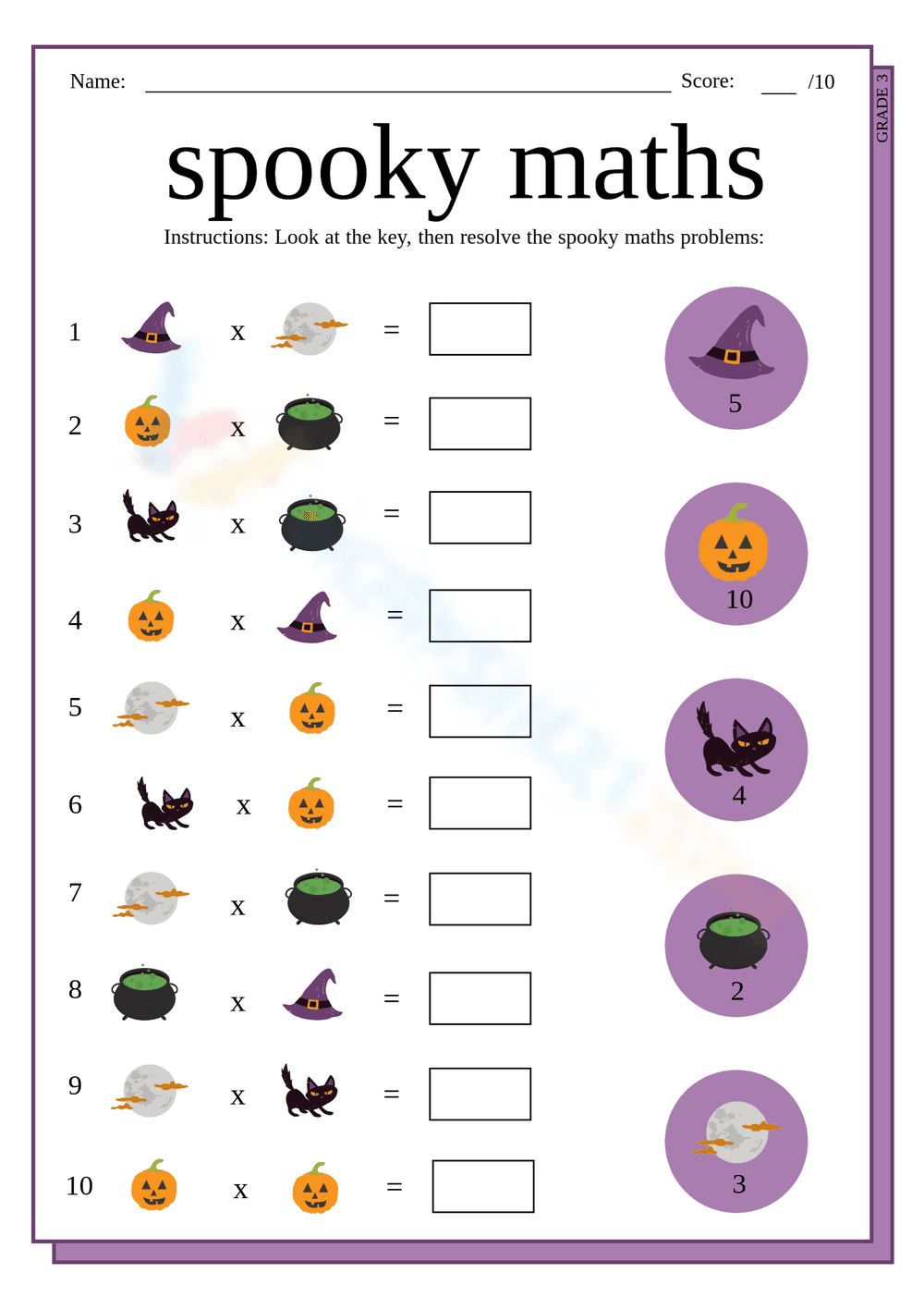

Halloween Multiplication Worksheet | Grade 3 Printable
Paste this activity's link or code into your existing LMS (Google Classroom, Canvas, Teams, Schoology, Moodle, etc.).
Students can open and work on the activity right away, with no student login required.
You'll still be able to track student progress and results from your teacher account.
This festive Grade 3 multiplication worksheet provides students with engaging practice to build fact fluency. By substituting spooky Halloween symbols for numbers, learners solve ten targeted math problems while strengthening their algebraic thinking and foundational multiplication skills.
At a Glance
- Grade: 3 · Subject: Math
- Standard:
CCSS.MATH.CONTENT.3.OA.C.7— Fluently multiply within 100 using mental strategies- Skill Focus: Multiplication facts and substitution
- Format: 1 page · 10 problems · Answer key included · PDF
- Best For: Independent practice or morning work
- Time: 10–15 minutes
What's Inside
Inside this single-page resource, educators will find a highly visual math activity featuring ten multiplication equations. Students use a provided symbol key—matching witches' hats, pumpkins, black cats, cauldrons, and moons to specific values—to decode and solve each problem. A complete answer key is included to ensure fast and accurate grading for teachers.
Zero-Prep Workflow
- Print (1 minute): Simply download the PDF and print a class set. The high-contrast design ensures clear copies every time.
- Distribute (1 minute): Hand out the worksheets as students enter the room or transition between subjects. The instructions are completely self-explanatory.
- Review (3 minutes): Use the included answer key to quickly check student work or project it on the board for self-correction.
Total teacher preparation requires under two minutes, making this an ideal, stress-free addition to any October lesson plan or emergency substitute binder.
Standards Alignment
This resource is strictly aligned to CCSS.MATH.CONTENT.3.OA.C.7: Fluently multiply and divide within 100, using strategies such as the relationship between multiplication and division or properties of operations. It also supports early algebraic thinking by requiring students to substitute symbols for numerical values. Both standard codes can be copied directly into lesson plans, IEP goals, or district curriculum mapping tools.
How to Use It
Deploy this worksheet during independent math centers to reinforce fact fluency while keeping students highly engaged with the holiday theme. Alternatively, use it as a fun morning work assignment on Halloween week. While students work, teachers can conduct quick formative assessments by observing how quickly learners recall the values from the key and compute the products. Expect most third graders to complete the ten problems within 10 to 15 minutes.
Who It's For
This activity is designed primarily for third-grade students mastering their basic multiplication tables. The visual nature of the symbol key provides a helpful scaffold for visual learners and students who benefit from gamified math tasks. It pairs perfectly with direct instruction on multiplication properties or a seasonal read-aloud to create a cohesive, festive learning block.
Developing automaticity with basic math facts is a critical milestone in elementary mathematics. According to a recent EdReports 2024 analysis of foundational math curricula, students who achieve early fact fluency demonstrate significantly higher success rates when tackling complex, multi-step word problems later in their academic careers. This resource directly supports that goal by targeting CCSS.MATH.CONTENT.3.OA.C.7, helping students fluently multiply within 100 using mental strategies. By integrating a substitution element with the Halloween symbol key, the worksheet also introduces pre-algebraic concepts in a low-stakes, highly engaging format. Regular, targeted practice with resources like this ensures that learners move beyond simple counting strategies and develop the robust mental math capabilities required for advanced mathematical reasoning, standardized testing success, and long-term academic achievement across all STEM disciplines.


