By 7s printable worksheets for 3rd Grade: Mastering the 7 Times Table
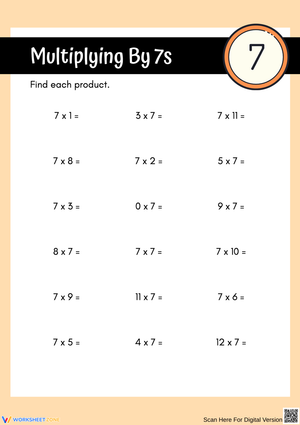
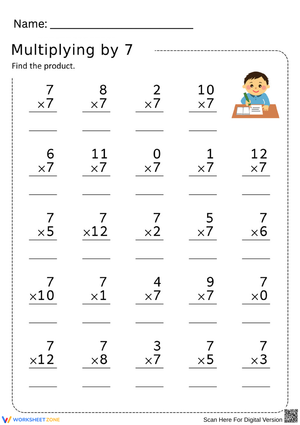
These by 7s printable worksheets for 3rd grade arrive at exactly the right moment in the multiplication unit — after students feel solid on the 2s, 5s, and 10s and before they need the 7s for division work and multi-digit problems. The set includes seven distinct worksheet formats: skip-counting sequences, multiplication wheels, missing factor equations, array drawing tasks, area model problems, word problems anchored in real-world contexts, and a timed fluency check.
What Makes the 7s the Hardest Fact Family in the Multiplication Unit
The difficulty is structural. The 5s always end in 0 or 5. The 2s, 4s, 6s, and 8s end in even digits. Students who know those patterns have a built-in self-check — if an answer ends in an odd number, something went wrong. The 7s offer no such shortcut. The multiples — 7, 14, 21, 28, 35, 42, 49, 56, 63, 70 — cycle through every digit from 0 through 9 in the ones place, which means a wrong answer like 7 × 6 = 43 passes a child's casual glance without triggering any alarm. That's a pattern problem, not a memorization problem, and standard drill alone doesn't fix it.
There's also a timing issue. The 7s typically land near the end of the fact-family sequence, when students are experiencing what teachers recognize as fact fatigue. By March or early April, many third graders have already worked through six or seven other fact families, and their motivation for another round of rote practice is low. The result is a predictable cluster of errors concentrated on the facts that don't benefit from any easy trick: 7 × 6, 7 × 7, 7 × 8, and 7 × 9.
What Each Worksheet Asks Students to Practice
The formats in this set are deliberately varied so the same facts get approached from different angles across a single week of instruction.
- Skip-counting sequences: Students complete the multiples of 7 on a number line or fill in a path maze by following the sequence 7, 14, 21, 28... This builds the mental map students need before they're asked to retrieve facts in isolation.
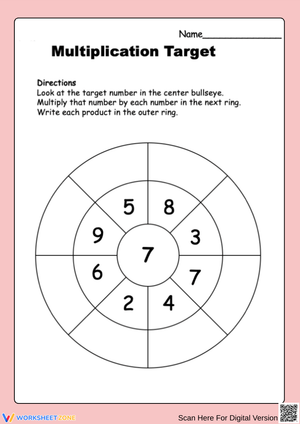
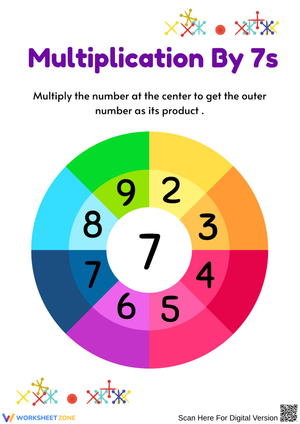
- Multiplication wheels: A 7 sits in the center; students multiply it by the numbers in the inner ring and write products in the outer ring. These run well as a three-minute warm-up because the circular format feels distinct from a column of equations.
- Missing factor problems: Rather than solving 7 × 8 = ___, students see 7 × ___ = 56 and must work backward. This is the same cognitive work that division requires, and it strengthens the fact bidirectionally.
- Array and area model tasks: Students draw a 7 × 4 array or shade a rectangle on a centimeter grid, then write the corresponding equation. Seeing seven rows of four dots provides a concrete anchor for an abstract product.
- Word problems: Problems are written around weeks and days, equal groups of 7 objects, and sharing scenarios — contexts students can reason through even when direct recall temporarily fails them.
Student Mistakes That Surface With the 7s — and What They Reveal
The most persistent error involves 7 × 8. Students write 54 instead of 56 with surprising frequency, conflating it with 6 × 9. Both products are two-digit numbers ending in an even digit; both live in the upper-right region of the multiplication chart that students find generally murky. The adjacency of 56 = 7 × 8 and 54 = 6 × 9 on the chart makes the confusion almost predictable. The mnemonic "5, 6, 7, 8 — fifty-six equals seven times eight" addresses this specific pair and is worth teaching explicitly rather than hoping students work it out on their own.
A second pattern appears when students apply the 5 + 2 decomposition strategy accurately on a worksheet but miss the same fact during a verbal check five minutes later. The strategy is correct — (5 × 6) + (2 × 6) = 30 + 12 = 42 — but the student hasn't run it enough times for retrieval to become fast. The missing factor worksheet helps here because working backward from the product forces students to internalize the relationship from both directions, which consolidates the fact more firmly than solving the same forward equation a dozen more times.
A third error pattern: students often write 7 × 3 correctly but miss 3 × 7 in a mixed-order drill. The commutative property feels abstract to many third graders even after direct instruction. Pointing out during a brief class discussion that any 3s fact is also a 7s fact — and that students who know their 3s already know 7 × 2, 7 × 3, and 7 × 4 — visibly reduces the number of facts students feel they need to memorize from scratch, which matters a lot in late March when motivation is thin.
How to Fold These Worksheets Into Your Multiplication Unit
The skip-counting worksheet works best at the start of the week. Students who can produce the sequence orally — even slowly — have a fallback strategy when retrieval fails during a problem. Running the sequence warm-up on Monday, switching to the multiplication wheel Tuesday and Wednesday for quick-fire practice, and finishing Thursday or Friday with the word problems gives students distributed exposure across different task types without stretching the 7s into a two-week detour.
These by 7s printable worksheets for 3rd grade also fit naturally into a small-group pull-aside model. When a handful of students are stuck on the 7s while the rest of the class has moved into two-digit multiplication, a targeted 12-minute session with the missing factor worksheet gives those students focused practice without requiring a separate lesson plan or a second set of materials entirely.
The classroom calendar is worth using as a permanent visual during this unit. Because every week contains exactly 7 days, any question about weeks and days is a 7s problem. Asking students how many days fall within 4 school weeks, or how many days until a break that's 9 weeks away, grounds the abstract sequence in something they consult every day. Most third graders can verify "6 weeks = 42 days" by counting calendar rows — a meaningful self-check that flash cards don't provide.
Standard Alignment
CCSS.MATH.CONTENT.3.OA.C.7 requires that students "fluently multiply and divide within 100" and "by the end of Grade 3, know from memory all products of two one-digit numbers." In classroom terms, this standard typically becomes the driving goal in the second half of the year — roughly February through May — when teachers shift from introducing fact families to building automatic recall across all of them. The 7s arrive late in that sequence, and this set fits naturally into the final fluency push before end-of-year assessments.
Adapting the Set for Students at Different Stages of Fact Fluency
Students who are still building the sequence need a visible step-by-step support before they can work through isolated equations. For those students, the skip-counting and number-line worksheets give them a path to a correct answer while still completing the same task as everyone else. Pairing the area model worksheet with a printed multiplication chart allows a struggling student to check adjacent facts and focus specifically on the 7s without getting blocked by gaps in other fact families.
Students who have already internalized the sequence benefit most from the missing factor and word problem worksheets. One extension move: after solving a missing factor problem one way, ask them to verify the answer using a different strategy — if they used the 5 + 2 method, can they confirm with a related known fact or repeated addition? This keeps advanced students working on mathematical reasoning rather than waiting.
For students who need movement breaks, the by 7s printable worksheets for 3rd grade formats adapt without changing the math. Cut the multiplication wheel into its individual number spokes and use the pieces as a matching activity. Post the word problems around the room and have students rotate to each one rather than sitting at a desk. The content stays identical; the physical format shifts to meet students who struggle with extended seated work.
Frequently Asked Questions
Why do students who know their 3s still miss 7 × 3 in a timed drill?
The commutativity of multiplication is a property third graders understand in theory but don't always apply automatically under time pressure. A student who knows 3 × 7 as a 3s fact may not immediately recognize 7 × 3 as the same problem when it appears in a different order on a 7s drill. Making this connection explicit verbally — during instruction, not just printed on a worksheet — closes the gap faster than additional practice alone.
When in the school year should these worksheets be introduced?
Most third-grade teachers reach the 7s after completing the 1s, 2s, 3s, 4s, 5s, 9s, and 10s — typically in late winter or early spring. Introducing the skip-counting worksheet as soon as the 7s unit begins, rather than jumping straight to equation practice, gives students a few days to build the sequence before they're asked to retrieve facts in isolation. The timed fluency check belongs at the end of the unit, not in the first week.
How does practicing the 7s connect to division later in the year?
Division within 100 falls under the same CCSS.MATH.CONTENT.3.OA.C.7 standard that governs multiplication fluency. A student with automatic recall of 7 × 8 = 56 answers 56 ÷ 7 = ___ as a direct retrieval rather than counting up from zero. The missing factor worksheet explicitly builds this connection — students who have practiced 7 × ___ = 56 have already done the cognitive work that 56 ÷ 7 requires, just framed differently.
What's the best place to start when a student is stuck on all four of the hardest 7s facts?
Start with 7 × 7 = 49 — the doubling of the factor makes it memorable, and students often find it satisfying once it clicks. Move to 7 × 8 = 56 next and teach the sequence mnemonic explicitly: 5, 6, 7, 8. With those two facts secure, the remaining unknowns are 7 × 6 and 7 × 9, both of which students can derive from facts they already know — 7 × 6 from (7 × 5) + 7, and 7 × 9 from (7 × 10) − 7. The by 7s printable worksheets for 3rd grade set supports this sequence because the equation and missing-factor formats can be assigned in the order that matches where individual students actually are in the fact family.
Clear All