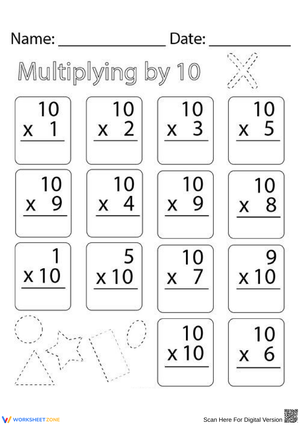
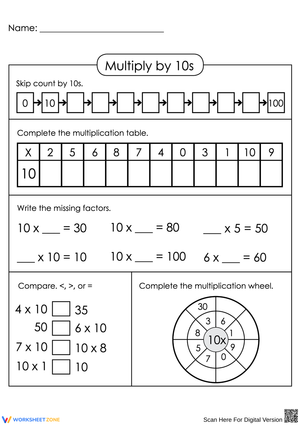
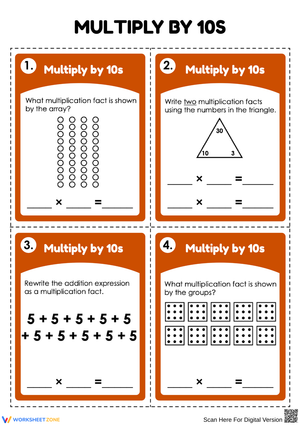
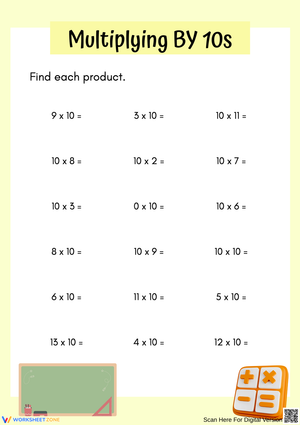
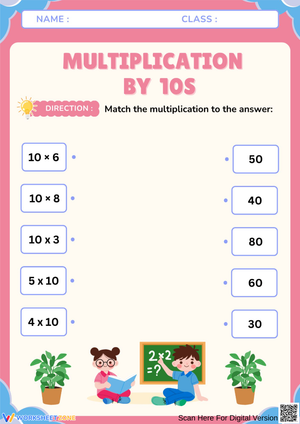
These 3rd grade by 10s worksheets give teachers a focused set of practice resources built around one of the most conceptually rich moments in third-grade multiplication: the place value shift that happens every time a number is multiplied by ten. The set moves from basic single-digit facts through multiples of ten up to 90 and includes tasks that ask students to explain the digit movement, not just compute a product.
What's Inside the Set
Each worksheet targets a distinct layer of the ×10 concept. The early worksheets establish fluency with single-digit factors — 3 × 10, 7 × 10, 9 × 10 — using place value charts where students record digits in the ones and tens columns before writing the product. Later worksheets move into multiples of ten: if 4 × 10 = 40, what is 4 × 20? Students have to treat 20 as "2 tens," which requires thinking in groups rather than reaching for a memorized fact. The final worksheets in the progression introduce word problems set in contexts students find plausible — counting dimes, figuring out how many pencils come in 6 boxes of ten, calculating the total cost of 10 items priced at $8 each.
Visual representation tasks appear throughout. Several worksheets include blank place value charts where students draw or annotate to show the shift from ones to tens. Others ask students to write both the repeated addition sentence (10 + 10 + 10 + 10 = 40) and the multiplication sentence (4 × 10 = 40) side by side — a structural choice that keeps the connection between the two operations visible while students are still internalizing it.
What Student Work on ×10 Gets Wrong
The most persistent problem in this unit isn't a calculation error — it's a conceptual shortcut gone unchallenged. Students learn quickly that multiplying by 10 means "put a zero at the end," and for whole numbers, that rule always gives the right answer. The problem surfaces later, but the roots are in third grade. A student who writes 7 × 10 = 70 by appending a zero has no mental model for what changes about the number's value. That same student, when they encounter 0.7 × 10 in fifth grade, will almost certainly write 0.70 rather than 7 — applying a procedural pattern rather than understanding that each digit moves one place to the left.
A second error pattern shows up specifically with multiples of ten. Students who answer 6 × 10 = 60 confidently will often write 6 × 30 = 60 as well, treating "30" as though it were still just a single ten. The confusion is understandable — they're being asked to hold two ideas simultaneously: the basic fact and the place value multiplier. Watching for that mistake during independent work tells you whether a student has made the conceptual leap or is still computing by surface pattern.
Standard Alignment
This set addresses CCSS.MATH.CONTENT.3.NBT.A.3, which requires students to multiply one-digit whole numbers by multiples of 10 in the range 10–90, using strategies based on place value and properties of operations. In most third-grade pacing guides, this standard falls after students have worked with arrays and equal-groups models for basic multiplication facts and before multi-digit multiplication enters the picture in fourth grade. That placement matters: 3.NBT.A.3 is the bridge between knowing a fact and understanding why the digits move. Worksheets that stay purely procedural meet the standard on paper but miss the reasoning it actually calls for.
Smart Ways to Work These Worksheets Into Your Week
The most reliable entry point is the 8-to-10 minute warm-up at the start of a math block. A place value chart worksheet takes students roughly seven minutes to complete independently — enough time to surface confusion before the lesson proper. If three or four students are consistently misplacing digits, that's the signal to pull a small group during center time rather than reteach to the whole class.
Exit tickets work particularly well here. Selecting two or three problems from a word-problem worksheet at the end of a lesson gives a quick read on whether students transferred the concept from guided practice to independent application. Keep those slips — a stack from Tuesday's lesson tells you exactly how to open Wednesday's warm-up. For homework, word-problem worksheets from the 3rd grade by 10s worksheets generate more conversation than straight equation practice, because a question like "how much do 10 books cost if each costs $6?" gives parents a clear foothold into the math their child is working on.
Adjusting the Worksheets for Different Learners
Students who are still building confidence with basic ×10 facts benefit most from the place value chart worksheets, where the column structure does some of the organizational work for them. Pairing those students with base-ten rod manipulatives while they work removes one layer of abstraction — they count the rods first, then record the answer. Once they stop reaching for the rods mid-problem, they're ready to move to the next worksheet in the sequence.
The multiples-of-ten word problems in this 3rd grade by 10s worksheets set extend the concept for students who already have ×10 facts solid, without pushing outside the standard's scope. Asking those students to write a second word problem that uses the same multiplication sentence is a low-prep extension that also builds mathematical communication. If a student can write a sensible problem for 8 × 40 = 320, they understand what that equation actually represents — and that task requires no extra preparation on the teacher's end.
Frequently Asked Questions
Do these worksheets address conceptual understanding, or are they mainly procedural practice?
Both. The place value chart tasks and visual annotation work build conceptual understanding; the equation practice and word problem sets build fluency. The two types are meant to be used in sequence — conceptual work first, then fluency practice once students can explain what happens to the digits when they multiply by ten.
Are answer keys included?
Yes. Each worksheet has a corresponding answer key formatted to match the student-facing task, so checking work during small-group instruction or scoring exit tickets doesn't require mental calculation on the teacher's end.
How does this skill connect to what students will do in fourth grade?
The place value reasoning students build here — understanding that multiplying by 10 shifts every digit one position to the left — is the same reasoning that underpins multi-digit multiplication algorithms in fourth grade. A student who understands 6 × 30 as "6 times 3 tens" is well-positioned to decompose 6 × 34 into 6 × 30 plus 6 × 4. That decomposition is the basis of the distributive property, and the groundwork for it gets laid in this 3rd grade by 10s worksheets set.













 Interactive Worksheet Maker
 Quiz Maker
 Word Search Maker
 Crossword Puzzle Maker
 Word Scramble Generator
 Sentence Scramble Generator
 Handwriting Worksheet Generator
 Name Tracing Generator
 Fill In The Blank Generator