Mastering the 6 Times Table with 3rd Grade Worksheets
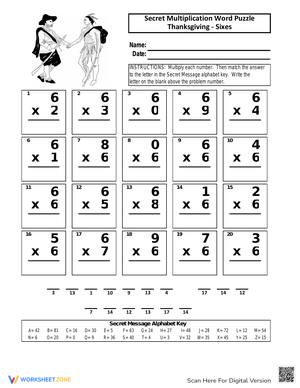
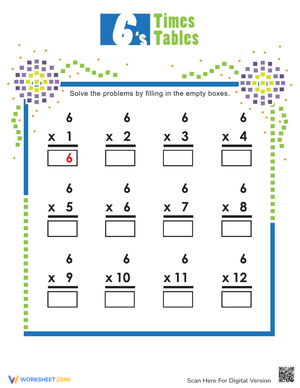
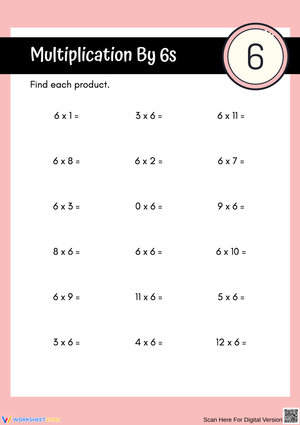
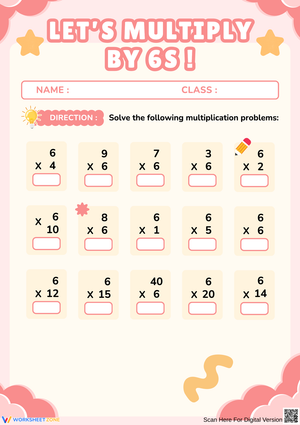
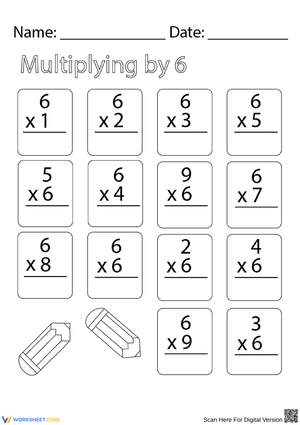
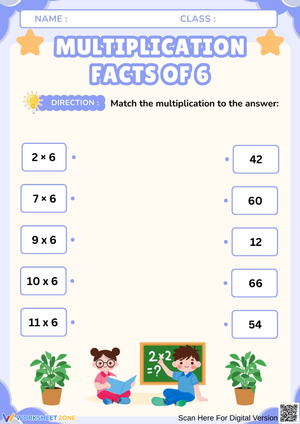
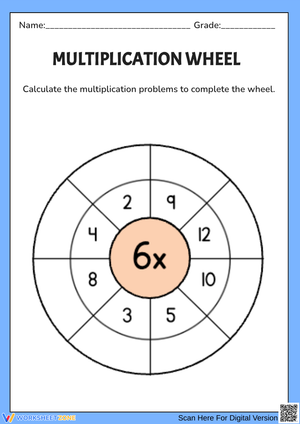
These 3rd grade by 6s printable worksheets give teachers a concrete, sequenced path from skip counting through fluent recall of the sixes—a fact family that resists shortcuts more than most in the Grade 3 year. The set spans multiple formats: number sequences, array tasks, strategy-guided practice, and timed recall columns. Teachers who have watched a class handle the 2s and 5s without much difficulty and then hit a collective wall at the 6s will recognize exactly the sticking points these worksheets address.
What Each Worksheet Targets
Rather than running through the same drill format across every worksheet, the set distributes practice across distinct skill areas. Each worksheet focuses on one of the following:
- Skip counting sequences — students fill in missing multiples along a number line or complete partial sequences such as 6, 12, __, 24, __, 36, building rhythmic familiarity with the multiples before formal fact practice begins
- Array reading and drawing — students interpret pre-drawn arrays with six rows, then draw their own and write the matching multiplication sentence
- Strategy-guided practice — problems walk students through the Double the 3s method and the 5-plus-1 method before asking for isolated retrieval
- Fact families — pairing 6 × 8 = 48 with 48 ÷ 6 = 8, so multiplication fluency connects directly to early division reasoning
- Word problems — single-step contexts that require students to identify the embedded 6s fact (e.g., six rows of seven chairs) rather than just complete a bare equation
- Timed recall drills — short columns used only after conceptual work is in place, so students enter timed practice with actual retrieval strategies rather than guessing under pressure
The word problem format deserves a note. Third graders who can recite 6 × 7 = 42 in isolation will often blank when a problem says "six baskets with seven apples each." That disconnect shows up constantly in student work, and this set addresses it directly by pairing strategy practice with applied contexts before timed drills appear.
The Two Mental Strategies at the Core of This Set
The Double the 3s approach is the most reliable entry point for students who know their 3s table but freeze on the 6s. Because 6 is exactly double 3, a student who blanks on 6 × 4 can calculate 3 × 4 = 12, then double it to reach 24. This is not a workaround—it directly applies the distributive property (2 × 3 × 4 = 2 × 12), and the worksheets make that structure visible by presenting the two-step reasoning before asking students to write the final product. Students who have worked through these problems stop second-guessing themselves on the larger 6s facts because they have a backup route that actually works.
The 5-plus-1 method serves students who have strong 5s recall but haven't yet internalized the 6s. To solve 6 × 7, a student thinks: 5 × 7 = 35, then adds one more group of 7 to reach 42. This reinforces the distributive property—(5 + 1) × 7 = 35 + 7—in a way that feels intuitive rather than formulaic. The value of including both strategies in the same set is that students develop more than one retrieval route to the same facts, which matters for long-term retention. When skip counting fails mid-sequence, having a second path keeps students from stalling entirely.
Frequent Errors to Watch For and Address
The two most commonly swapped facts in the 6s are 6 × 7 = 42 and 6 × 8 = 48. In student work, these appear interchanged more than almost any other pair in the single-digit multiplication table—partly because 42 and 48 look similar on paper, and partly because students who rely on skip counting from zero are likely to lose count somewhere between the seventh and eighth multiples. When a student writes 6 × 7 = 48, the error is almost always sequential miscounting rather than a conceptual gap, and targeted practice on just this pair resolves it quickly.
A second pattern worth watching: students who can recite the skip counting sequence (6, 12, 18, 24...) in order but cannot isolate a single fact when asked out of sequence. Ask "what is 6 × 9?" and they restart the count from 6. That is a fluency gap, not a knowledge gap—and the timed recall worksheets in this set are built to close it. The even-product rule is also worth teaching explicitly as a self-check: all multiples of 6 are even, without exception. Any student who writes 6 × 5 = 25 or 6 × 3 = 21 has an immediate signal that something went wrong. The 3rd grade by 6s printable worksheets include answer spaces wide enough for students to mark their check-step, a small design choice that prompts this self-monitoring without requiring a separate written task.
Lesson-Planning Ideas to Get the Most From These Worksheets
The most effective sequence starts skip counting worksheets at the beginning of a 6s unit—not as a warm-up novelty, but as genuine pre-work before students see a single multiplication equation. Students who can fluently produce the sequence 6, 12, 18, 24, 30, 36, 42, 48, 54, 60 are far better positioned to recognize whether a recalled answer is in the right range. A Monday morning opening that includes a shared choral count by 6s, followed by the skip counting worksheet as written practice, locks in the sequence in under ten minutes and sets the tone for the week.
Strategy-guided worksheets belong in the middle of the unit, after students know the sequence but before they are expected to recall facts automatically. Small group time is the right setting—while other students work independently on array tasks, pull the students who are still counting from zero and walk through the Double the 3s or 5-plus-1 method together on the strategy worksheet. Timed drills should come last, after several strategy-based sessions. Dropping a timed drill on students who haven't yet built a retrieval strategy creates test anxiety without building fluency. These 3rd grade by 6s printable worksheets work best when the sequence is deliberate: concept before strategy, strategy before speed.
Standard Alignment
CCSS.MATH.CONTENT.3.OA.C.7 — "By the end of Grade 3, know from memory all products of two one-digit numbers." This is the primary target. In classroom terms, 3.OA.C.7 is typically assessed in the spring of Grade 3, which means teachers have most of the year to build toward it. The 6s usually enter the curriculum after the 2s, 3s, 4s, and 5s are solid—generally in the second semester—so this set fits naturally into the February–April window for most district pacing guides.
Several worksheets in the set also address CCSS.MATH.CONTENT.3.OA.A.3, which covers using multiplication and division within 100 to solve word problems. The word problem format here asks students to construct the multiplication sentence themselves rather than fill in a pre-labeled equation, which is closer to what 3.OA.A.3 actually requires on Grade 3 assessments.
Adjusting the Worksheets Across Ability Levels
Students who are still building fluency with the 3s and 4s should start on the skip counting and array worksheets before touching strategy-based practice. The array format in particular gives students a visual anchor—they can count rows and columns if recall fails, which keeps them working productively while still building number sense. Pairing a struggling student with a fact family worksheet lets them see 6 × 8 = 48 and 48 ÷ 6 = 8 side by side, which often helps more than repeated multiplication drill alone, because the inverse relationship provides a second way to verify the answer.
For students who have already internalized the 6s, the word problem and fact family worksheets offer the right level of challenge. These students benefit from explaining in writing which strategy they used and why—that metacognitive step reveals whether fluency is real or whether a student has just memorized a sequence they can't yet apply flexibly. Students who are ready to move further can use the 3rd grade by 6s printable worksheets as a base and then extend into mixed-table reviews that combine the 6s with the 7s—another fact family where transfer errors are common, and where the connection between the two tables is worth making explicit.
Frequently Asked Questions
When in the school year should the 6s unit typically begin?
Most Grade 3 pacing guides introduce the 6s in January or February, after students have had several months of work with the 2s, 3s, 4s, and 5s. The 6s build directly on the 3s through doubling and on the 5s through the plus-one strategy, so introducing them before those earlier tables are solid slows the whole unit down. If students are still skip counting on the 3s by November, push the 6s unit back and shore up those foundations first.
How long should timed drills run for third graders?
Two to three minutes is a practical window at this grade level. Longer drills tend to produce anxiety rather than additional fluency gains once students exhaust the facts they can retrieve quickly. Three minutes on Monday, three minutes on Wednesday, and three minutes on Friday outperforms one longer block per week—shorter, more frequent sessions build automaticity more effectively than infrequent longer ones for eight and nine-year-olds.
Which worksheets in the set are safe to send home as homework?
Skip counting and array worksheets travel home well because students can complete them independently with minimal prior instruction. Strategy-based worksheets are better kept in the classroom until the strategy has been explicitly taught and practiced together. Sending home a worksheet that asks students to apply the Double the 3s method before they have seen it modeled typically results in parents completing the work—or the worksheet returning blank with a note of frustration attached.
What should teachers do when students plateau on just 6 × 7 and 6 × 8?
Isolate those two facts from the rest of the table and practice them together, without the surrounding sequence. Students who plateau at 6 × 7 and 6 × 8 have almost always been relying on sequential counting from zero and are losing track between the seventh and eighth multiples. Running the full drill again does not fix that—it just gives them more opportunities to make the same counting error. The fact family format works well here: seeing 6 × 7 = 42, 7 × 6 = 42, 42 ÷ 6 = 7, and 42 ÷ 7 = 6 on the same worksheet builds the associative connection that makes 42 stick specifically to the 6–7 pair rather than floating interchangeably with 48.
Clear All