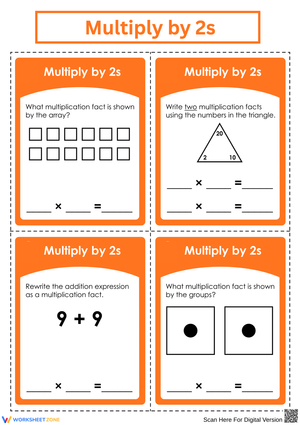
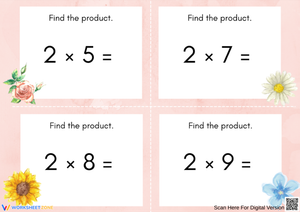
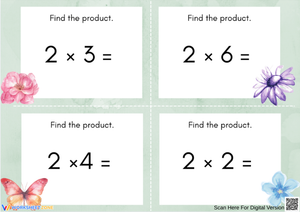
These 3rd grade by 2s printable worksheets give teachers a direct entry point into multiplication at exactly the moment students are ready to connect skip counting to formal notation. Most third graders arrive with reliable "doubles" knowledge from first- and second-grade addition — 4 + 4, 7 + 7, 9 + 9 — and the 2s table is where that prior work finally becomes multiplication fluency. The set includes arrays, equation completion, skip counting sequences, and word problems, so every stage of the unit has a matching format.
Skills These Worksheets Build
The core skill is equation fluency with all 2s facts, moving from supported formats to bare problems as the unit progresses. Each worksheet targets one of the following:
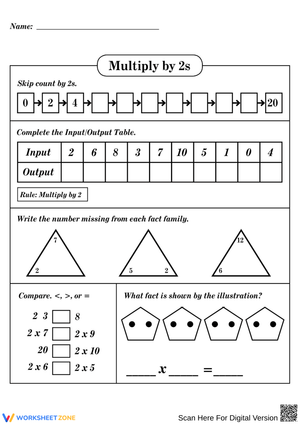
- Skip counting sequences with missing numbers (2, __, 6, __, 10, __)
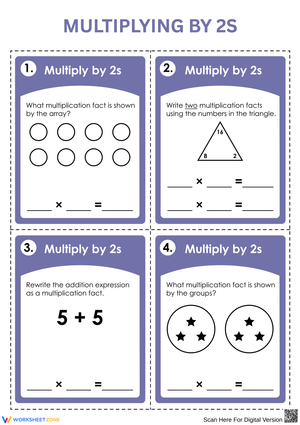
- Array drawing — students construct a two-row grid for a given equation and record the product
- Addition-to-multiplication bridges — a sentence like 6 + 6 = 12 paired with 2 × 6 = __
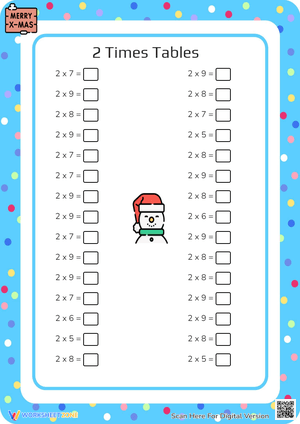
- Standard equation practice, horizontal and vertical
- Word problems with concrete equal-groups contexts
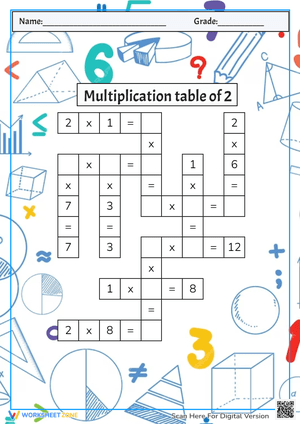
- Mixed-orientation review with missing factors
The addition-to-multiplication bridge format activates knowledge students already own before asking them to use new notation — seeing the addition fact they already know alongside the multiplication form reduces the anxiety that makes the new symbol feel foreign. The 3rd grade by 2s printable worksheets that include mixed orientations and missing-factor problems are ones to save for the end of the unit, when fluency needs to hold regardless of how a problem appears, making them a reliable check before moving on to the 5s or 10s.
Fitting These Into Your Weekly Math Routine
The most reliable use is a short daily warm-up — eight to ten problems during the first five minutes of math, three or four days per week. Spaced practice over multiple short sessions moves facts into automatic recall far more efficiently than one longer weekly block. On Mondays after a weekend gap, the skip counting sequence worksheets rebuild the pattern before students face cold equations. Array drawing worksheets take more time and work better mid-unit, when students need a conceptual reset rather than a speed check.
During small-group rotations, a worksheet from the 3rd grade by 2s printable worksheets set works as genuinely independent practice because the format is self-explanatory — students don't need teacher direction to begin, which matters when you're pulled to work with another group. Word problem worksheets are the exception: use those as a brief whole-class discussion launch before students work independently, especially in the first week students encounter them.
Error Patterns Teachers Should Expect With the 2s Table
The most persistent problem isn't forgetting a fact — it's sequence dependence. Students who can recite 2, 4, 6, 8, 10... fluently will freeze when asked "what is 2 × 7?" without counting up from two. They've memorized the sequence, not the isolated facts. A quick diagnostic: ask a student for 2 × 9 without counting aloud. If the answer takes more than three seconds, they're retrieving through the chain. The skip counting worksheets build the pattern; the bare-equation worksheets force students to break free of it.
The commutative property produces a second predictable error. Students who write 2 × 8 = 16 correctly will sometimes write 8 × 2 = 8 — applying "times" to the larger number against itself in a half-formed logic. This appears most often in weeks two and three, before commutativity settles. The mixed-orientation worksheets surface it quickly. Also watch for the dropped zero: 2 × 10 = 1, because students hear "ten" and write the digit they've always associated with that word rather than the full two-digit product.
Using the Set With the Full Range of Students in the Room
Students who haven't yet secured skip counting by 2s need the sequence worksheets with a number line printed along the top. That reference removes the memory burden so they can focus on recognizing the pattern rather than struggling to produce it from nothing. Pair those worksheets with physical counters — students group objects in pairs before writing any numbers — to give the sequence a concrete anchor.
Students who already answer 2s facts quickly need the missing-factor and word problem worksheets right away. Problems like 2 × __ = 14 or __ × 2 = 18 push them to work backwards from the product, planting the seed for division reasoning without formally naming it. For students well above grade level, extend each word problem: after solving it, they write a second question the same number setup could answer — a comparison, a subtraction follow-up, or a "how many fewer." No extra materials needed, and it keeps those students thinking while classmates consolidate the core facts.
Standard Alignment
These worksheets address CCSS.MATH.CONTENT.3.OA.C.7, which requires third graders to fluently multiply and divide within 100 and to know all products of two one-digit numbers from memory by end of year. The 2s table is the natural starting point for this standard: every product follows a visible pattern (all even numbers), the rule is easy for students to state ("you're just doubling"), and most arrive in Grade 3 with enough prior doubles knowledge to see early success. Beginning here keeps cognitive load manageable while the multiplication symbol is still new territory. The array and skip counting worksheets also address CCSS.MATH.CONTENT.3.OA.A.1, which asks students to interpret multiplication as counting equal groups — a conceptual standard, not a fluency target, and these formats serve it directly.
Frequently Asked Questions
Do students need to have skip counting by 2s solid before starting?
Basic familiarity helps, but it is not a prerequisite. The skip counting sequence worksheets introduce the pattern rather than test it. A student who can count by 2s to 10 with some hesitation has enough to begin — the number-line format provides the structure to extend the sequence further without requiring full memorization up front.
How long does each worksheet typically take to complete?
A ten-to-fifteen problem equation drill takes most third graders five to eight minutes at the start of the unit and under three minutes after two to three weeks of daily practice. Array drawing worksheets run closer to ten to twelve minutes because students are constructing and counting, not recalling. Word problem worksheets vary most — plan for eight to fifteen minutes depending on the number of problems and whether you debrief as a class.
Can these be used as formative assessments?
The equation completion and mixed-review worksheets serve well as quick formative checks. Collect them after a timed session and scan for students below 80% accuracy — those students need more concrete work before moving to the next fact family. The 3rd grade by 2s printable worksheets in this set aren't built as summative instruments, but a completed run over two weeks gives a clear picture of growth from introduction to automaticity.
What should a student who finishes very quickly do next?
Have them convert each completed equation into a missing-factor problem — cover the product and ask which number times 2 produces that answer. This takes no extra materials, adds about two minutes of work, and pushes the student directly into division reasoning. A student who does this naturally and quickly is ready to move to a different fact family while classmates finish consolidating the 2s.













 Interactive Worksheet Maker
 Quiz Maker
 Word Search Maker
 Crossword Puzzle Maker
 Word Scramble Generator
 Sentence Scramble Generator
 Handwriting Worksheet Generator
 Name Tracing Generator
 Fill In The Blank Generator