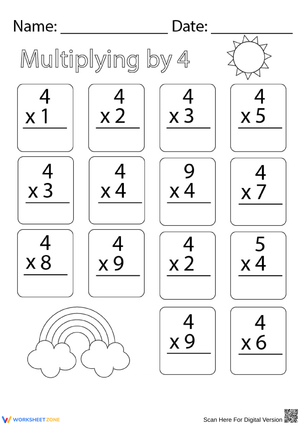
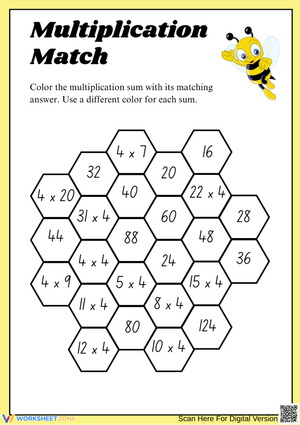
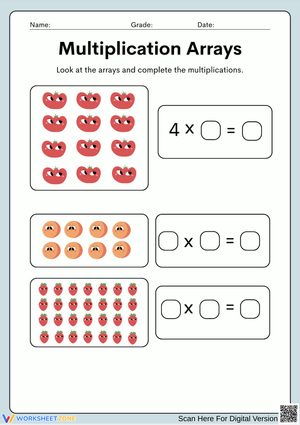
These by 4s printable worksheets for 3rd grade give teachers a focused set of standalone resources for building four times table fluency — covering the double-double mental math strategy, array models, skip counting sequences, and word problems that ask students to recognize a multiplication situation rather than just execute an equation they've already been handed. Each worksheet targets a specific skill, which means you can match the resource to the lesson rather than working around irrelevant content.
The Double-Double Strategy and How These Worksheets Teach It
The most reliable entry point for the four times table is the double-double method: double the number once, then double the result. To find 4 × 7, a student doubles 7 to get 14, then doubles 14 to reach 28. For most third graders, doubling is already a secure skill — they've been working with equal groups and "double that" problems since second grade. The strategy converts an unfamiliar multiplication fact into two steps of familiar addition, which keeps the cognitive demand manageable at a point in the year when multiplication itself is still new.
Several worksheets in the set walk students through this two-step process explicitly before asking for a direct answer. The format shows the first doubled value as a visible fill-in step, so students can't collapse the process into one move by accident. That structural detail matters in practice: students who have the intermediate step in front of them make far fewer single-stop errors than students working from a blank equation with no intermediate prompt.
What Each Worksheet Covers
By 4s printable worksheets for 3rd grade span five distinct skill areas, so you have both concept-building resources and fluency practice available, at whatever stage of the unit the class has reached.
- Skip counting sequences, including number lines with missing multiples of four
- Array models with four rows and varying column counts, plus the reverse orientation
- The double-double strategy with guided two-step practice
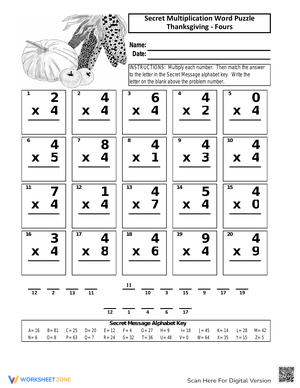
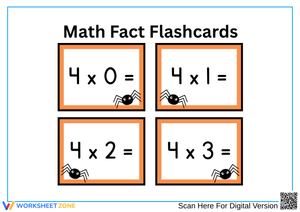
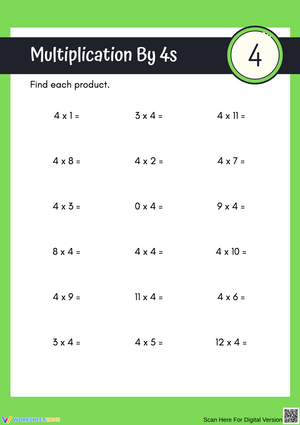
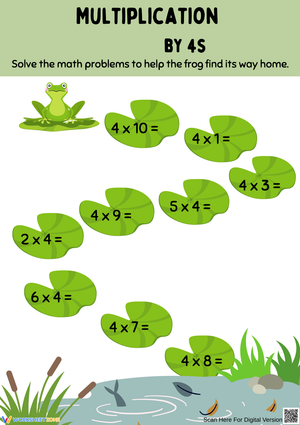
- Basic fact drills in both horizontal and vertical formats
- Word problems that embed multiplication by four in real-world contexts
- Unknown-factor equations, such as 4 × ___ = 36, which preview division thinking
Frequent Student Errors Worth Watching For and Correcting
The most common mistake in double-double practice is what you might call the single-stop error. A student doubles 8 to get 16, then writes 16 as the final answer rather than doubling again. When you scan papers for this pattern, the giveaway is answers that match the two times table: 4 × 6 = 12, 4 × 9 = 18, 4 × 7 = 14. It isn't random guessing — the student performed one correct step and stopped. They understood "double-double" as "double it once." Having the intermediate step visible on the worksheet surface cuts this error dramatically, which is one reason the two-step format carries more instructional weight than it might first appear.
Array orientation is a separate, quieter stumbling block. A 4 × 6 array drawn with four columns and six rows looks visually different from one with six columns and four rows, and students who haven't yet internalized the rows-times-columns convention will sometimes count the wrong dimension. Two or three minutes of whole-group pointing — "which number tells you how many rows?" — before independent work prevents most of this confusion. Students who still misread arrays during independent practice usually need a few more concrete experiences counting physical objects arranged in rows before the printed model becomes reliably readable.
Building These Worksheets Into Your Lesson Plans
The sequence that works best moves from array-model work to double-double strategy practice to word problems, across roughly three to five days before any timed fluency component is introduced. Arrays carry the conceptual work first. Once students can explain what a 4 × 5 array represents — four rows of five, twenty total — the double-double worksheet lands as a useful shortcut rather than an arbitrary rule. Word problems come last because they add a reading demand on top of the math; asking students to parse a word problem before they've secured the four times table facts makes both the math and the reading harder to assess cleanly.
By 4s printable worksheets for 3rd grade fit naturally into the 10-to-15-minute independent practice block that follows whole-group instruction. One worksheet per session keeps the volume manageable and gives you a same-day read on who has the concept and who doesn't. Skip counting worksheets work especially well as Monday warm-ups — the sequential pattern is easier to re-enter after a weekend away from math than cold fact recall is. Reserve timed fluency exercises for the tail end of the unit, after students have completed multiple untimed sessions with solid accuracy. Running a timed drill too early does not accelerate fluency; it locks in errors under pressure.
Standard Alignment
These worksheets address CCSS.MATH.CONTENT.3.OA.A.1, which asks students to interpret products of whole numbers as the total number of objects in equal-sized groups — the standard that array and equal-groups worksheets directly target. They also support 3.OA.C.7, the fluency standard that calls for students to multiply and divide within 100 with accuracy and reasonable speed. In practical classroom terms, 3.OA.A.1 covers the concept-building phase and 3.OA.C.7 covers the fluency phase. Knowing the distinction tells you which worksheet to reach for when a student is struggling: a student who doesn't yet understand what 4 × 8 means needs the array worksheet, not another round of timed fact drills.
Adjusting the Resources for a Range of Learners
Students who are not yet comfortable with symbolic notation can use the same double-double worksheets as the rest of the class — the adjustment is in what happens before they pick up a pencil. Have those students build each problem with interlocking cubes first: four groups of six, physically assembled on the desk, before they write anything. That concrete step does not require modified materials; it changes the entry point without changing the task. Students who need that physical anchor typically transition to paper-and-pencil work within a few sessions once the pattern becomes familiar.
By 4s printable worksheets for 3rd grade that include unknown-factor equations give students who have already secured the times table a meaningful extension rather than more of the same. A problem like 4 × ___ = 32 shifts the cognitive demand from recall to reasoning and quietly lays groundwork for division, which arrives later in the same school year. That forward connection makes the extension feel purposeful to students, not just busywork.
Students in the middle — those with partial fluency who make the single-stop doubling error — benefit from slowing the double-double process down deliberately: write the first double, then write the second double, then circle the answer. That structure adds roughly fifteen seconds per problem. It also nearly eliminates the error, which is a worthwhile trade for a student who would otherwise keep practicing the wrong answer.
Frequently Asked Questions
When should I introduce timed practice with these worksheets?
After students demonstrate solid accuracy on untimed work — typically three to five sessions into the unit, though accuracy is the real trigger, not the date. A student still producing single-stop doubling errors on an untimed worksheet is not ready for a timed drill. Running the clock on unsecured facts deepens errors by adding pressure on top of an unstable process.
Do the array worksheets work for students who haven't yet learned to distinguish rows from columns?
The worksheets work, but those students need a brief orientation before independent work begins. Project an array and spend two or three minutes asking the class to identify which number in the equation tells them how many rows are present. Students who conflate rows and columns during independent practice usually need a few more concrete experiences — actual objects arranged on a desk — before the printed array model becomes readable on its own. The worksheet isn't the wrong tool; it just can't do that foundational work by itself.
How do the word problems on these worksheets connect to reading instruction?
The word problems ask students to identify what is being grouped, how many are in each group, and how many groups there are — which is a reading comprehension task as much as a math task. Students who circle random numbers rather than identifying the group size are showing a reading-strategy gap alongside the math gap. That overlap makes the word problem worksheets useful diagnostic tools: the errors tell you whether a student needs more multiplication practice or more structured reading-for-information work, and those are different instructional responses.













 Interactive Worksheet Maker
 Quiz Maker
 Word Search Maker
 Crossword Puzzle Maker
 Word Scramble Generator
 Sentence Scramble Generator
 Handwriting Worksheet Generator
 Name Tracing Generator
 Fill In The Blank Generator