3rd Grade By 3s Printable Worksheets
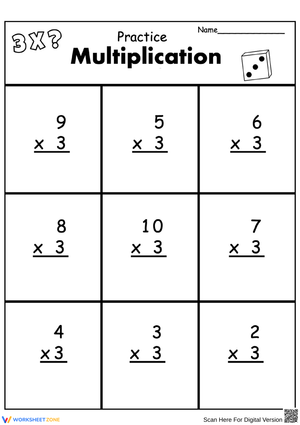
These 3rd grade by 3s printable worksheets give teachers a targeted set of practice resources that moves students from skip counting through automatic recall of the threes multiplication table — without bypassing the visual and conceptual groundwork that makes facts actually stick. The set spans six distinct exercise types, so teachers can match the right worksheet to wherever a student actually is in the unit.
What Each Worksheet Covers
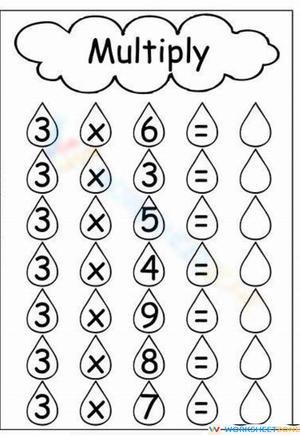
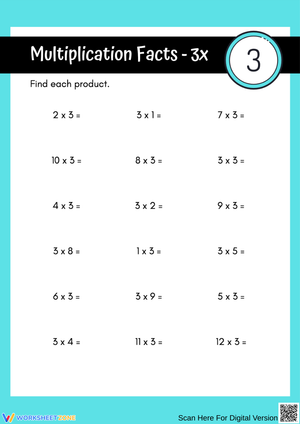
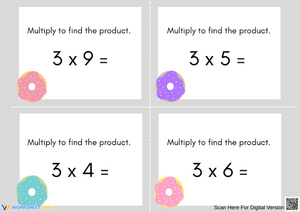
Each worksheet in the set addresses a specific entry point into the threes table:
- Skip counting number lines — students mark the sequence 3, 6, 9, 12 and count jumps to complete multiplication sentences, building the auditory pattern before introducing symbolic notation.
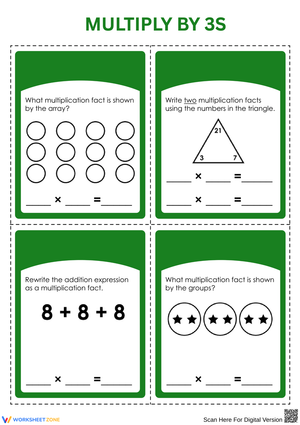
- Array drawing exercises — students draw or annotate rows and columns, working with the area model and the commutative property simultaneously.
- Equal-group diagrams — students draw a specified number of circles and place dots inside each one, making the "equal groups of" definition visible rather than implied.
- Word problems — problems use objects that naturally come in threes: tricycle wheels, rows of planted seedlings, cans of tennis balls. The contexts are functional, not decorative.
- Fact family triangles — students write all four related facts from a single number set, making the inverse relationship between multiplication and division explicit from the start.
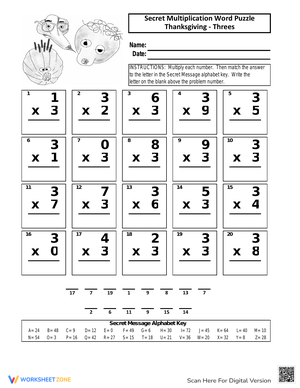
- Digit-sum pattern exercises — students test the divisibility rule for 3: add the digits of a number; if the sum is a multiple of 3, the original number is too. With 27, for instance, 2 plus 7 equals 9, which is divisible by 3, so 27 is as well. Third graders find this genuinely surprising, and the discovery holds their attention in a way that straight fact drilling does not.
The Visual Models and What They Each Do
Arrays and number lines appear on separate worksheets because they do different instructional work. An array gives students an area model they can count when a fact slips — three rows of seven squares remains 21 even when memory fails. A number line shows the repeated-addition logic directly: three jumps of seven lands on 21, connecting the skip count to the written multiplication sentence. When students work with both models during the same week, each one reinforces the other. The students who benefit most are those who can recite the skip count sequence aloud but haven't connected it to the symbolic fact — a gap that shows up constantly in third grade and that these worksheets surface quickly.
Equal-group drawings appear on several worksheets as a third representation. The drawing slows down fast guessers and reveals whether a student actually understands the equal-size constraint — a distinction that's nearly invisible when students just fill in a fact table with answers.
How to Work These Worksheets Into Your Teaching Week
The 3rd grade by 3s printable worksheets fit into daily routines without requiring a separate lesson structure around them. A skip count worksheet during Monday morning work reactivates the sequence after the weekend. By Wednesday, the array or equal-group worksheet works well during the first math center rotation while the teacher pulls a small group for direct instruction with manipulatives. Word problem worksheets are most productive Thursday or Friday, once students have had enough repetition with the visual models that the arithmetic no longer stalls their reading of the problem. Fact family worksheets send home on Friday — the format is legible enough that a parent or caregiver can check the work even without a math background.
The digit-sum worksheets are a strong Monday re-engagement tool after the class has moved through the initial memorization phase. Students who feel bored with straight fact practice often re-engage with the puzzle format, and the teacher gets a quick formative read on who has internalized the multiples well enough to apply them in a new context.
Frequent Student Errors Worth Watching For and Addressing
The most persistent mix-up sits at 3 × 6 and 3 × 7. Students who have memorized both facts will still write 3 × 6 = 21 with full confidence because the error feels like a memory, not a guess. It usually means the two facts were learned in isolation rather than as part of a sequence. Walking a student through a skip count from 15 — "15, 18, 21" — gives them a procedure to self-correct that works faster than re-memorization, because it anchors the fact inside a sequence they already own.
A second error appears regularly on array worksheets: students draw the correct total number of objects but arrange them in one long row rather than the specified number of rows. A student building a 3 × 5 array will sometimes produce fifteen dots in a single line. The product is right, but the model is wrong — it signals the student hasn't separated rows and columns as distinct dimensions, which will matter increasingly through fourth and fifth grade. This is invisible when students fill in a fact table and visible the moment a teacher scans the drawings during center time. These worksheets create exactly that opportunity.
Standard Alignment
The primary standard addressed is CCSS 3.OA.C.7, which expects students to fluently multiply and divide within 100 and to know all single-digit products from memory by end of year. The threes table typically enters a unit mid-year, after 2s and 5s — those tables share multiples with 3 (6, 10, and 15 each appear across multiple tables), giving students reference points for checking new threes facts. Array and equal-group worksheets address 3.OA.A.1, which asks students to interpret products as the total in a set of equal groups. Fact family and inverse-operation work connects to 3.OA.B.6, which frames division as an unknown-factor problem: recognizing that 3 × ? = 18 is structurally the same question as 18 ÷ 3 = ?.
Adjusting the Set for a Range of Learners
For students still building a conceptual foundation, pair the array and equal-group worksheets with physical counters before asking for drawn work. The worksheet becomes a record of what they built with objects — a translation task rather than an abstract one. Students at grade level work through each worksheet as intended, relying on visual support early in the unit and moving toward recall-only exercises as automatic retrieval develops. The 3rd grade by 3s printable worksheets in the digit-sum section give students who have already secured the facts a genuine challenge: ask them to test the rule on larger numbers — does it hold for 312? For 4,017? It does, and working that out independently builds the number sense that resurfaces in later multiplication and factoring work.
In small-group instruction, the equal-group drawing worksheets are especially useful for students who need more processing time. Drawing keeps students inside a problem rather than leaving a blank and moving on, and it produces a concrete artifact the teacher can look at and respond to — not just a circled number.
Frequently Asked Questions
Do these worksheets address division as well as multiplication?
Yes. The fact family triangle worksheets ask students to write all four related facts from a single number set, making the connection between 3 × 4 = 12 and 12 ÷ 3 = 4 explicit rather than incidental. This means the 3rd grade by 3s printable worksheets cover both operations without teachers needing a separate resource to introduce the inverse relationship when working through the threes unit.
At what point in a multiplication unit should I introduce these worksheets?
After students have worked through 2s and 5s. Those tables give students a foothold — they already know 3 × 2, 3 × 5, and 3 × 10 from skip counting experience, so the threes table isn't starting from nothing. Array and number line worksheets belong in the first week of the threes unit; word problem and recall-focused worksheets fit better in week two, once visual model repetition has built enough familiarity that automatic retrieval is beginning to feel possible for most students.
What adjustments help students who find the word problems difficult to read?
The word problems use short sentences and concrete, familiar contexts — tricycle wheels, rows of garden plants, stacked cans — so the reading demand is low to begin with. For students with reading difficulties, reading the problem aloud once before independent work removes the decoding barrier without reducing the math task at all. A partner-read arrangement is another practical option that keeps the focus on multiplication rather than shifting it toward reading comprehension.
Clear All