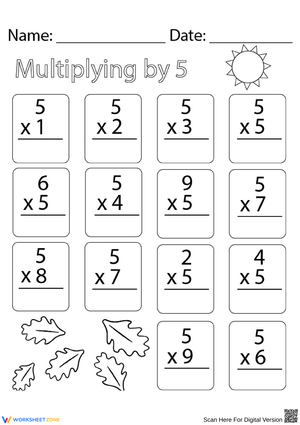
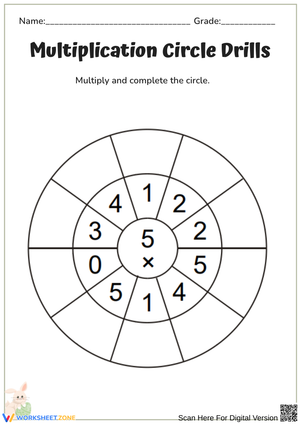
3rd Grade By 5s PDF Worksheets – Multiply by 5 Practice
These 3rd grade by 5s pdf worksheets give teachers a targeted way to build multiplication fluency around one of the most pattern-rich fact sets in the times tables. Every product in the 5s table ends in either 0 or 5 — no other table offers that kind of built-in self-check — and students can lean on the skip-counting sequence they already know from first and second grade as a bridge toward full recall. The set pairs that reliable pattern with varied practice formats so students encounter the same facts from enough angles to actually hold them in memory.
The Pattern That Does Half the Teaching
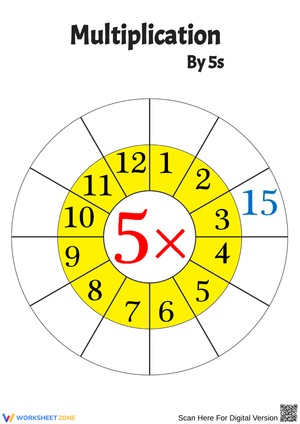
Before students touch a single problem, hand them a slip of paper and ask them to write out the 5s sequence: 5, 10, 15, 20, 25, 30, 35, 40, 45, 50. Most third graders can do it. That sequence is the 5s table — multiplication is just a faster way to express the same count. Teaching students to see it that way from day one removes a layer of mystery from the whole unit. And because every answer ends in 0 or 5, students have an instant error-check they can apply without asking the teacher. A student who writes 5 × 7 = 34 can catch the mistake herself; 34 doesn't end in 0 or 5, so something went wrong.
The 5s table also carries real-world anchors that other tables simply lack at this grade level. Analog clocks mark minutes in 5-minute intervals, so knowing 5 × 3 = 15 is literally how a student reads a quarter past on the classroom clock. Nickels bring the same structure to money. These aren't manufactured connections — they're the reason the 5s table belongs near the front of the third-grade multiplication sequence, not buried in the middle.
What's Inside the Set
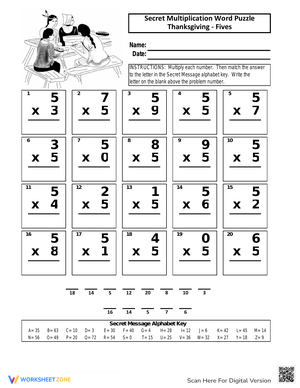
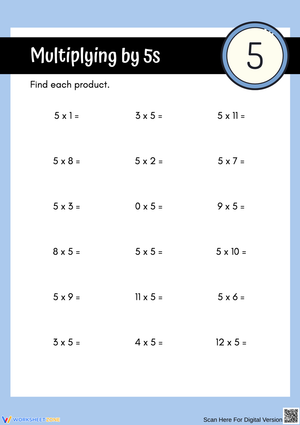
Each worksheet targets a specific skill within the 5s multiplication family rather than mixing everything together. The formats span:
- Fill-in-the-blank tables: Students complete the products in a structured grid — good for initial exposure and for pinpointing exactly where recall breaks down, which is usually around 5 × 7 or 5 × 8.
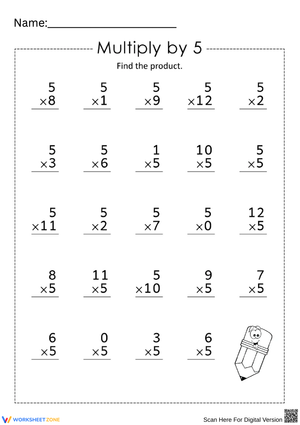
- Vertical and horizontal drill layouts: Switching orientation discourages students from pattern-matching by position and pushes them toward genuine recall instead of visual memory of where an answer sits on the page.
- Missing-factor problems: Questions like 5 × __ = 35 reverse the direction of thinking. Students who can recite facts forward sometimes freeze when the unknown shifts to the factor side.
- Word problems: Short one-step scenarios set in contexts involving coin collections, equal groups, and clock reading give the abstract equations a concrete foothold.
- Tiered drill sheets: Easier sheets cover 5 × 1 through 5 × 5 for students who need more step-by-step support; extended sheets reach 5 × 12 for students ready for a challenge.
How to Build These Worksheets Into Your Lesson Plans
Short, frequent practice builds multiplication fact retention better than long, infrequent drill — that's consistent across math fluency research, and it shows up clearly in student work by the third week of any fact-family unit. The most effective approach with the 3rd grade by 5s pdf worksheets is a daily 10-to-12-minute block rather than a 30-minute session once a week. That window fits cleanly into a morning warm-up or the transition between subjects without eating into core instruction time.
A reasonable two-week progression: begin with skip-counting warm-ups using a hundreds chart, move to fill-in-the-blank tables where students can still count on if they need to, then shift to timed vertical drills once the sequence is solid, and close the cycle with missing-factor and word-problem formats. Running a timed sheet before students have stable recall builds anxiety faster than it builds automaticity — save the clock for the end of the cycle, not the beginning.
One routine worth keeping: ask students to write the full 5s sequence in the margin of each worksheet before starting any problems. It takes about 90 seconds and activates the skip-counting pathway in working memory. Students who skip this step make more mid-sequence errors — the ones who write it rarely do.
Errors Students Make That These Worksheets Help You Catch
The most common mistake isn't getting facts wrong outright — it's losing track of position in the skip-counting chain. A student will recite 5, 10, 15, 20, 25, 30 correctly, then write 5 × 6 = 30 because she miscounted which multiple she landed on. The gap between 5 × 5 = 25 and 5 × 6 = 30 is the single most frequent stumble point in the 5s table. It looks like a random error, but it's almost always a tracking error — the student knows the sequence but lost her place in it. Asking students to circle each answer and verify it ends in 0 or 5 catches most of these before they leave the worksheet.
The missing-factor format surfaces a second issue. Students who have fully memorized 5 × 8 = 40 sometimes cannot reverse it: 5 × __ = 40 reads like an entirely different problem. This is a conceptual gap, not a memory gap. Showing a worked example on the board — writing both versions of the equation side by side and asking students what they notice — closes it faster than more drill alone.
Standard Alignment
These worksheets address CCSS 3.OA.C.7, which requires third-grade students to fluently multiply and divide within 100 by year's end. Fluency under that standard means accuracy and efficiency together, not speed alone. The 5s table is a natural early focus within 3.OA.C.7 because students arrive in third grade with the skip-counting foundation already in place from the primary grades. Teachers who address the 5s in the first quarter can build on that fluency when introducing related fact families — 5 × 6 connects directly to 6 × 5 under the commutative property addressed in CCSS 3.OA.B.5, and both connect to the work on multiplication patterns in 3.OA.D.9.
Adjusting the Set for a Range of Learners
Students who are still counting on their fingers for every problem need a different starting point than students who already recall most facts automatically. For students earlier in the learning curve, the fill-in-the-blank tables with a reference skip-counting strip at the top of each worksheet let them work independently without guessing. Starting the practice range at 5 × 1 through 5 × 5 before extending to 5 × 10 keeps the working memory load manageable while the pattern solidifies.
Students ready for more challenge benefit most from the missing-factor and word-problem formats — those push beyond recall into multiplicative reasoning. Asking a fast finisher to write one sentence explaining their thinking for each missing-factor answer adds depth without requiring a separate resource. The 3rd grade by 5s pdf worksheets in the extended set reach 5 × 12, giving advanced students a clear target while the rest of the class builds core fluency through 5 × 10.
Frequently Asked Questions
What multiplication facts should students know by the end of third grade?
CCSS 3.OA.C.7 expects fluency with all products of two one-digit numbers — that covers 0 × 0 through 9 × 9. The 5s table is one component of that full range. Most teachers address 2s, 5s, and 10s early in the year because the patterns are strong and accessible, then work through the remaining fact families across the second and third quarters.
How much daily practice supports fact fluency at this grade?
NCTM research on math fact fluency consistently points to 10 to 15 minutes of focused daily practice as more effective than longer, less frequent sessions. The 3rd grade by 5s pdf worksheets are sized to fit that window — most students finish each worksheet in 8 to 12 minutes, leaving a few minutes for a whole-class check-in before moving on.
When should skip counting give way to direct recall?
Skip counting is a legitimate bridge strategy, not a problem to eliminate. The goal is that students gradually stop needing to count from 5 each time and start retrieving facts directly — but that shift happens through repeated practice, not through being told to stop counting. A student who consistently answers 5s facts in under 3 seconds without visible finger counting has made the transition. Until then, skip counting is the right tool for the job.
How is a missing-factor problem different from a standard multiplication drill?
In a standard drill, students produce the product: 5 × 7 = __. In a missing-factor problem, they identify the factor: 5 × __ = 35. The second format requires students to think about multiplication as a relationship rather than recite a memorized sequence forward. Many students who score well on standard drills stumble on missing-factor problems because they've only memorized facts in one direction. Including both formats in the practice rotation catches that gap early in the unit.
Clear All